
ATPL Forum Practice Test
$69.00
- Buy to unlock unlimited access to all Quiz questions.
- After purchase you can print a PDF of the whole quiz at any point. The PDF will contain the questions and the correct answers.
About this Exam
The Airline Transport Pilot License (ATPL) is the highest level of aircraft pilot certification. Achieving this license signifies that a pilot possesses the theoretical knowledge and operational expertise to command large, multi-crew commercial aircraft. However, the path to obtaining an ATPL is rigorous, requiring candidates to pass a series of notoriously difficult theoretical examinations covering complex aviation subjects.
This is where the ATPL Forum Practice Test platform becomes an indispensable tool for aspiring airline pilots. This resource is designed specifically for student pilots who are currently enrolled in or preparing for their official EASA or FAA ATPL theory exams. It serves as a comprehensive question bank and simulation environment, bridging the gap between textbook learning and the pressure of the final examination room. Whether you are struggling with Air Law, Meteorology, or Flight Planning, the ATPL Forum Practice Test provides the targeted practice necessary to build confidence and competence.
Ready to test your knowledge?
Buy Now to Access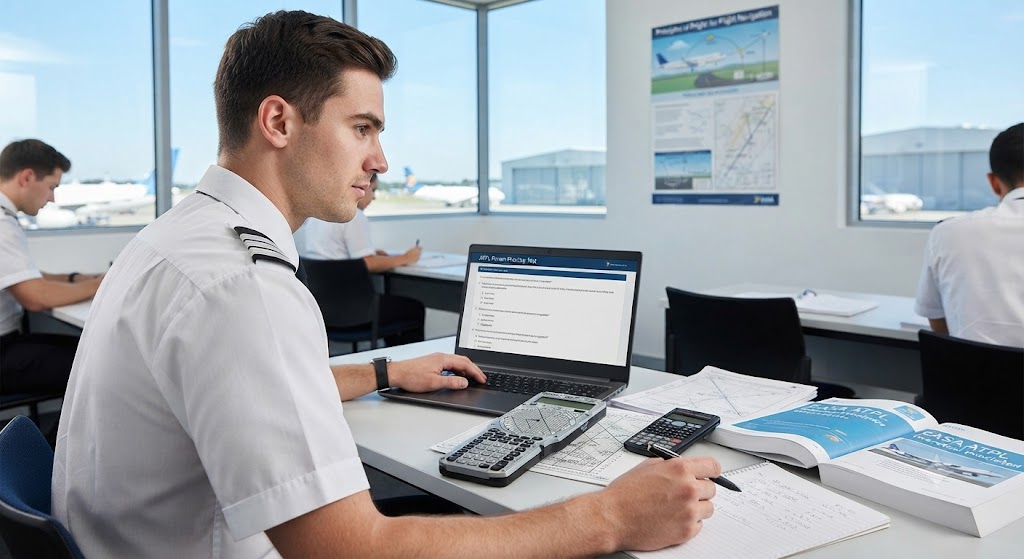
Additional Information
What to Expect in
the Final Exam
The official ATPL final exams are computer-based assessments
administered by the relevant civil aviation authority (e.g., the CAA in the UK,
or other EASA member state authorities).
While the exact format can vary slightly depending on the
authority, candidates generally face the following structure:
- Format:
All exams are multiple-choice questions (MCQs). Some exams may include
"multiple-response" questions where more than one answer is
correct.
- Number
of Questions: This varies significantly by subject. For example, Air
Law may have fewer questions (approx. 40-50) with a shorter time limit,
while General Navigation or Flight Planning may have more questions
(approx. 60-80) and require significantly more time.
- Time
Limits: The time allocated is strictly enforced, usually allowing
approximately 1.5 to 2 minutes per question, though complex calculation
subjects (like Flight Planning) grant more time per question. The total
exam session may involve sitting multiple subjects in one day.
- Passing
Score: The required pass mark for every ATPL subject exam is
rigidly set at 75%.
- Exam
Rules: Strict security measures are in place. Candidates are typically
only permitted to use authorized materials, such as a specific flight
computer (e.g., CRP-5), a non-programmable calculator, navigation rulers, and
authorized chart extracts. No personal items, smartwatches, or
unauthorized notes are allowed in the testing room.
How to Study and
Exam Centers
Success in ATPL exams requires dedication, structured
planning, and active recall practice. Relying solely on reading textbooks is
rarely sufficient.
Actionable Study Strategies
Subject-by-Subject Approach: Do not attempt to study
all 13 subjects simultaneously. Break the syllabus down into manageable chunks.
Focus deeply on one or two subjects (e.g., Meteorology and Instrumentation)
until you achieve consistent passing scores in practice tests before moving on.
Active Recall with ATPL Forum:
Use the ATPL Forum Practice Test database extensively. After reviewing a
chapter in your training manual, immediately jump to the forum’s practice
questions for that specific topic. This reinforces memory retention.
Simulate Exam Conditions:
When using the ATPL Forum Practice Test, do not always do practice sets of 10
questions while looking up answers. Set aside time to complete full-length
practice exams under timed conditions, without any external aids (except your
authorized flight computer/calculator). This builds stamina and time-management
skills.
Analyze Weaknesses: The
most significant benefit of the ATPL Forum Practice Test is the feedback
mechanism. After every practice test, thoroughly review the questions you
answered incorrectly. Understand why the correct answer is right and why
your chosen answer was wrong. Often, the forum includes explanations or
discussions from other users that clarify difficult concepts.
Consistent Revision: The
volume of information is immense. Regularly revisit subjects you completed
weeks ago to prevent knowledge decay.
Where and How to Take the Official Exam:
You cannot take the official ATPL theory exams directly
through the ATPL Forum. These exams must be sat at approved examination centers
designated by the aviation authority you are certifying under.
- Authorization:
Before booking an exam, you must be registered with an approved flight
training organization (ATO) that will verify your theoretical knowledge
course completion.
- Booking:
Once authorized, you will typically book your exams through an online
portal provided by the aviation authority. Common testing providers
utilized by authorities include Pearson VUE.
- Location:
You will select a specific physical Pearson VUE or authority-run testing
center when booking. These centers are located globally, allowing
flexibility, although many students choose to sit exams in the country
where they completed their flight training. Job Opportunities from the
Course
Successfully passing the ATPL theory exams (and subsequent
flight training) is the gateway to a professional career in aviation. This
certification is mandatory to act as Pilot in Command (Captain) or Co-pilot
(First Officer) in commercial air transport operations.
The specific job titles and career paths this certification
unlocks include:
- First
Officer (FO) for Commercial Airlines: This is the primary entry-level
role for newly qualified ATPL holders, flying passengers and cargo on
regional or international routes.
- Airline
Captain: After gaining significant experience (thousands of flight
hours) and demonstrating command ability, First Officers upgrade to
Captain, taking full legal responsibility for the flight.
- Cargo
Pilot: Flying for dedicated freight carriers, operating similar jet or
turboprop aircraft to passenger airlines but often with varying schedules.
- Corporate
Pilot / Business Aviation: Flying private jets for corporations or
high-net-worth individuals, requiring high levels of operational
flexibility and customer service.
- Charter
Pilot: Operating on-demand flights for smaller charter companies,
flying a diverse range of missions and aircraft types.
- Flight
Instructor: Many pilots use their ATPL knowledge to become Flight
Instructors (FI) or Type Rating Instructors (TRI), teaching the next
generation of aviators either in the classroom or the aircraft.
Frequently Asked Questions
Reviews
5.0
Based on 0 reviews
Leave a Review
No reviews yet. Be the first to review!