
ATPL Meteorology Practice Test
$69.00
- Buy to unlock unlimited access to all Quiz questions.
- After purchase you can print a PDF of the whole quiz at any point. The PDF will contain the questions and the correct answers.
About this Exam
Welcome to the definitive guide for mastering one of the most challenging subjects in professional aviation: the Airline Transport Pilot Licence (ATPL) Meteorology exam. This examination is a critical milestone for any commercial pilot aspiring to fly multi-crew, multi-engine aircraft in an airline environment. It is designed to test your theoretical knowledge and practical application of complex weather phenomena.
Passing this exam proves that you possess the advanced meteorological insight necessary to ensure flight safety, make critical operational decisions, and navigate diverse global weather systems. Whether you are undertaking an integrated course or modular training, this study guide will help you understand what it takes to prepare effectively and pass on your first attempt
Ready to test your knowledge?
Buy Now to Access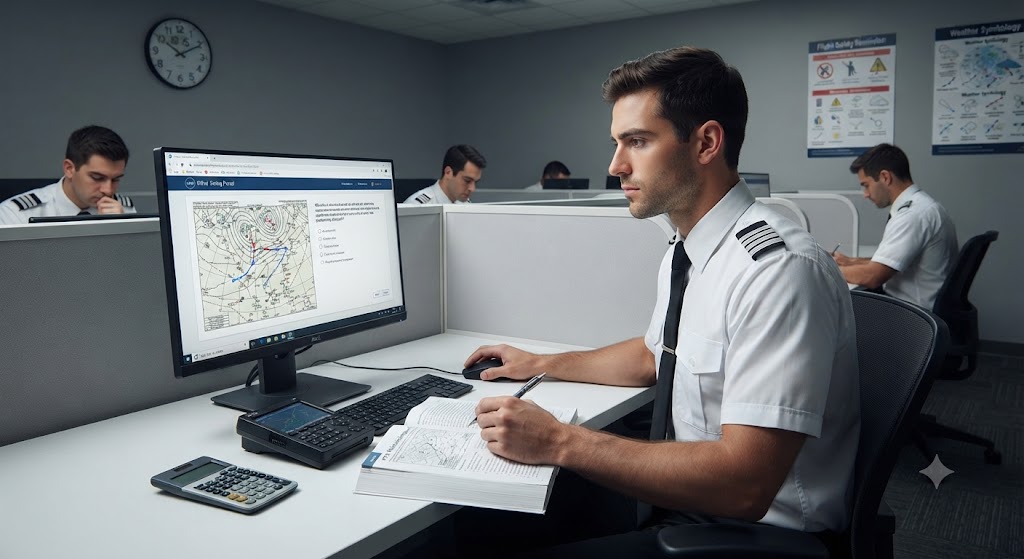
Additional Information
What the Course Entails and Exam Details
The ATPL Meteorology syllabus is extensive and dives far
deeper than Private Pilot Licence (PPL) or Commercial Pilot Licence (CPL)
theory. The course is structured to build a comprehensive mental model of the
atmosphere and its behavior.
Core topics typically include:
- The
Earth's Atmosphere: Composition, layers, pressure, temperature, and
density.
- Thermodynamics:
Humidity, adiabatic processes, stability, and instability.
- Clouds
and Precipitation: Formation processes, types, and associated hazards.
- Visibility
and Fog: Formation, types of fog, mist, and restrictions to
visibility.
- Wind
and Airmasses: Global circulation, local winds, jet streams,
convergence zones, and airmass classification.
- Fronts:
Structure, characteristics, and associated weather of cold, warm,
stationary, and occluded fronts.
- Ice,
Turbulence, and Thunderstorms: Hazards to aviation, avoidance
strategies, and windshear.
- Pressure
Systems: Anticyclones, depressions, and synoptic chart analysis.
- Climatology:
World climatology, upper air climatology, and seasonal variations.
- Flight
Hazards: Icing, turbulence, windshear, thunderstorms, and microbursts.
- Meteorological
Information: Aviation weather reports (METAR, TAF), forecasts, charts,
and satellite imagery.
- Altimetry:
Pressure settings, corrections for temperature, and definitions.
The syllabus demands not just memorization, but a deep
understanding of why weather events occur and how they directly impact
aircraft performance and flight safety.
What to Expect in
the Final Exam
The ATPL Meteorology exam is renowned for its rigor. It is a
theoretical examination, typically administered by a Civil Aviation Authority
(CAA) or an authorized examination body (such as the EASA examination system in
Europe).
- Format:
The exam is computer-based and consists almost exclusively of
multiple-choice questions (MCQs). Some questions may require complex
calculations or the interpretation of meteorological charts and diagrams.
- Number
of Questions: This varies depending on the regulatory authority (e.g.,
EASA currently uses a question bank where exams are generated, typically
consisting of around 40-50 questions for Meteorology).
- Time
Limit: You are generally allotted approximately 1.5 to 2 hours for the
Meteorology exam, averaging about 2-3 minutes per question. Time
management is crucial.
- Passing
Score: The required passing score is strictly 75% or higher. There is
no room for ambiguity in your knowledge.
- Reference
Material: During the exam, you will typically have access to standard
reference materials, such as a navigation computer (CRP-5 or similar),
permitted annexes containing charts, and sometimes a standard calculator.
You will not have access to textbooks or personal notes.
- Question
Style: Be prepared for scenario-based questions. For example, you
might be presented with a synoptic chart and asked to determine the
weather conditions at a specific airport at a future time, or analyze the
risk of icing based on a given temperature lapse rate and humidity.
How to Study and
Exam Centers
Achieving a pass in ATPL Meteorology requires a structured
and disciplined approach. You cannot rely solely on ground school lectures.
- Study
Strategies:
Master the Theory: Do not attempt practice tests
until you have thoroughly understood the underlying principles. Use
authoritative textbooks (such as those from Jeppesen or Oxford Aviation
Academy) and official EASA/CAA syllabus documents.
Visualize the Concepts: Meteorology is dynamic. Use
diagrams, 3D models (mental or physical), and online resources to visualize air
circulation, frontal systems, and cloud formation. Drawing weather systems
yourself is an excellent study technique.
Focus on Why, Not Just What: Many exam
questions are designed to test deep understanding. If you understand the
physics behind adiabatic cooling, you will be able to answer questions about
cloud formation, fog, and stability without needing to memorize every single
fact.
Practice with Purpose:
Utilize a reputable question bank (Q-bank) database (like Aviation Exam,
Bristol Groundschool, or Padpilot). However, use it correctly: do not just
memorize answers. After completing a practice set, review every
question—both correct and incorrect—to understand the reasoning. Identify your
weak areas and return to the textbook to reinforce those topics.
Use Official Annexes: Regularly practice interpreting
the weather charts, GAFOR charts, METARs, and TAFs provided in your examination
annexes. Familiarity with these documents saves precious time during the actual
exam.
- Exam
Centers:
- The
exam must be taken at an official testing facility authorized by your
aviation regulatory authority.
- Candidates
typically register for the exam through an online portal provided by the
authority (e.g., the EASA Member State's portal).
- On
the day of the exam, you will report to the designated physical testing
center (often located near major flight schools or CAA offices).
- Security
is extremely strict; you will be required to present valid identification
and will not be permitted to bring unauthorized items into the testing
room.
Job Opportunities
from the Course
Passing the ATPL Meteorology exam (along with the other 12
ATPL subjects) is a mandatory step toward obtaining a "frozen" ATPL,
which unlocks a professional piloting career.
This qualification qualifies you for the following roles:
- First
Officer (FO) / Co-Pilot: The primary entry-level role for multi-crew
commercial operations.
- Airline
Transport Pilot: The eventual goal once you have accrued the required
flight hours (typically 1,500 hours) to "unfreeze" the ATPL and
become a Captain.
- Commercial
Pilot: Flying charter services, corporate jets (business aviation), or
aerial work.
- Flight
Instructor: Teaching meteorological theory to future pilots (often as
you build hours).
- Cargo
Pilot: Operating scheduled or unscheduled freight flights, which often
involve diverse operating environments.
The knowledge validated by this exam is fundamental to
safety and professionalism in all these career paths. A strong understanding of
meteorology distinguishes a competent pilot and is essential for long-term
career success in aviation.
Frequently Asked Questions
Reviews
5.0
Based on 0 reviews
Leave a Review
No reviews yet. Be the first to review!