
ATPL Navigation Practice Test
$69.00
- Buy to unlock unlimited access to all Quiz questions.
- After purchase you can print a PDF of the whole quiz at any point. The PDF will contain the questions and the correct answers.
About this Exam
The Airline Transport Pilot License (ATPL) Navigation exam is one of the most challenging and critical steps on the journey to becoming a commercial airline pilot. This rigorous examination is designed for aspiring pilots who have already mastered Private Pilot (PPL) and Commercial Pilot (CPL) levels and are seeking the highest qualification for piloting multi-crew aircraft.
Passing this exam demonstrates an advanced theoretical knowledge of global navigation, radio aids, and flight planning necessary to operate safely and efficiently under Instrument Flight Rules (IFR) in complex airspace. It is a mandatory requirement for the issuance of a frozen ATPL.
Ready to test your knowledge?
Buy Now to Access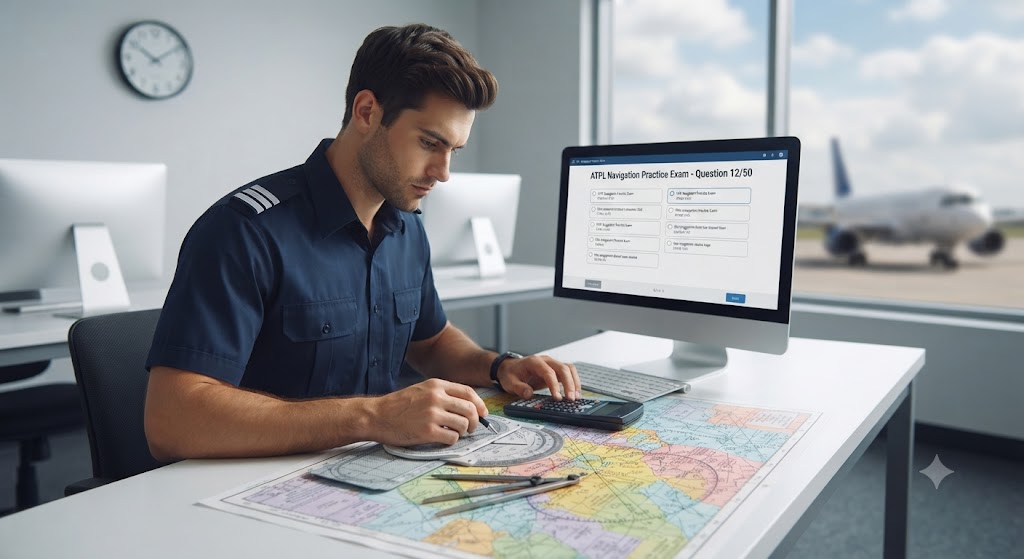
Additional Information
What the Course
Entails and Exam Details
The ATPL Navigation syllabus is extensive, blending
theoretical concepts with practical application. The goal is to ensure pilots
can navigate accurately over long distances, utilizing diverse methods ranging
from basic pilotage to sophisticated satellite-based systems.
The core subject areas covered in the course and exam
include:
- General
Navigation: This includes the study of the earth’s magnetism, charts
and projections (e.g., Lambert’s Conformal, Mercator), time systems, and
calculations regarding speed, distance, time, and fuel consumption.
- In-Flight
Navigation: Focuses on practical techniques used during flight,
including the application of wind velocity triangles, determining heading
and groundspeed, and establishing an aircraft’s position using visual
fixes and radio navigation aids.
- Radio
Navigation: This section covers the principles, limitations, and
operational use of ground-based aids like NDB, VOR, DME, and ILS, as well
as space-based systems like GNSS (GPS) and RNAV. It also includes airborne
radar and Long Range Navigation systems (LRNS) such as Inertial Navigation
Systems (INS) and FMS.
What to Expect in
the Final Exam
The ATPL Navigation exam is known for its complexity and
time pressure. It is a demanding theoretical examination that requires thorough
preparation.
While specific formats may vary slightly depending on the
aviation authority (e.g., EASA, FAA), the general structure is highly
standardized:
- Format:
The exam consists almost exclusively of multiple-choice questions.
However, these are rarely straightforward recall questions; many require
complex, multi-step calculations using navigation computers (like the
CRP-5), charts, and whiz wheels.
- Number
of Questions: Typically, the exam contains between 45 and 60
questions, depending on the specific authority's breakdown of subjects.
- Time
Limit: You are usually allotted between 1.5 to 2.5 hours. This equates
to roughly 2 to 3 minutes per question, highlighting the need for speed
and accuracy in calculations.
- Passing
Score: The required pass mark is consistently high, usually set at a
minimum of 75% or 80%.
- Materials
Allowed: In the exam room, you will typically be permitted specific
authorized materials. These usually include a navigation computer (CRP-5
or E6B), a protractor, a compass, approved navigation charts, and a
non-programmable calculator. Strict rules apply to what is allowed on your
desk; invigilators will inspect all materials beforehand.
How to Study and
Exam Centers
Success in the ATPL Navigation exam demands a structured
study approach and significant practice. Rote memorization of question banks is
rarely sufficient; you must understand the underlying principles to solve the
varied problems presented in the exam.
Actionable Study Strategies:
Master the CRP-5 (or E6B):
This is your primary tool. Practice until you can perform wind calculations,
compressibility corrections, and conversions swiftly and accurately without
second-guessing the mechanics.
Chart Work Proficiency:
You must be extremely comfortable using navigation charts. Practice plotting
positions, measuring tracks, calculating distances using latitude scales, and
identifying topographical and radio navigation features under time constraints.
Consistent Question Bank
Practice: Utilize official or reputable third-party question banks to
familiarize yourself with the question style. Do not just memorize answers;
work through every problem until you arrive at the correct solution
independently.
Identify Weaknesses: After
practice tests, rigorously review incorrect answers. Focus your subsequent
study on weak areas (e.g., polar navigation or specific radio aid limitations)
rather than reviewing subjects you already know well.
Where and How to Take the Exam:
ATPL exams are not taken casually; they must be scheduled
through official channels.
- Authorization:
Before booking, you must have completed the required theoretical knowledge
course at an approved training organization (ATO) and received
authorization (a course completion certificate).
- Booking:
Registration is typically handled through an online portal managed by your
national aviation authority (e.g., the CAA in the UK, or specific
designated service providers like ASL).
- Testing
Centers: The exams are administered at secure, authorized testing
centers. These centers are equipped with monitored computer stations
designed for high-stakes exams. In some cases, larger ATOs (flight
schools) may host these exams on-site if they are authorized testing
facilities.
Job Opportunities from the Course
The ATPL Navigation exam is a pivotal component of the
frozen ATPL, which is the baseline requirement for professional airline flying.
Passing this exam, along with the other 12 ATPL subjects, opens the door to a
lucrative and exciting career in commercial aviation.
This certification unlocks the following specific job titles
and career paths:
- First
Officer (Co-pilot): This is the primary entry-level role for newly
qualified pilots. You will work alongside the Captain in multi-crew
commercial air transport operations for passenger or cargo airlines.
- Airline
Captain: With experience and flight hours gained as a First Officer,
you can upgrade to Captain, assuming full command responsibility for the
aircraft, crew, and passengers.
- Corporate
Pilot: Many corporations operate private aircraft for business travel,
offering varied flying schedules and operations.
- Charter
Pilot: Flying on-demand charter services provides diverse operational
experience, often flying into smaller airports and remote locations.
- Cargo
Pilot: Flying for dedicated air freight carriers, often involving
night operations and long-haul flights across continents.
- Flight
Instructor: You may choose to use your advanced theoretical knowledge
to instruct the next generation of pilots at flight schools, teaching CPL
or ATPL ground school subjects.
Frequently Asked Questions
Reviews
5.0
Based on 0 reviews
Leave a Review
No reviews yet. Be the first to review!