
ANCC Non-Clinical Practice Test.
$69.00
- Buy to unlock unlimited access to all Quiz questions.
- After purchase you can print a PDF of the whole quiz at any point. The PDF will contain the questions and the correct answers.
About this Exam
Welcome to your essential guide for preparing for the ANCC Non-Clinical Practice Test. The American Nurses Credentialing Center (ANCC) recognizes that nursing expertise extends far beyond the bedside. A wide array of non-clinical certifications allows nurses to validate their skills and leadership capabilities in areas like informatics, nursing leadership, professional development, and case management.
This practice test is specifically designed as a powerful preparation tool for aspiring non-clinical nurse professionals, whether you are aiming for a certification as a Nurse Executive, an Informatics Nurse, a Nurse Educator, or a Case Manager. It is a simulated exam experience that helps gauge your readiness, identify critical knowledge gaps, and familiarize you with the rigorous style of questions you can expect in the final certification journey. This guide is for motivated registered nurses looking to transition into influential, strategic non-bedside roles within the healthcare landscape.
Ready to test your knowledge?
Buy Now to Access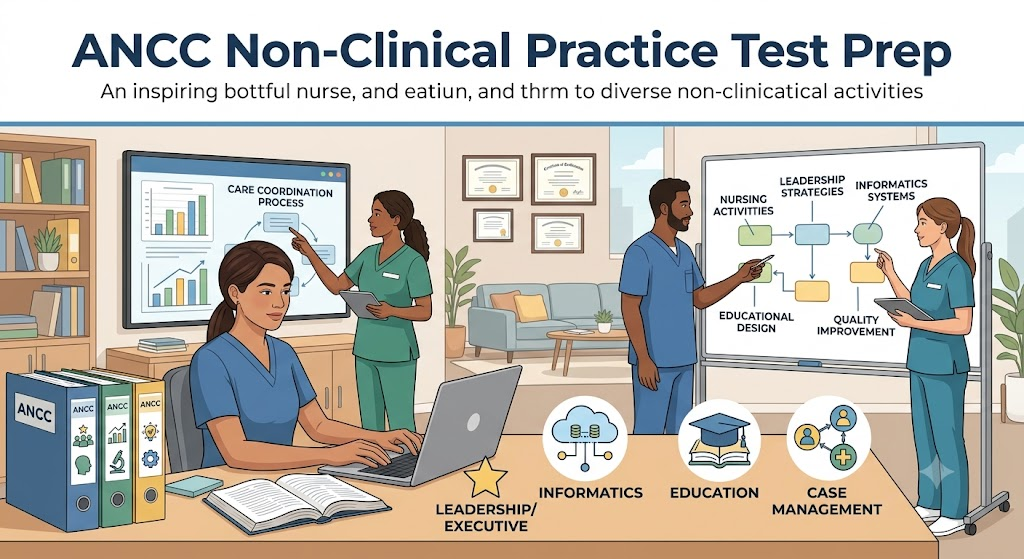
Additional Information
What the Course Entails and Exam Details
The associated certifications and this preparation resource are structured around key domains critical for non-clinical nursing success. The core topics generally include:
Organizational Leadership & Management: Understanding healthcare systems, human resources, financial management, strategic planning, and ethical leadership practices within complex organizations.
Healthcare Informatics & Technology: The role of data, information systems (such as electronic health records), process design, and technology integration in improving patient outcomes and operational efficiency.
Nursing Professional Development (NPD): Principles of education, learning theories, curriculum design, training implementation, and staff development within clinical and academic settings.
Case Management & Care Coordination: Strategies for managing patient populations, coordinating resources across the care continuum, advocating for patients, and evaluating care outcomes in various healthcare settings.
Quality Improvement & Patient Safety: Applying evidence-based practices, analyzing data to improve care quality, managing risks, and fostering a culture of safety.
Health Policy & Ethical Considerations: Navigating healthcare legislation, understanding regulatory requirements, and addressing ethical challenges in leadership and decision-making.
The ANCC Non-Clinical Practice Test will test your ability to apply knowledge across these diverse but interconnected domains, preparing you to succeed in the specific ANCC certification exam you pursue.
What to Expect in the Final Exam
While this guide focuses on the practice test, it is crucial to understand the structure of the final ANCC non-clinical certification exam you are working towards:
Exam Format: The actual certification exams are predominantly computer-based. You will encounter a mix of question formats, significantly including:
Multiple-Choice Questions: Standard single-answer questions.
Multiple-Response Items: Selecting all that apply from several options.
Drag and Drop Exercises: Matching concepts or sequencing steps.
Hotspot Questions: Identifying specific areas on a graphic or image.
Number of Questions: The total number can vary depending on the specific certification (e.g., Nurse Executive might have 175 total, with a significant number being scored and a portion being unscored pretest questions).
Passing Score: ANCC exams are criterion-referenced. Your score is based on the number of correct responses, typically reported as pass or fail with a scaled score to account for variation in test form difficulty. In many cases, a minimum scaled score (e.g., 350 out of 500) is required for passing.
Time Limit: Certification exams are generally timed, typically between 3 and 4 hours.
Specific Rules: Strict rules govern the actual testing experience, including proper identification, a secure testing environment, and prohibitions on any materials or devices. This non-clinical practice test will give you a sense of this timed, focused environment. Always consult the specific certification handbook and test content outline on the official ANCC website for the most accurate and up-to-date information for your chosen path.
How to Study and Exam Centers
Developing a focused study plan is key to success on both the practice test and the final certification exam. Leverage these effective strategies:
Review the Official Test Content Outline (TCO): This is your definitive roadmap, detailing the specific domains, weighted percentages, and competencies tested in your chosen ANCC certification. Align all your study efforts here.
Utilize High-Quality Practice Tests: Timed, realistic practice exams, such as this ANCC Non-Clinical Practice Test, are invaluable. Mimic exam conditions (silence, no phone, strict timing) to build stamina and identify your weak points. Review the detailed rationale provided for each correct and incorrect answer – this is where deep learning occurs.
Identify Your Knowledge Gaps: Use results from your practice test to create a targeted list of areas that need substantial review. Consult authoritative non-clinical nursing textbooks, current professional standards, clinical guidelines, and relevant peer-reviewed articles.
Practice Spaced Repetition: Use flashcards (digital apps or physical) for key terms, leadership theories, informatics concepts, educational principles, and relevant healthcare policies. Review these consistently over weeks to improve long-term retention.
Focus on Applied Knowledge & Scenarios: The ANCC exams often use scenario-based questions that require you to apply critical thinking and decision-making skills to real-world healthcare situations.
Form or Join a Study Group: Collaborative learning can expose you to different perspectives and provide encouragement.
Taking the Exam:
Final Certification Exam: The official ANCC non-clinical certification exams are typically administered at proctored testing centers globally, often through established test delivery partners like Prometric or Pearson VUE.
Scheduling: You must register for your certification exam and then schedule your appointment time at an authorized physical testing center. Always check your authorization to test notice and the official ANCC registration website for current test center information and procedures.
Practice Materials: Various ANCC readiness tests, review courses, and practice questions might be available in both online portal formats for study purposes, as well as scheduled center-based practice experiences. Consult the specific ANCC resources for clarity on the nature and location of the practice tools. Ensure you are clear about which experiences are study tools and which are the official, proctored final exams.
Job Opportunities from the Course
Successfully preparing for and achieving an ANCC non-clinical certification can significantly boost your credibility and expand your career possibilities. Depending on the specific certification you pursue, some key job titles and pathways include:
Nurse Manager
Nurse Director
Chief Nursing Officer (CNO)
Nurse Executive / CNE
Informatics Nursing Specialist
Clinical Application Analyst (Informatics Focus)
Nurse Educator
Nursing Professor / Faculty Member (with education focus)
Case Manager
Care Coordinator
Quality Improvement Coordinator
Patient Safety Officer
Healthcare Policy Analyst (within professional nursing organizations)
Take the next step in your professional journey and use this ANCC Non-Clinical Practice Test as your springboard to a dynamic and impactful non-clinical nursing career!
Frequently Asked Questions
Reviews
5.0
Based on 0 reviews
Leave a Review
No reviews yet. Be the first to review!