
ANCC Adult–Gerontology Acute Care Nurse Practitioner Certification (AGACNP) Practice Test.
$69.00
- Buy to unlock unlimited access to all Quiz questions.
- After purchase you can print a PDF of the whole quiz at any point. The PDF will contain the questions and the correct answers.
About this Exam
The Adult-Gerontology Acute Care Nurse Practitioner (AGACNP) Board Certification examination is a critical milestone for nurses specializing in the comprehensive care of adults and gerontology patients with acute, critical, and complex chronic health conditions.
This competency-based, entry-level exam provides a rigorous assessment of the clinical knowledge and advanced skills requisite for a safe and effective practice.
It is designed for registered nurses who have completed the appropriate graduate-level education, including a Master's, Post-Graduate Certificate, or Doctor of Nursing Practice (DNP) from an accredited program.
This certification validates your dedication to high-acuity nursing and provides potential employers with external validation of your capabilities to perform at an advanced practice level within dynamic, fast-paced acute care environments.
Ready to test your knowledge?
Buy Now to Access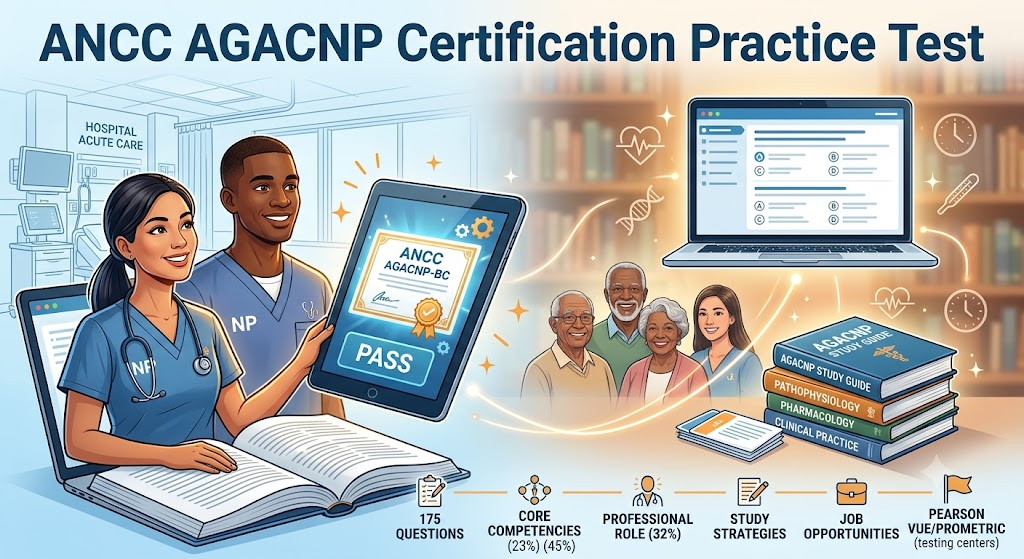
Additional Information
What the Course Entails and Exam Details
The path to AGACNP certification ensures you have mastered advanced practice concepts and possess the depth and breadth of knowledge necessary for this demanding field.
The examination's content domains and sub-domains are meticulously developed and regularily updated to reflect current, evidence-based practices and scope of practice.
Typically, the primary content domains for the ANCC AGACNP certification are:
Core Competencies (23%): This section evaluates your essential knowledge across key areas. Topics include advanced pathophysiology (across the lifespan), advanced pharmacology (principles and application for body systems and drug agents), and foundational health assessment skills and non-pharmacologic interventions. Understanding these fundamentals is crucial for diagnosing and managing complex cases.
Clinical Practice (45%): This is the largest and most clinically focused domain. It assesses your ability to apply your knowledge in real-world scenarios. Content covers patient history taking, physical examination skills, selecting and interpreting diagnostic tools, determining appropriate medication management and therapeutic interventions, and developing comprehensive care plans for various acute and chronic conditions across diverse patient populations.
Professional Role (32%): This domain tests your understanding of the nurse practitioner’s comprehensive responsibilities beyond direct patient care. You will be evaluated on concepts related to health policy development, patient-nurse and nurse-family dynamics, patient education strategies, professional standards and ethics, quality improvement, and the use of evidence-based strategies in professional practice.
The exam ensures you have a comprehensive understanding of diverse body systems and the physiological changes associated with aging, as well as the ability to address psychosocial, cultural, and spiritual determinants of health.
What to Expect in the Final Exam
Prepare yourself for a dynamic and extensive computer-based testing experience.
The official ANCC AGACNP Board Certification examination format is typically as follows:
Format: A comprehensive multiple-choice test. All questions are designed to assess competency rather than just recall.
Total Questions: 175 questions.
Scored Questions: 150 of these questions are actively scored to determine your results.
Pretest Questions: The remaining 25 questions are experimental (pretest) and are not scored towards your result. These are used to collect data on question performance for future exams. However, they are not marked as pretest, so you must treat every question as if it counts.
Time Limit: You will have 3.5 hours (or 210 minutes) to complete all 175 questions. This requires a balanced and consistent pace throughout the exam.
Passing Score: The exam uses scaled scoring rather than a raw percentage. Passing requires a scaled score between 350 and the maximum score of 500. This conversion ensures that scores are fair across different test administrations.
Rules and Registration: You must confirm your eligibility (educational requirements, clinical hours, etc.) before applying. Applications can be submitted year-round through the ANCC website. Once approved, you will receive an Authorization to Test (ATT) and can then schedule your exam within a designated window.
How to Study and Exam Centers
Achieving your certification requires a dedicated and multifaceted approach to preparation. Success hinges on both strong content knowledge and strategic test-taking skills.
Effective Study Strategies:
Create a Study Plan: Develop a realistic and consistent study schedule. Allocate specific times to cover each of the primary content domains, focusing on areas you find most challenging.
Utilize Practice Tests: Practice tests, such as the one we are discussing, are an invaluable resource. They help you:
Familiarize yourself with the multiple-choice format and the specific phrasing of AGACNP exam questions.
Assess your understanding of each domain and identify knowledge gaps.
Practice time management for the real, timed exam setting.
Build confidence and reduce exam-day anxiety by simulating the test experience.
Review Core Material: Use textbooks, lecture notes, and official ANCC study resources and reference lists to reinforce your knowledge of pathophysiology, pharmacology, advanced health assessment, and clinical guidelines. Pay close attention to the age-specific considerations of adult-gerontology populations and high-acuity care procedures.
Use Flashcards and Checklists: These can be effective for quick recall of important drugs, drug effects, diagnostic values, and disease characteristics. Use content domain checklists to track your progress and ensure you've covered all required topics.
Simulate the Exam: Periodically, take full, timed practice exams. This helps condition you for the endurance and mental fatigue you may experience during the actual 3.5-hour test.
Where and How to Take the Exam:
Once you have received your Authorization to Test (ATT) letter from the ANCC, you will schedule your exam through the official, designated computer-based testing agency.
The ANCC partners with established, secure testing centers across the United States and internationally to deliver the exam. Most candidates use third-party testing centers, such as those run by Prometric or Pearson VUE, depending on the ANCC's current provider. The ATT and scheduling portal will clearly indicate which centers are available and how to schedule your specific date and time within your authorized window. These are secure, monitored, physical locations where you will take the exam on a computer provided by the center. Be sure to understand all requirements for identification and acceptable behavior on test day. Practice tests, while valuable, are taken through various educational platforms and providers online and are separate from the official certification exam process and scheduling.
Job Opportunities from the Course
Earning your ANCC AGACNP-BC credential opens a wide array of career opportunities in high-demand and high-acuity settings. This certification demonstrates your specialization and validates your capability to manage complex patient situations, unlocking several professional paths.
Your career as an Adult-Gerontology Acute Care Nurse Practitioner could include the following roles:
Acute Care Nurse Practitioner (general settings)
Adult-Gerontology Acute Care Nurse Practitioner
Hospitalist Nurse Practitioner
Critical Care Nurse Practitioner
Emergency Department Nurse Practitioner
Surgical Nurse Practitioner (perioperative, preoperative, postoperative care)
Cardiology Nurse Practitioner
Neurology Nurse Practitioner
Oncology Nurse Practitioner
Trauma Nurse Practitioner
Pulmonology Nurse Practitioner
Urgent Care Nurse Practitioner (in settings with high-acuity patients)
Specialty Service Line Clinical Leader
Nurse Practitioner in intensive care units (ICUs), emergency departments (EDs), trauma centers, surgical units, medical-surgical units, and specialized inpatient services.
Educator or Acute Care Service Coordinator roles
Your specialized skills in managing critical conditions among adult and elderly populations are in high and growing demand, leading to dynamic career potential and significant impact in complex healthcare environments.
Frequently Asked Questions
Reviews
5.0
Based on 0 reviews
Leave a Review
No reviews yet. Be the first to review!