
ANCC Adult–Gerontology Acute Care Nurse Practitioner Certification (AGACNP) Practice Test
$69.00
- Buy to unlock unlimited access to all Quiz questions.
- After purchase you can print a PDF of the whole quiz at any point. The PDF will contain the questions and the correct answers.
About this Exam
The ANCC Adult-Gerontology Acute Care Nurse Practitioner Certification (AGACNP) is a prestigious credential that validates the advanced knowledge and clinical skills necessary for nurse practitioners caring for patients from adolescence through the spectrum of adulthood in acute care settings. This certification is specifically designed for experienced Registered Nurses (RNs) who have completed an accredited graduate program that prepares them as an AGACNP. It signifies that the practitioner is ready to provide complex care, manage acutely or critically ill patients, and work within high-acuity environments such as intensive care units, emergency departments, and specialty services. The AGACNP is a critical role in today’s complex healthcare system, and passing this exam is a key milestone for professionals in this field.
Ready to test your knowledge?
Buy Now to Access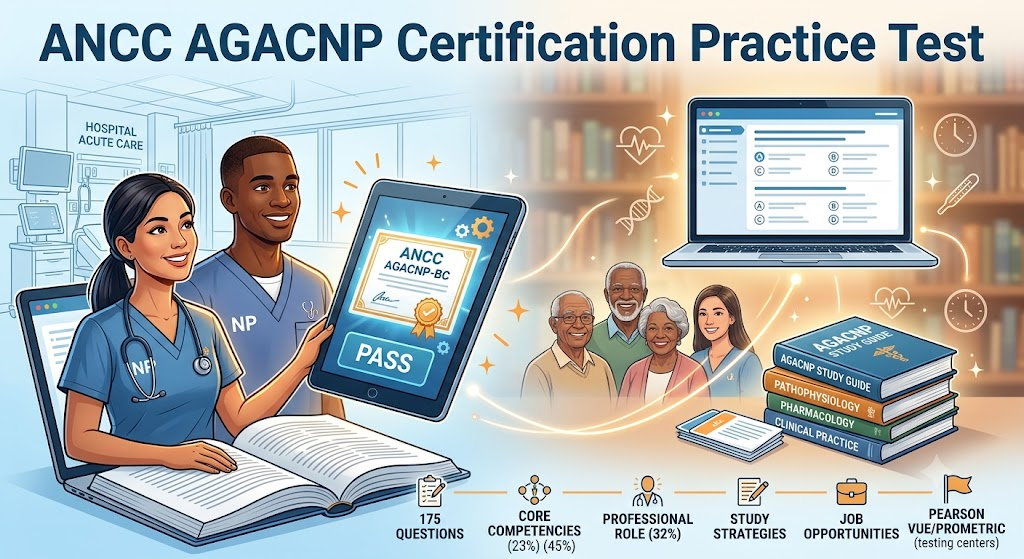
Additional Information
What the Course Entails and Exam Details
This comprehensive AGACNP practice exam study guide covers multiple domains that are crucial for success. The underlying curriculum for this certification focuses on the assessment, diagnosis, and management of acute and chronic health conditions in the adult and gerontology populations. It builds upon foundational knowledge with advanced clinical reasoning, advanced pharmacology, and advanced physical assessment.
Core knowledge areas include, but are not limited to:
Advanced Health Assessment: Advanced procedures and skills for complex patient presentations.
Advanced Pharmacology: Principles of drug therapy, interactions, and therapeutic monitoring in acute care.
Advanced Pathophysiology: Mechanisms of disease and their manifestations across the lifespan of adults.
Clinical Management: Evidence-based treatment of acute, critical, and complex chronic illnesses.
Role and Professional Issues: Interprofessional collaboration, legal, ethical, and healthcare system principles.
Research and Evidence-Based Practice: Applying research to clinical decision-making.
What to Expect in the Final Exam
The actual ANCC AGACNP Certification Exam is a computer-based test (CBT) that requires critical thinking, clinical judgment, and the application of advanced knowledge. You will have a limited time to complete a set number of questions.
Format: The exam consists of multiple-choice questions, which may include alternate formats (e.g., select-all-that-apply, ordering items).
Time Limit: You will typically be given 4 hours to complete the examination.
Number of Questions: The number of scored questions varies, but it is a significant amount, often around 175. There may also be non-scored pretest questions.
Passing Score: The passing score is determined by the American Nurses Credentialing Center (ANCC) based on a statistical analysis of performance, rather than a fixed percentage.
Rules: Standard testing center protocols will be in place, and you will not be allowed outside materials.
How to Study and Exam Centers
Preparation for the AGACNP exam requires a structured and dedicated approach. As this is a practice-oriented guide, your primary focus should be on practical application.
Study Strategies:
Take Multiple Practice Tests: This is critical! Practice tests are invaluable for familiarizing yourself with the question types, timing, and areas where you need further review. Look for reliable sources that provide detailed rationales for every answer.
Focus on Rationales: When you answer a practice question, understand why the correct answer is correct and why the other options are not. This deepens your understanding of clinical principles.
Review Core Content: Revisit your graduate textbooks and notes, focusing on pathophysiology, pharmacology, and clinical management. Create flashcards for key medications, disease processes, and diagnostic criteria.
Identify Weaknesses: Use the results of your practice exams to pinpoint specific topics that need focused study. Don't waste time reviewing what you already know.
Simulate Exam Conditions: Periodically take full-length practice tests under timed conditions to build your stamina and confidence.
Exam Centers and Location: The ANCC utilizes a third-party testing agency to administer the exam. You will need to register and schedule your appointment.
Pearson VUE: The exam is typically offered at designated Pearson VUE professional testing centers across the United States and sometimes internationally.
Online Proctoring: Some organizations have begun offering remote proctoring options, but it’s essential to check the latest guidelines from the ANCC and Pearson VUE regarding availability and requirements.
Find Your Center: You can find the closest authorized testing centers by visiting the Pearson VUE website and searching for the ANCC AGACNP examination.
Job Opportunities from the Course
Earning the AGACNP certification opens doors to specialized roles within high-acuity healthcare environments. These positions offer great responsibility and require advanced skills.
Specific Job Titles:
Acute Care Nurse Practitioner (ACNP) in Hospital Systems (ICU, ER, Step-Down Units)
Specialty Services NP (e.g., Cardiology, Neurology, Orthopedics, Oncology in an acute setting)
Hospitalist Nurse Practitioner
Inpatient Palliative Care NP
Nurse Practitioner in Sub-Acute Facilities or Long-Term Acute Care Hospitals (LTACH)
Clinical Nurse Educator (with a focus on acute care)
Acute Care Research Nurse Practitioner
This certification is not only a marker of expertise but also a requirement for licensing and practice in many states and by many healthcare institutions. Your journey to becoming a certified AGACNP begins with diligent study and thorough practice.
Frequently Asked Questions
Reviews
5.0
Based on 0 reviews
Leave a Review
No reviews yet. Be the first to review!