
Telemetry Monitor Technician Practice Test
$69.00
- Buy to unlock unlimited access to all Quiz questions.
- After purchase you can print a PDF of the whole quiz at any point. The PDF will contain the questions and the correct answers.
About this Exam
The Telemetry Monitor Technician certification is a vital credential for healthcare professionals specializing in the remote, real-time monitoring of patients' cardiac activity. This exam is designed to validate your knowledge of Electrocardiogram (ECG/EKG) interpretation, standard lead placement, heart rhythms, and the ability to detect and report life-threatening arrhythmias. Typically intended for current healthcare workers, nursing students, or those aspiring to enter a crucial, focused medical technology role, this certification proves you possess the precise skills required to ensure patient safety and support diagnostic processes in a dynamic medical environment. Utilizing a comprehensive practice exam is an essential step to ensure you are fully prepared for the challenges of the actual certification test.
Ready to test your knowledge?
Buy Now to Access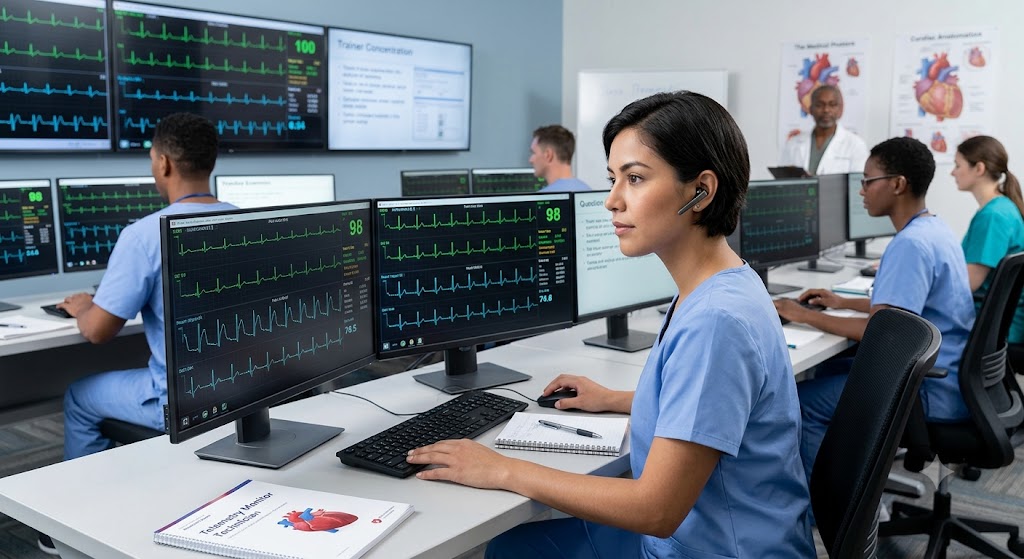
Additional Information
What the Course Entails and Exam Details
To excel on the final certification exam, you must have a thorough understanding of the entire cardiac monitoring process. This encompasses a strong grasp of cardiovascular anatomy and physiology, including the electrical conduction system of the heart. The core syllabus and subsequent exam will cover:
Detailed principles of the ECG, including waves (P, QRS, T), intervals (PR, QRS, QT), and the J point.
Accurate placement and troubleshooting of standard ECG leads (3-lead, 5-lead, and often 12-lead).
Mastery in the interpretation of normal and, crucially, all common and critical cardiac rhythms. This includes sinus rhythms, atrial/ventricular/junctional arrhythmias, heart blocks, and paced rhythms.
In-depth recognition and response protocols for lethal rhythms like ventricular fibrillation and ventricular tachycardia.
Basic medical terminology related to cardiology.
Understanding of standard patient privacy (HIPAA), infection control, and professional communication within the healthcare team.
The exam itself is typically computer-based and consists of a significant number of multiple-choice questions, along with potential innovative formats like "hot spot" identification on rhythm strips or drag-and-drop sequencing in some modern exam versions.
What to Expect in the Final Exam
You should prepare for a rigorous, timed evaluation. Common parameters of the final certification exam (and aspects often simulated in a good practice exam) include:
Format: A closed-book, computer-based exam.
Questions: A typical exam, like those from Cardiovascular Credentialing International (CCI) for CCT or CRAT certifications, might contain around 130 multiple-choice questions. It's important to note that a portion of these (e.g., 20 questions) may be unscored, pretest questions randomly distributed throughout the test.
Time Limit: Generally, you will be allotted around 2 hours to complete the examination. Time management is crucial.
Passing Score: Scoring is often scaled. A common example is a passing score of 650 on a scale that can range from 500 to 900. These requirements and scaling can vary by certifying body, so always check your specific organization's current standards.
Rules: You must present valid identification, only specified items are allowed in the testing area (check specific rules), and the use of reference materials or calculators is typically prohibited. The environment is closely monitored.
How to Study and Exam Centers
Effective preparation is key to your success on the Telemetry Monitor Technician exam. Implement these action-oriented strategies:
Utilize Practice Exams: This is one of your most powerful tools. Our [Telemetry Monitor Technician Practice Test] is designed to mirror the structure, difficulty, and question types you will face on the actual exam. Taking simulated, timed practice tests builds endurance, improves time management, and identifies your strong and weak areas.
Master Rhythm Identification: Engage in consistent rhythm drill sessions. Use flashcards and online simulators until you can immediately and accurately identify common and critical arrhythmias and normal rhythms.
Review Official Materials: Deeply study the resources provided by your specific certifying body (e.g., CCI study guides, NTA materials).
Focus on Fundamentals: Ensure you have an unshakable understanding of cardiac anatomy, lead placement, and the basic interpretation of ECG components.
Exam Centers: The final certification exams are usually administered at specific physical testing centers like Pearson Professional Centers (for CCI certifications) or, increasingly, through authorized secure online proctoring portals. When registering for your final exam, you will select a suitable testing location or online option.
Develop a Study Plan: Be consistent and dedicate specific times to focused study, breaking down key topics and allocating sufficient time for both review and practice exams.
Job Opportunities from the Course
A Telemetry Monitor Technician certification significantly enhances your career prospects, opening doors to various exciting roles and pathways within the healthcare industry. Earning this credential unlocks job titles and opportunities such as:
Telemetry Monitor Technician in hospitals, cardiac units, and intensive care units.
Cardiac Monitor Technician within specialized cardiac monitoring departments or outpatient clinics.
Rhythm Analysis Technician focusing on detailed strip interpretation.
ECG/EKG Technician – often, skills and certifications can overlap or be enhanced by a telemetry certification.
Cardiac Technologist roles in advanced clinical settings.
Clinical Research Assistant in studies involving cardiac monitoring.
It also serves as a strong foundation and valuable skill for those pursuing or advancing within Nursing (LPN/RN), Physician Assistant studies, Emergency Medical Technology, or specialized cardiac care careers.
Further advancement can lead to Lead Technician, Department Supervisor, Telemetry/Clinical Educator, or specialized clinical roles with additional training.
This certification demonstrates a high level of specialized skill that is in demand across many healthcare settings, contributing to improved patient monitoring and care.
Ensure you are fully prepared for your future. Use our comprehensive and realistic [Telemetry Monitor Technician Practice Test] to take the first critical step towards achieving your certification and launching a successful career in this essential healthcare field. Good luck!
Frequently Asked Questions
Reviews
5.0
Based on 0 reviews
Leave a Review
No reviews yet. Be the first to review!