
TCM Foundations Board: Daily Practice Test
$69.00
- Buy to unlock unlimited access to all Quiz questions.
- After purchase you can print a PDF of the whole quiz at any point. The PDF will contain the questions and the correct answers.
About this Exam
The Traditional Chinese Medicine (TCM) Foundations Board certification is a critical, initial milestone for aspiring practitioners, marking the successful mastery of the core theories that underpin this ancient, holistic medical system. This exam is designed for students of TCM, acupuncture, and oriental medicine who are seeking validation of their fundamental knowledge before advancing to specialized clinical training and, ultimately, national or state licensure. The purpose of a Daily Practice Test is to provide a consistent, low-stakes environment for students to reinforce learning, identify knowledge gaps, and build the mental stamina required for the final comprehensive board examination. It serves as an essential tool for turning vast amounts of complex theory into fluent, accessible clinical knowledge.
Ready to test your knowledge?
Buy Now to Access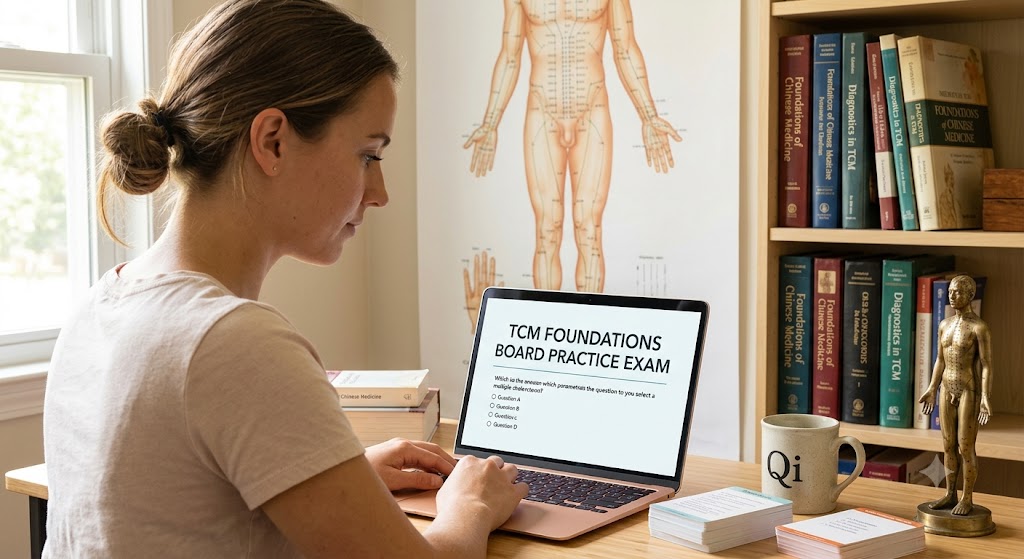
Additional Information
What the Course Entails and Exam Details
A comprehensive study course and the corresponding TCM Foundations Board exam focus exclusively on the core principles and diagnostic methodologies of Traditional Chinese Medicine. The syllabus typically encompasses:
Fundamental TCM Theory: In-depth study of Yin-Yang, the Five Elements (Wu Xing), the concept of Qi, Blood, Body Fluids (Jin Ye), and Essence (Shen).
Zang-Fu Organ Systems: Understanding the physiological functions, interrelationships, and pathological patterns of the six Zang (solid) organs and six Fu (hollow) organs.
Etiology and Pathogenesis: Causes of disease, including external pathogens, internal emotions, and lifestyle factors, and how they lead to pattern development.
Diagnostic Methods: Mastery of the Four Pillars of Diagnosis: Observation (including tongue analysis), Hearing & Smelling, Interrogation (the Ten Questions), and Palpation (including pulse diagnosis).
Pattern Differentiation (Ba Gang): Applying the Eight Principles (Interior/Exterior, Heat/Cold, Full/Empty, Yin/Yang) and other systems like Six Stages, Four Levels, and Triple Burner to categorize a patient’s condition.
Treatment Principles: Formulating therapeutic strategies based on pattern differentiation, such as tonifying deficiency, reducing excess, or expelling pathogens.
What to Expect in the Final Exam
The final TCM Foundations Board exam, often part of a larger national certification process like the NCCAOM (National Certification Commission for Acupuncture and Oriental Medicine) in the United States, is a rigorous assessment. Candidates can generally expect the following format:
Format: The exam is primarily multiple-choice, designed to test both factual recall and the application of theoretical concepts to clinical scenarios. Some exams may include integrated case studies.
Time Limit: The test is timed, typically ranging from 2.5 to 4 hours, requiring efficient time management.
Passing Score: While specific requirements vary by region and board, passing is often determined by a scaled score, with the benchmark usually around 70% or higher.
Rules: These are proctored exams, often taken on a computer. No reference materials, textbooks, or electronic devices are permitted in the testing area. Strict security protocols are enforced.
How to Study and Exam Centers
Effective preparation requires a multi-faceted approach, balancing memorization with conceptual understanding. Consider these strategies:
Utilize a Daily Practice Test: Consistent, daily interaction with practice questions is paramount. This builds memory, helps you get accustomed to the question format, and reveals weak areas you need to review.
Master Core Textbooks: Deeply study the primary textbooks for TCM foundations, creating detailed notes and mind maps for complex systems like Zang-Fu.
Leverage Study Guides and Flashcards: Use established study guides for the specific board you are taking. Flashcards are excellent for memorizing pulse qualities, tongue indications, and basic theory terms.
Form or Join a Study Group: Discussing difficult concepts and teaching others is one of the most effective ways to solidify your own knowledge.
Practice Case Analysis: Work through as many sample case studies as possible to practice applying the Eight Principles and formulating treatment plans.
For taking the exam, most major boards utilize authorized computer-based testing networks. Candidates often take the exam at a dedicated testing center, such as Pearson VUE, which has locations worldwide. In some cases, authorized schools or specific state licensing facilities may serve as testing sites. Always check the official website of your specific certification board for the most accurate list of testing centers and registration procedures.
Job Opportunities from the Course
Passing the TCM Foundations Board exam is a significant prerequisite on the path to becoming a licensed professional. Successfully completing the full certification process and obtaining your license unlocks a diverse and growing range of career paths:
Licensed Acupuncturist (L.Ac.) / Oriental Medicine Practitioner: Establish a private practice or join an existing clinic to provide holistic care to a dedicated patient base.
Integrative Health Clinic Practitioner: Collaborate with biomedical doctors, chiropractors, and other therapists in a multidisciplinary environment.
Wellness Center and Spa Consultant: Provide TCM-based wellness consultations, lifestyle advice, and stress reduction treatments.
Sports Medicine Specialist: Work with athletic teams or fitness centers to improve performance and accelerate injury recovery.
Teaching and Education: Become an instructor at a TCM school or a continuing education provider, shaping the next generation of practitioners.
Clinical Researcher: Design and conduct studies to expand the scientific understanding and evidence base for TCM.
Herbalist / Consultant: Focus on prescribing and advising on Chinese herbal formulas in a clinical or retail setting.
Corporate Wellness Program Provider: Develop and implement wellness initiatives for companies, focusing on stress management and prevention.
Cruise Ship Practitioner: Offer acupuncture and wellness services to international travelers.
Qigong / Tai Chi Instructor: Integrate these foundational movement and breath practices into a clinical setting or teach them as standalone wellness classes.
Frequently Asked Questions
Reviews
5.0
Based on 0 reviews
Leave a Review
No reviews yet. Be the first to review!