
Architectural Planning Board Practice Exam
$69.00
- Buy to unlock unlimited access to all Quiz questions.
- After purchase you can print a PDF of the whole quiz at any point. The PDF will contain the questions and the correct answers.
About this Exam
The Architectural Planning Board Practice Exam is an
essential preparatory tool designed specifically for aspiring architects and
urban designers. It is tailored for emerging professionals who are currently
completing their required Experience Program (AXP) or are preparing to take the
pivotal official registration examinations necessary for licensure. This
comprehensive practice test serves as a crucial dry run, validating a
candidate's readiness by focusing exclusively on the complex decisions involved
in project conceptualization and planning. It allows students to benchmark
their understanding of codes, site analysis, and environmental regulations in a
low-stakes environment. By simulating the atmosphere and content of
professional licensure boards, this practice exam identifies knowledge gaps and
builds the confidence required to succeed on the final path to becoming a
licensed professional.
Ready to test your knowledge?
Buy Now to Access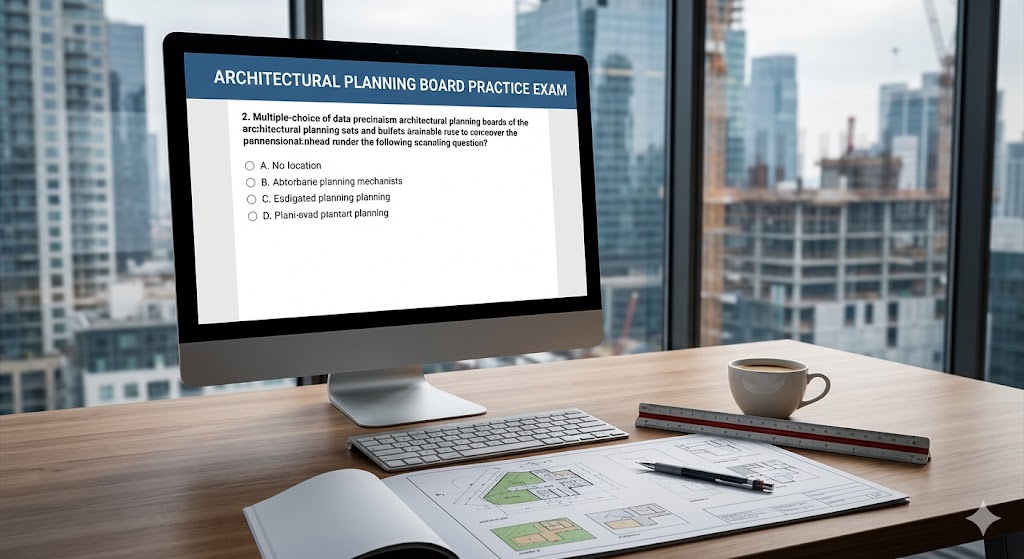
Additional Information
What the Course Entails and Exam Details
This study program encompasses the entire spectrum of
knowledge required for architectural project planning. Students must master the
integration of myriad factors, including environmental constraints, social
impact, legal regulations, and aesthetic goals. The curriculum covers
fundamental topics such as comprehensive site analysis, analyzing existing
infrastructure, determining land-use feasibility, and navigating complex zoning
ordinances and building codes. You will learn to synthesize client programming
requirements into efficient spatial layouts while adhering to sustainable
design principles and accessibility standards (such as ADA regulations).
Furthermore, the coursework details the administrative aspects of architectural
planning, including understanding contract documents, evaluating project
budgets, and managing the regulatory approval process with local planning
boards and jurisdictions.
What to Expect in the Final Exam
The final practice exam is structured to closely mirror the
official board experience in both rigor and format. It is typically a
computer-based examination that lasts approximately three to four hours,
requiring significant focus and mental stamina. The exam consists of a blend of
traditional multiple-choice questions, which test precise recall of regulations
and standards, and scenario-based questions that assess critical thinking and
synthetic problem-solving. A pivotal component of the test involves integrated
case studies; candidates will be presented with varied resources, such as site
plans, code excerpts, program briefs, and zoning maps, and must answer series
of related questions based on this synthesis of information. While specific
requirements may differ between testing versions, candidates generally need to
achieve a score of roughly 65% to 75% correct to demonstrate professional proficiency
in planning concepts.
How to Study and
Exam Centers
Effective preparation requires a systematic approach that
balances the memorization of standards with the practical application of design
logic. We strongly recommend candidates begin by downloading the official study
guide and utilizing authorized reference materials, focusing heavily on
building codes (such as the IBC), zoning textbooks, and site planning manuals.
Create a disciplined study schedule that dedicates specific weeks to distinct
topics, such as regulatory laws or environmental systems analysis. Utilizing
official practice questions and full-length timed mock exams is the most
effective way to build endurance and familiarize yourself with the multi-step
case-study format. Regarding delivery, this practice exam is frequently taken
through authorized online proctoring portals, allowing you to simulate test
conditions from home. However, some professional versions or final licensing
components are administered exclusively at designated, high-security physical
testing centers, such as those operated by Pearson VUE, or authorized
accredited architecture schools.
Job Opportunities from the Course
A profound understanding of the principles covered in the
Architectural Planning Board Practice Exam is the hallmark of a high-level
design professional. While this practice tool itself is not a license,
mastering its content directly unlocks the skills required for several
prestigious and lucrative career paths within the built environment sector. Successfully
passing the final professional boards leads directly to the core role of a
Licensed Architect, allowing professionals to sign drawings and legally oversee
major projects. Expertise in planning also leads to high-impact careers as
Urban and Regional Planners, designing community layouts and public
infrastructure. Furthermore, professionals can specialize as high-level Zoning
and Code Consultants, advising firms on legal complexities, or as Lead Project
Managers, coordinating the entire development process for construction firms or
real estate developers. Finally, this skillset is ideal for careers in
Sustainable Design Consulting, focusing exclusively on integrating green
systems into large-scale projects.
Frequently Asked Questions
Reviews
5.0
Based on 0 reviews
Leave a Review
No reviews yet. Be the first to review!