
Tactical Air Control Party (TACP) Practice Test
$69.00
- Buy to unlock unlimited access to all Quiz questions.
- After purchase you can print a PDF of the whole quiz at any point. The PDF will contain the questions and the correct answers.
About this Exam
Welcome to your essential resource for the Tactical Air Control Party (TACP) Practice Test. The TACP career field is one of the most elite and challenging paths within the United States Air Force Special Warfare. These specialists operate in advanced, often dangerous environments, directly embedding with Army, Marine, and Special Operations units. Their primary role is Joint Terminal Attack Control (JTAC)—the precise planning, synchronization, and final directing of Close Air Support (CAS) aircraft to strike ground targets. This practice test is designed to support ambitious Airmen and candidates preparing to enter the TACP training pipeline, ensuring they possess the fundamental knowledge required for this high-stakes mission.
Ready to test your knowledge?
Buy Now to Access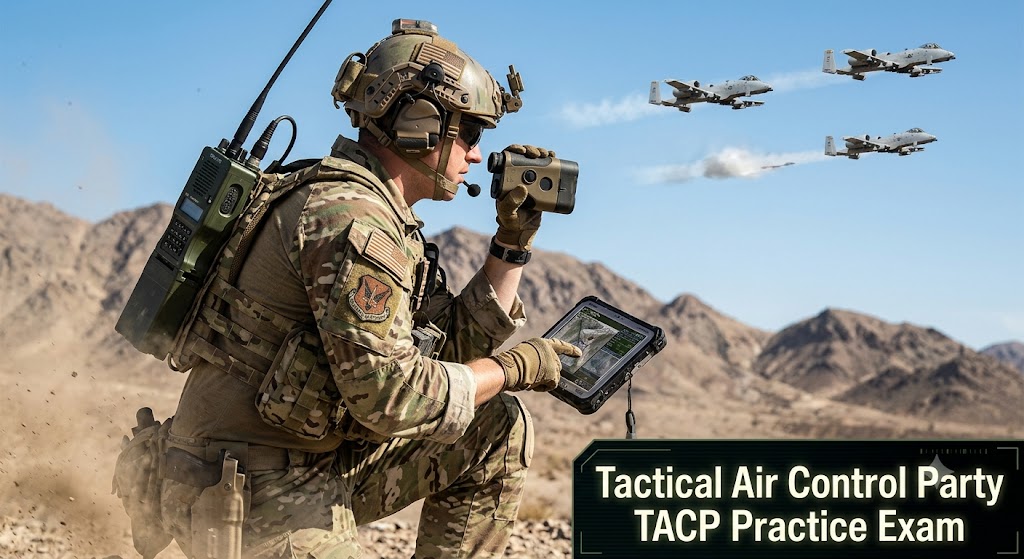
Additional Information
What the Course Entails and Exam Details
The TACP pipeline begins with an intensive assessment and selection process, followed by months of rigorous training. Key components of the formal course include:
Joint Terminal Attack Controller (JTAC) Fundamentals: In-depth study of procedures for coordinating air-to-ground fires.
Close Air Support (CAS) Doctrine: Master the legal, tactical, and safety frameworks of employing airpower near friendly forces.
Tactical Communications: Proficiency with satellite, multi-band, and specialized radios crucial for secure air combat control.
Navigation and Battlefield Awareness: Advanced land navigation, map reading, and understanding unit positioning.
Small Unit Tactics: Basic combat skills required when operating within the ground force’s maneuver element.
The TACP practice test focuses on the academic portion of this knowledge, preparing you for the formal written evaluations you will face during selection and the primary TACP apprentice course. It simulates the cognitive demands required to excel under pressure.
What to Expect in the Final Exam
When you sit for the final TACP academic qualification exams during your pipeline training, you will be tested on both raw knowledge and practical application.
Format: The primary academic exams are multiple-choice. They require quick recall of complex, critical data.
Practical Scenarios: Some parts may involve scenario-based questions, requiring you to analyze a tactical situation and choose the correct protocol for calling in support or identifying targets.
Passing Score: Like most Special Warfare and JTAC certifications, a score of 80% or higher is typically required to pass the academic portion.
Time Limits: Exams are strictly timed to assess your ability to process information and make decisions efficiently, mimicking operational speed.
Standardization: The exams are governed by specific Air Force and Joint publications (e.g., JP 3-09.3, Joint Tactics, Techniques, and Procedures for Close Air Support).
How to Study and Exam Centers
Preparation for the TACP academic evaluations requires disciplined, focused study.
Actionable Study Strategies:
Focus on Publications: Master key manuals. If it’s in the joint publication, it’s fair game for the test.
Use Flashcards: Create digital or physical flashcards for definitions, acronyms, procedures, and comms formats.
Scenario-Based Practice: Actively simulate calling in an airstrike. Work through the 9-line brief (the CAS mission request format) until it is instinctual.
Take Multiple Practice Exams: Repeat this practice test frequently. Identify your weakest topics and double down on studying those areas.
Exam Centers:
It is crucial to understand that TACP qualification is a formal military certification process. The TACP Practice Test can be taken online here for self-study. However, the official qualification exams are only administered at specific Air Force training facilities, primarily within the 350th Special Warfare Training Wing, often located at Hurlburt Field, FL, or Joint Base San Antonio, TX, during designated stages of the TACP training pipeline. They are not available at public testing centers like Pearson VUE.
Job Opportunities from the Course
A successfully completed TACP pipeline and the resulting certifications open the door to unique and highly-coveted career paths within the United States Air Force and Special Operations Command.
Tactical Air Control Party (TACP) Specialist (AFSC 1Z3X1)
Joint Terminal Attack Controller (JTAC) Instructor/Evaluator
Special Warfare Tactical Air Control Party (TACP) Officer (19ZX)
JTAC Liaison Officer (LNO) to Army/Marine Ground Forces
Advanced TACP roles within Special Tactics Squadrons (STS)
Combat Control Team (CCT) roles (often closely aligned with TACP and JTAC mission sets)
Frequently Asked Questions
Reviews
5.0
Based on 0 reviews
Leave a Review
No reviews yet. Be the first to review!