
307 Advanced Damage Control Practice Exam
$69.00
- Buy to unlock unlimited access to all Quiz questions.
- After purchase you can print a PDF of the whole quiz at any point. The PDF will contain the questions and the correct answers.
About this Exam
The 307 Advanced Damage Control
(DC) certification is a critical qualification designed for personnel
operating in high-risk maritime and industrial environments, most notably
within naval and coast guard forces. This advanced exam moves beyond basic
survival and firefighting skills, focusing instead on the leadership, complex
engineering, and tactical decision-making required to preserve a vessel's
structural integrity, maneuverability, and combat capability during extreme
casualties. It is intended for individuals moving into supervisory roles, such
as Repair Party Leaders, Damage Control Assistant (DCA) candidates, and senior
engineering petty officers, who must command response teams under pressure.
Ready to test your knowledge?
Buy Now to Access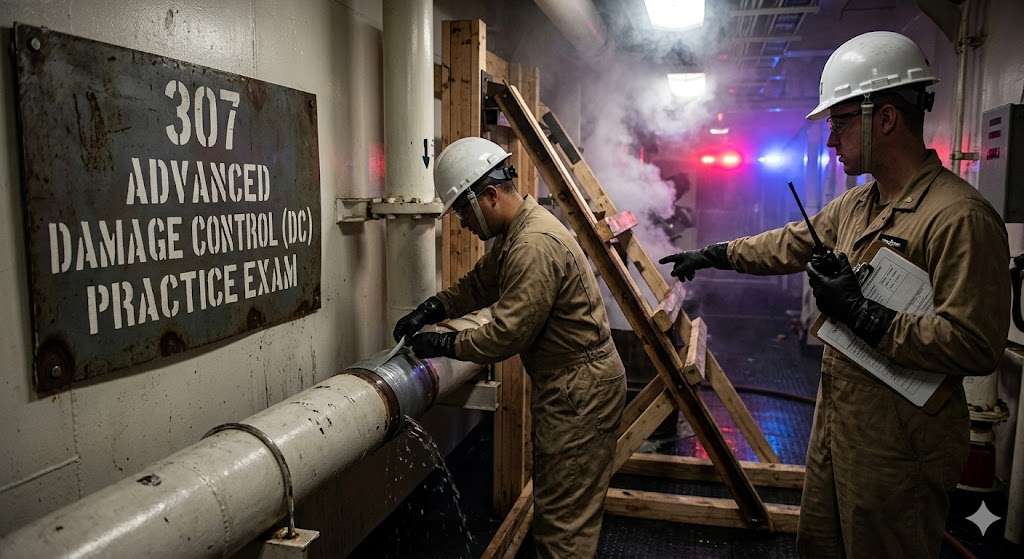
Additional Information
What the Course Entails and Exam Details
This comprehensive course covers the theoretical
knowledge and practical applications needed to manage severe shipboard damage.
The syllabus is rigorous and requires a deep understanding of fluid dynamics,
structural engineering, and command principles.
Core
Topics Covered:
<!--[if !supportLists]-->·
<!--[endif]-->Advanced Firefighting Tactics: Commanding multi-team
responses to large-scale, persistent fires, including space isolation, boundary
warfare, and the fixed extinguishing system activation sequence.
<!--[if !supportLists]-->·
<!--[endif]-->Structural Shoring and Containment: Detailed methods
for erecting complex wood and metal shoring (I, K, and H types) to support
weakened bulkheads and decks, calculating load distributions, and managing
progressive structural failure.
<!--[if !supportLists]-->·
<!--[endif]-->Pipe Patching and Plugging: Expert application of
varied patching techniques including EWARP (Emergency Water Activated Repair
Patch), soft patches, jubilee patches, and banding, as well as complex plugging
below the waterline.
<!--[if !supportLists]-->·
<!--[endif]-->Dewatering Systems: Operation, alignment, and
troubleshooting of advanced dewatering equipment, including electrical
submersible pumps (ESP), P-100 portable pumps, and installed eductor systems.
<!--[if !supportLists]-->·
<!--[endif]-->Casualty Power Distribution: Theoretical and practical
knowledge of rigging casualty power to restore vital systems, understanding
phase rotation, and prioritizing electrical loads.
<!--[if !supportLists]-->·
<!--[endif]-->CBRN Defense (Advanced): Managing a crew’s defense
against Chemical, Biological, Radiological, and Nuclear threats, including
collective protection systems and decontamination protocols.
<!--[if !supportLists]-->·
<!--[endif]-->Stability and Buoyancy: Understanding the effects of
flooding on ship stability (free surface effect, list, and trim management).
What to Expect in the Final Exam
The 307
Advanced Damage Control Final Exam is a standardized, comprehensive
assessment that validates your mastery of the material. While specific formats
may vary slightly depending on the certifying body (e.g., US Navy, international
maritime authorities), candidates should prepare for the following general
structure.
<!--[if !supportLists]-->·
<!--[endif]-->Format: The primary component is a closed-book,
written examination. It typically consists of 75 to 100 multiple-choice questions. These questions
are designed not just to test recall, but to require the analysis of complex
casualty scenarios.
<!--[if !supportLists]-->·
<!--[endif]-->Practical Application: In many cases, the written exam
is preceded by a series of practical "sign-offs" or a "final
problem" scenario where you must lead a repair party in a simulator or
actual shipboard environment. You must pass the practical assessments before
you are eligible for the written theory test.
<!--[if !supportLists]-->·
<!--[endif]-->Time Limit: Candidates are usually allotted 2 to 3 hours to complete
the written portion.
<!--[if !supportLists]-->·
<!--[endif]-->Passing Score: A minimum score of 80% is generally required
to pass the advanced theory section, reflecting the high stakes of the
material.
How to Study and Exam Centers
Preparation for the 307 DC exam requires a blend of
rigorous theoretical study and hands-on familiarity with the equipment.
Actionable
Study Strategies:
<!--[if !supportLists]-->·
<!--[endif]-->Master the Manuals: The primary source materials, such
as the NSTM 079 V2 (Damage
Control) and your specific vessel’s Damage Control Book, are your bibles. Study them
section by section.
<!--[if !supportLists]-->·
<!--[endif]-->Use the 307 Practice Exam: Take practice exams
repeatedly. They are your best tool for familiarizing yourself with the
phrasing of questions and identifying weaknesses in your knowledge,
particularly in system alignment and calculations.
<!--[if !supportLists]-->·
<!--[endif]-->Create Scenarios: Practice with flashcards focusing on
critical specs (e.g., pump capacities, curing times, max pressure loads).
Actively visualize casualty scenarios and narrate your command steps out loud.
<!--[if !supportLists]-->·
<!--[endif]-->Practical Revision: Spend time in the repair lockers.
Handle the shoring kits, review the alignment diagrams for the eductors, and
practice rigging casualty power cables (under supervision). Physical
familiarity cements theoretical knowledge.
Exam
Centers and How to Apply: Because this is a technical, often military-grade
qualification, you cannot usually take this exam at a public testing center
like Pearson VUE. The 307 DC exam is administered at authorized training facilities.
<!--[if !supportLists]-->·
<!--[endif]-->Military Personnel: The exam is typically taken at Fleet Training Centers (FTC)
or specific Damage Control
"C" Schools. You will be scheduled through your command training
officer.
<!--[if !supportLists]-->·
<!--[endif]-->Civilian Maritime: For civilian mariners, the exam is
often held at certified maritime
academies or specialized safety training schools authorized by the Coast
Guard or relevant maritime authority.
<!--[if !supportLists]-->·
<!--[endif]-->Online Portals: While the final exam is proctored in
person, prerequisite training modules and official practice assessments may be
accessed through official military or organizational learning management
systems (e.g., Navy e-Learning).
Job Opportunities from the Course
Earning your 307 Advanced Damage Control qualification
demonstrates that you possess specialized skills that are highly valued in both
military and specialized civilian sectors. This certification often serves as a
prerequisite for advancement into key leadership and technical roles.
Here are specific job titles and career paths this
qualification unlocks:
<!--[if !supportLists]-->·
<!--[endif]-->Damage Control Assistant (DCA) - Candidate
<!--[if !supportLists]-->·
<!--[endif]-->Repair Party Leader / Scene Leader
<!--[if !supportLists]-->·
<!--[endif]-->Chief Damage Controlman (DCC)
<!--[if !supportLists]-->·
<!--[endif]-->Shipboard Fire Marshal
<!--[if !supportLists]-->·
<!--[endif]-->Senior Marine Engineer
<!--[if !supportLists]-->·
<!--[endif]-->Maritime Safety Officer / Inspector
<!--[if !supportLists]-->·
<!--[endif]-->Offshore Platform Safety Supervisor
<!--[if !supportLists]-->·
<!--[endif]-->Industrial Fire Brigade Leader
<!--[if !supportLists]-->·
<!--[endif]-->Emergency Management Specialist (Maritime)
Frequently Asked Questions
Reviews
5.0
Based on 0 reviews
Leave a Review
No reviews yet. Be the first to review!