
Surface Rescue Swimmer Practice Exam
$69.00
- Buy to unlock unlimited access to all Quiz questions.
- After purchase you can print a PDF of the whole quiz at any point. The PDF will contain the questions and the correct answers.
About this Exam
The Surface Rescue Swimmer (SRS) certification is a demanding and essential qualification for military and emergency response personnel tasked with performing rescues in aquatic environments. These individuals, often part of the Navy, Coast Guard, or specialized fire and rescue teams, are trained to deploy from helicopters or vessels to recover distressed personnel from the water surface. This is a physically and mentally rigorous role, requiring peak conditioning, advanced swimming skills, and the ability to perform complex rescue procedures under extreme stress.
Ready to test your knowledge?
Buy Now to Access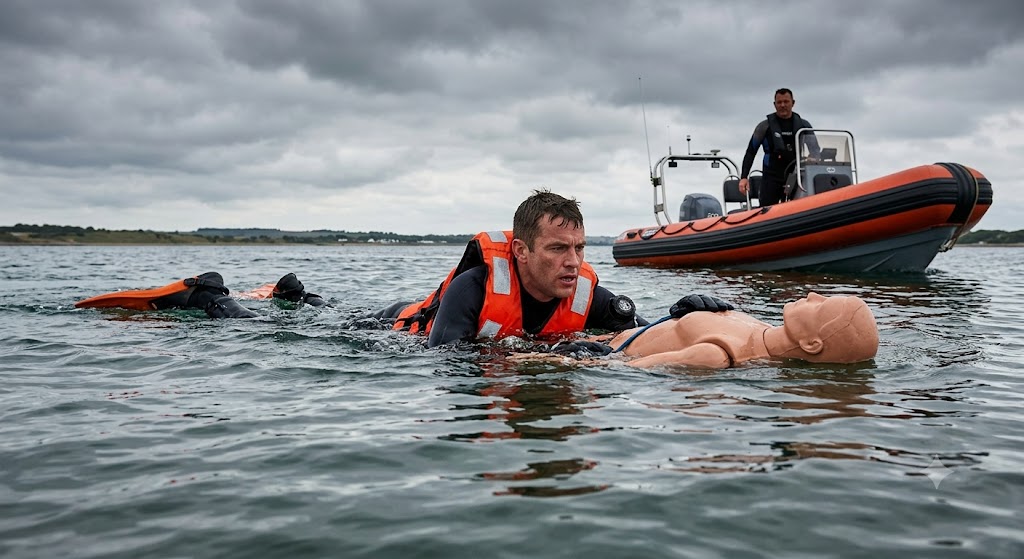
Additional Information
What the Course Entails and Exam Details
The comprehensive training program for Surface Rescue Swimmers covers critical skills needed for maritime search and rescue (SAR) operations. Candidates must master:
Advanced Water Survival & Conditioning: High-intensity swimming, treading water, and breath-hold exercises.
Rescue Techniques: Approaches to conscious and unconscious victims, disentanglement, and underwater search procedures.
Deployable Skills: Jumping from height, rappelling, and deploying from various platforms.
Emergency Medical Care: CPR, first aid, and specialized treatment for hypothermia and near-drowning.
Equipment Proficiency: Proper use of rescue harnesses, litters, masks, snorkels, and fins.
What to Expect in the Final Exam
While "practice exams" for this qualification often focus on the knowledge base (e.g., first aid protocols, navigation basic), the actual final certification is heavily focused on physical and practical performance. It is generally split into two main phases:
Physical Fitness Test (PFT): Candidates must meet or exceed strict standards for a 500-meter swim, push-ups, sit-ups, pull-ups, and a timed run. These standards are typically high and mandatory for progression.
Practical Evaluation: This is the core of the exam. Under the watchful eye of instructors, candidates must flawlessly execute a series of rescue scenarios in a controlled environment (e.g., a training pool or defined open water area). These scenarios test every practical skill learned, including victim recovery, medical assessment, and equipment operation.
To "pass," candidates must meet the minimum physical scores and demonstrate complete competency in all practical drills, adhering strictly to safety protocols. A failure in any safety-critical step often results in a disqualification.
How to Study and Exam Centers
Preparation for the Surface Rescue Swimmer certification requires an intensive, dual approach: physical conditioning and practical repetition.
Physical Preparation: Focus your training on endurance swimming (especially freestyle and sidestroke), core strength, and upper body endurance. Building high aerobic and anaerobic capacity is crucial. Practice the required PFT elements regularly.
Practical Skills: For those already in a training pipeline, take advantage of every pool and practical session. Repetition is key to mastering rescue techniques and remaining calm under pressure. Practice with the specific gear (fins, mask, harness) you will use during testing.
Official Guidance: Rely heavily on the official curriculum and guides provided by the training command (e.g., the US Navy or Coast Guard).
Exam Centers: The final evaluation does not take place at standard commercial testing sites like Pearson VUE. The Surface Rescue Swimmer certification and practical testing are conducted exclusively at specialized military training facilities, such as:
Naval Air Station Pensacola (US Navy)
Coast Guard Aviation Technical Training Center (USCG)
Specialized state or municipal fire and rescue academies for civilian first responders.
Job Opportunities from the Course
Earning the Surface Rescue Swimmer certification opens the door to critical and rewarding life-saving careers:
United States Navy Naval Aircrewman Tactical Helicopter (AIRR)
United States Coast Guard Aviation Survival Technician (AST)
Municipal Firefighter/Paramedic (Water Rescue Team Member)
Law Enforcement Tactical Water Rescue Officer
Offshore Oil Rig Rescue Specialist
Frequently Asked Questions
Reviews
5.0
Based on 0 reviews
Leave a Review
No reviews yet. Be the first to review!