
ACE THE 106 SURFACE OBSERVATION FUNDAMENTALS PRACTICE EXAM
$69.00
- Buy to unlock unlimited access to all Quiz questions.
- After purchase you can print a PDF of the whole quiz at any point. The PDF will contain the questions and the correct answers.
About this Exam
The 106 Surface Observation Fundamentals Practice Exam is a
crucial stepping stone for individuals aspiring to work in the field of
meteorology, aviation, and atmospheric science. This examination is designed to
test your knowledge and practical understanding of surface weather
observations, which are the backbone of weather forecasting, climate
monitoring, and aviation safety.
This certification is ideal for:
- Aviation
Professionals: Pilots, air traffic controllers, and airport operations
staff who need a thorough understanding of weather reports (METARs) and
observations.
- Aspiring
Meteorologists: Students and individuals looking to enter the field of
weather forecasting.
- Weather
Observers: Those looking to work for national weather services or
private weather companies.
- Environmental
Scientists: Professionals who rely on accurate weather data for
environmental studies and impact assessments.
Ready to test your knowledge?
Buy Now to Access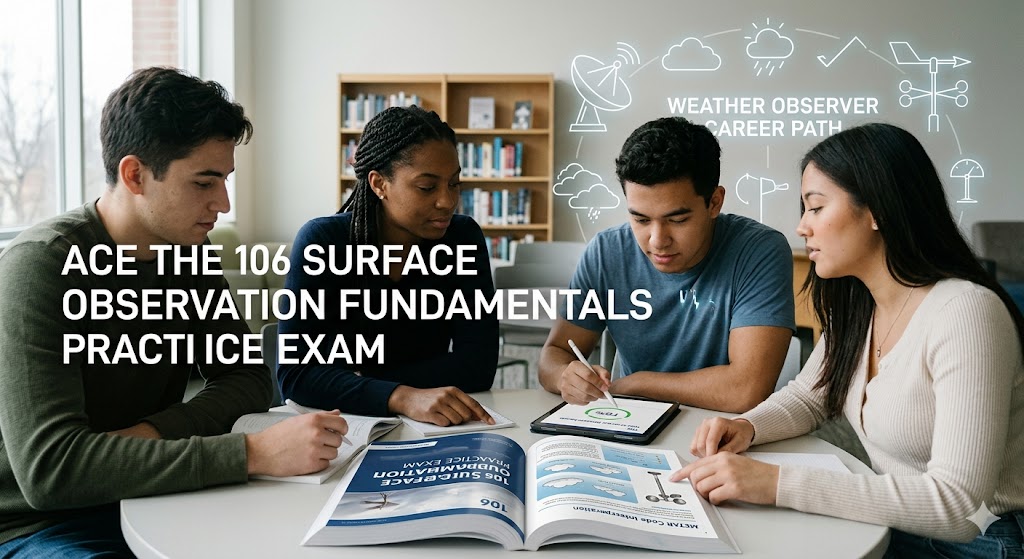
Additional Information
What the Course Entails and Exam Details
This examination is typically the culmination of a
comprehensive training program or self-study in surface observation techniques.
It covers the fundamental principles of meteorology and the standardized
methods for recording and reporting weather data.
Key Topics Covered:
- Cloud
Classification: Identifying different cloud types (cirrus, cumulus,
stratus, etc.), their characteristics, and reporting cloud cover.
- Precipitation
Types: Distinguishing between rain, snow, drizzle, hail, and other
forms of precipitation.
- Visibility:
Measuring and reporting atmospheric visibility in statute miles or
kilometers.
- Temperature
and Humidity: Correctly reading and recording temperature and dew
point from meteorological instruments.
- Wind
Observations: Determining wind speed and direction, as well as
reporting wind gusts.
- Atmospheric
Pressure: Measuring barometric pressure and understanding pressure
changes.
- Significant
Weather Phenomena: Recognizing and reporting weather events such as
thunderstorms, fog, haze, and lightning.
- METAR
and SPECI Reports: Decoding and encoding standardized weather messages
used in aviation.
What to Expect in the Final Exam
The 106 Surface Observation Fundamentals exam is generally
designed to assess your ability to apply theoretical knowledge to real-world
scenarios.
Exam Format:
- Multiple
Choice Questions: This is the most common format. Questions will test
your ability to recall definitions, identify meteorological phenomena from
descriptions or images, and solve problems related to weather reporting
codes.
- Scenario-Based
Questions: You may be presented with a hypothetical weather situation
and asked to provide the correct observation data or select the
appropriate action.
- Practical
Component (Depending on the Certifying Body): Some versions of the
exam, or the complete course that leads to it, might include a practical
demonstration of instrument reading and report encoding. The practice exam
itself is typically a written (digital) assessment.
Typical Details:
- Time
Limit: Usually 1-2 hours.
- Number
of Questions: Typically ranges from 50 to 100.
- Passing
Score: A passing grade is usually set between 70% and 80%.
How to Study and Exam Centers
Preparation is key to success on the 106 Surface Observation
Fundamentals exam. It requires a balanced approach of studying theory and
practicing application.
Effective Study Strategies:
- Master
the WMO and Local Manuals: Deeply study the official guides from the
World Meteorological Organization (WMO) and your local meteorological
service (e.g., NOAA in the US, Met Office in the UK). These contain the
official standards for observations.
- Practice
METAR Decoding Daily: Go online, find current METAR reports from
different airports, and decode them manually. Then, check your answers.
- Use
Digital Flashcards: Create flashcards for cloud types, precipitation
symbols, wind speed conversions, and visibility definitions.
- Simulate
Exam Conditions: Take a full-length 106 Surface Observation
Fundamentals Practice Exam without interruptions. This builds stamina and
helps manage time effectively.
Exam Centers and Testing Portals:
This exam is rarely a generalized, universally recognized
standard offered by a single body. It is typically part of a specific
organization's or agency's internal training program.
- Authorized
Training Providers: Accredited weather schools, aviation academies, or
meteorological training institutes (e.g., the NOAA training portal or the
FAA's integrated training system for aviation-specific observations).
- In-House
Exams: Often, the exam is administered by the employer (e.g., a
private weather observing contractor or an aviation ground services
company).
- Online
Portals: Many certifications can now be taken via secure online
proctored platforms or through the certifying body's own internal
web-based exam system.
Job Opportunities from the Course
Earning a certification that demonstrates mastery of surface
observation fundamentals opens doors to multiple career paths in fields that
depend heavily on accurate weather data.
Specific Job Titles:
|
Job Title |
Industry |
Description |
|
Meteorological Observer |
National Weather Service, Private Weather Companies |
Collecting and recording weather data at specific stations
for forecasting and climate monitoring. |
|
Aviation Meteorological Observer (AMO) |
Airports, Airlines, Civil Aviation Authorities |
Generating the critical METAR/SPECI reports that pilots
and air traffic controllers use for flight operations. |
|
Weather Forecaster (Entry-Level) |
Broadcasting, Research, Commercial Meteorology |
Using observation data to help analyze weather patterns
and create short-term forecasts. |
|
Air Traffic Controller |
Civil Aviation Authorities (e.g., FAA, NATS) |
Understanding weather data is essential for guiding air
traffic safely. |
|
Field Technician (Environmental) |
Research Institutions, Environmental Consulting Firms |
Maintaining and reading data from weather stations as part
of environmental impact studies. |
|
Port Weather Officer |
Marine Industry, National Meteorological Services |
Providing specialized marine weather observation and
reporting at commercial ports. |
Frequently Asked Questions
Reviews
5.0
Based on 0 reviews
Leave a Review
No reviews yet. Be the first to review!