
Surface Professional Apprenticeship Career Track (SPACT) Test 2 Practice
$69.00
- Buy to unlock unlimited access to all Quiz questions.
- After purchase you can print a PDF of the whole quiz at any point. The PDF will contain the questions and the correct answers.
About this Exam
The Surface Professional Apprenticeship Career Track (SPACT) is a vital pathway for undifferentiated enlisted personnel in the United States Navy to build a foundation for a successful career.
This unique program is designed for Sailors who have not yet selected a specific job specialty, known as a "rating."
Through S-PACT, you will gain invaluable hands-on experience on surface ships, learning the core principles of seamanship, basic engineering, damage control, and watchstanding.
The purpose of this 'Test 2' practice material is to focus on the advanced professional knowledge and critical thinking skills needed to move from an apprentice level to a specific, highly skilled rate.
It aims to simulate the cumulative knowledge and readiness required for selection into your desired career path.
Ready to test your knowledge?
Buy Now to Access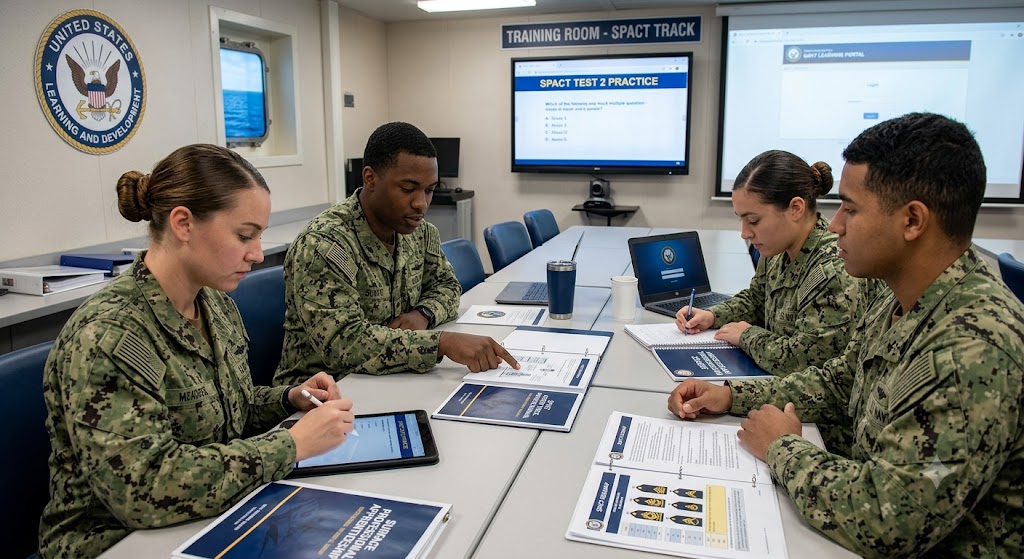
Additional Information
What the Course Entails and Exam Details
This phase of your professional journey doesn't involve a single classroom course, but rather, a comprehensive program of on-the-job training, official Navy correspondence courses, and a rigorous process called the Practical Qualification Standards (PQS).
You will build a diverse skill set that spans several core areas crucial to life and operations at sea.
Key topics you will master include:
Advanced Seamanship: Anchoring, mooring, underway replenishment, and complex line-handling procedures.
Engineering Basics: Introduction to primary propulsion systems, auxiliary systems, and electricity fundamentals.
Damage Control: Firefighting techniques, dewatering procedures, chemical, biological, and radiological (CBR) defense, and shoring.
Navigation and Watchstanding: In-depth understanding of the Rules of the Road, navigation chart work, and duties of various shipboard watches.
Surface Warfare Fundamentals: Familiarity with your ship’s combat systems, sensors, and basic tactics.
Leadership and Teamwork: Practical experience leading small teams in a dynamic, high-pressure environment.
Progression and final certification within the track are not determined by one external exam but through the accumulation of knowledge, the completion of dozens of specific PQS line items, and positive command recommendations.
What to Expect in the Final Exam
As an apprenticeship track, there is no single, external 'Final Exam' with a specific format, time limit, or score.
Instead, your success is measured by consistent performance and professional growth.
A practice 'Test 2' for S-PACT simulates the type of comprehensive, cumulative professional knowledge you must demonstrate to be deemed "rate-ready."
You should prepare for a comprehensive set of assessments that test both your understanding of the material and your ability to apply it.
This process will typically include:
Comprehensive Knowledge Reviews: These can be command-administered written tests, often involving multiple-choice and short-answer questions.
Practical Demonstrations (Check-rides): Senior enlisted leaders and officers will observe you performing critical tasks to ensure you are proficient in every PQS area, from firefighting to navigation.
Oral Boards: Formal, face-to-face interviews with a board of experienced senior personnel, where you will be tested on a wide range of surface warfare knowledge, Navy policy, and scenario-based decision-making.
Rate Selection Eligibility: Successfully navigating this phase of S-PACT determines your ability to "strike" (select and qualify) for a specific, desirable Navy Rating.
How to Study and Exam Centers
Preparation for success in S-PACT must be integrated into your daily work and requires dedication outside of regular duty hours.
There are no external commercial testing centers for this internal Navy track. All official assessments are conducted within your command or via official Navy systems.
Here are highly effective, actionable study strategies used by successful S-PACT Sailors:
Master the PQS: Make your Practical Qualification Standards manuals your bible. Do not just get signatures; truly understand the theory and the 'why' behind each task before you are qualified.
Utilize Navy E-Learning: Actively complete all required and recommended Navy E-Learning courses related to surface warfare, professional military education, and your targeted ratings.
Leverage 'Navy COOL': The Navy Credentialing Opportunities On-Line (COOL) website is an invaluable resource for researching different ratings, finding civilian equivalents, and locating professional study guides.
Find a Mentor: Actively seek guidance from a Chief Petty Officer (CPO) or a First Class Petty Officer (PO1) in a rating you are interested in. They have the experience to guide your professional development.
Participate in Shipboard Training: Never miss a damage control drill, a seamanship training session, or a general military training (GMT) class. These are your best opportunities for practical learning.
Take Command-Led Mock Boards: Request that your chain of command organize mock oral boards to help you build confidence and identify areas where you need to study more.
Job Opportunities from the Course
Upon successful completion of the Surface Professional Apprenticeship Career Track and passing your final reviews, you will be eligible to select, or "strike," for a wide variety of exciting and highly skilled Navy ratings.
Selecting a rating isn't just about a job title; it defines your entire career path, determining your specialized training, pay, promotion opportunities, and role within the Fleet.
The S-PACT program unlocks dozens of distinct careers, including these highly respected fields:
Boatswain's Mate (BM): The original Navy rating; experts in seamanship, navigation, and leadership of deck operations.
Operations Specialist (OS): The nerve center of the ship; operating sophisticated radar, navigation, and communication systems in the Combat Information Center (CIC).
Gunner's Mate (GM): Responsible for the operation, maintenance, and repair of the Navy's major weapon systems, from small arms to guided missiles.
Sonar Technician, Surface (STG): Detect, classify, and track underwater contacts (including submarines) using advanced SONAR technology.
Mineman (MN): Experts in underwater mine warfare, responsible for the assembly, testing, and deployment of mines and mine countermeasures.
Damage Controlman (DC): The ship's premier emergency response team; responsible for maintaining all firefighting and stability equipment and training the crew in survival.
Quartermaster (QM): The Captain’s assistants for safe navigation; experts in plotting courses, maintaining charts, and performing celestial and electronic navigation.
Culinary Specialist (CS): Vital for morale and logistics; managing food service operations for hundreds or thousands of sailors.
Frequently Asked Questions
Reviews
5.0
Based on 0 reviews
Leave a Review
No reviews yet. Be the first to review!