
Super Hornet Plane Captain Board Practice Test
$69.00
- Buy to unlock unlimited access to all Quiz questions.
- After purchase you can print a PDF of the whole quiz at any point. The PDF will contain the questions and the correct answers.
About this Exam
The Super Hornet Plane Captain (PC) qualification is one of the most critical and respected certifications on a Navy flight deck. This designation identifies sailors who have demonstrated the maturity, knowledge, and technical proficiency required to take charge of a multi-million dollar F/A-18E/F aircraft. The Plane Captain is the final set of eyes on the jet before launch, responsible for ensuring the aircraft is fundamentally safe for flight and safe for the aircrew.
This certification is designed for junior and mid-level Aviation Ordnancemen (AO), Aviation Machinist's Mates (AD), Aviation Electrician's Mates (AE), and other aviation ratings assigned to Super Hornet squadrons. Earning the PC designation is a prerequisite for advancing to more senior maintenance qualifications.
Ready to test your knowledge?
Buy Now to Access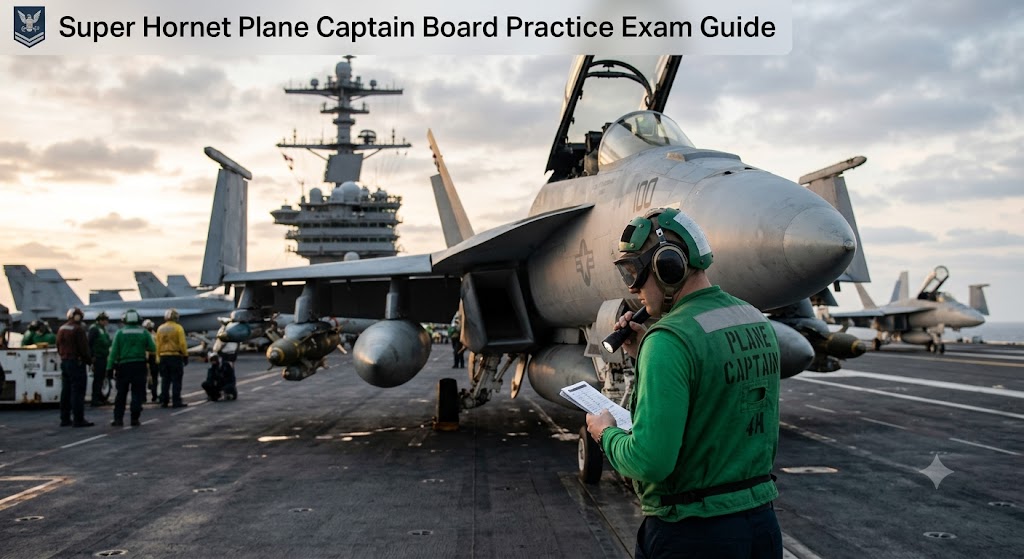
Additional Information
What the Course Entails and Exam Details
Preparing for the Plane Captain Board is a comprehensive process involving months of practical, on-the-job training (OJT) and self-study. There is no single "classroom course"; rather, it is a syllabus of practical qualifications (PQS) that must be signed off by qualified mentors.
The core competencies covered in this qualification include:
Aircraft Servicing: Proper procedures for fueling, de-fueling, and adding engine oil or hydraulic fluid.
Launch and Recovery Procedures: Mastering day and night flight deck hand signals.
Daily and Pre-flight Inspections: Conducting rigorous, visual inspections of the airframe, engines, landing gear, and flight controls for defects.
Emergency Procedures: Responding to flight deck emergencies, including fires (APU, brake, engine), hung ordnance, and medical emergencies.
Tool Control and FOD Prevention: Strict adherence to Foreign Object Damage (FOD) prevention programs.
Safety and PPE: Comprehensive knowledge of flight deck safety hazardous materials (HAZMAT), and proper wear of personal protective equipment.
What to Expect in the Final Exam
The culmination of the Plane Captain syllabus is the Plane Captain Board. It is important to understand that this is not a written, multiple-choice exam. It is an oral examination conducted by a panel of senior maintainers, typically including the Squadron Maintenance Officer (MO), the Maintenance Master Chief (MMCO), and Quality Assurance (QA) representatives.
Format: Oral Examination (Board). The panel will ask situational and technical questions based on the PQS and NAVAIR manuals.
Duration: The board typically lasts between 60 and 90 minutes.
Passing Requirements: There is no numerical score. The board is a "Pass/Fail" assessment of your confidence, knowledge depth, and, most importantly, your judgement. The board must be confident that you can make the correct decision under pressure when a pilot’s life is on the line.
Retakes: If a candidate fails the board, they are typically given a "murder board" (a practice run) and remedial training before they are allowed to look for a re-board, usually after a minimum waiting period (e.g., two weeks).
How to Study and Exam Centers
Studying for the Plane Captain qualification is a hands-on process that requires dedication.
Master the NAVAIR 01-1A-509: This is the primary manual detailing corrosion control and general aircraft servicing. Also study the specific Super Hornet Interactive Electronic Technical Manuals (IETMS) and the Plane Captain PQS (NAVEDTRA 43108 series).
Conduct Mock Boards: The best way to prepare for the pressure of the oral board is to practice. Ask your leading petty officers (LPOs) and Chief Petty Officers to conduct mock boards, asking difficult situational questions.
Practical Application: Don't just read the manuals; perform the inspections. Spend as much time as possible on the aircraft, learning the location of every component and inspection checkpoint.
Exam Centers: There are no commercial testing centers for this qualification. The "exam center" is your squadron's maintenance department. The board is convened at the discretion of your command leadership, usually in a squadron conference room or Maintenance Control.
Job Opportunities from the Course
Earning the Super Hornet Plane Captain designation is the "golden ticket" that unlocks advanced career paths within Naval Aviation maintenance.
Upon earning this qualification, sailors immediately take on the primary responsibility of launching and recovering aircraft. This certification is a required step toward subsequent advanced qualifications, including:
Collateral Duty Inspector (CDI): Qualifying to inspect and sign off on technical maintenance work completed by other technicians.
Quality Assurance Representative (QAR): Becoming a senior squadron inspector, responsible for the overall safety and compliance of all maintenance practices.
Maintenance Safe-for-Flight (SFF) Signatory: The ultimate maintenance qualification, authorizing a sailor to release the aircraft to the pilot as safe for flight.
Flight Deck Leading Petty Officer (LPO): Supervising all flight line operations and mentoring new Plane Captain candidates.
Frequently Asked Questions
Reviews
5.0
Based on 0 reviews
Leave a Review
No reviews yet. Be the first to review!