
SQA Higher Physics Practice Exam
$69.00
- Buy to unlock unlimited access to all Quiz questions.
- After purchase you can print a PDF of the whole quiz at any point. The PDF will contain the questions and the correct answers.
About this Exam
SQA Higher Physics is a prestigious qualification within the Scottish education system, bridging the gap between National 5 and Advanced Higher levels. Designed primarily for senior high school students (usually around 16-18 years old) with a strong interest in physical sciences, it provides a rigorous and in-depth understanding of the laws governing the universe. This course is an essential stepping stone for students intending to pursue careers or further studies in diverse fields, ranging from core physics and astrophysics to mechanical, civil, and electrical engineering. Its goal is to challenge and inspire the next generation of scientific minds.
Ready to test your knowledge?
Buy Now to Access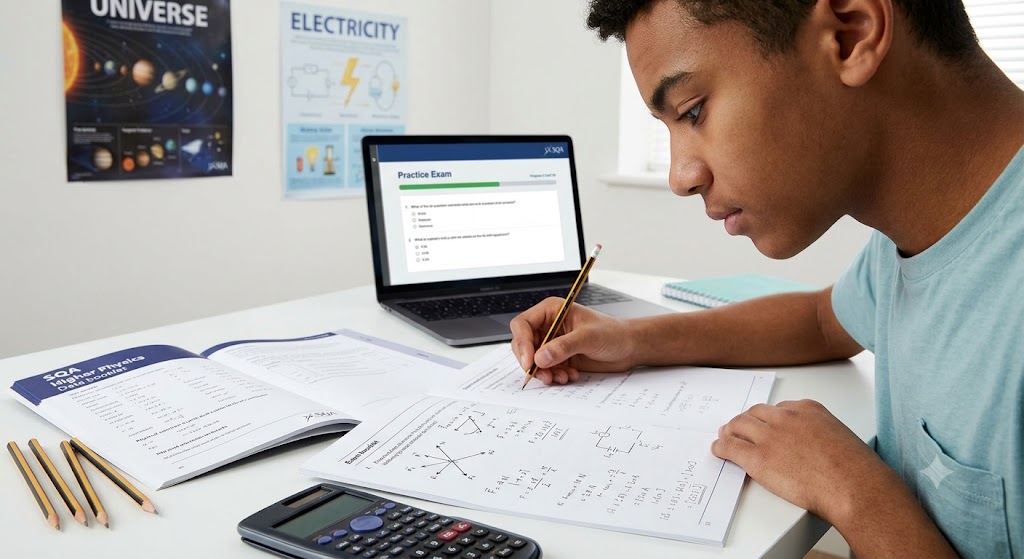
Additional Information
What the Course Entails and Exam Details
The SQA Higher Physics curriculum is extensive, structured to cultivate analytical reasoning, scientific inquiry, and strong mathematical problem-solving skills. Students explore several core units:
Dynamic Universe: Covering kinematics, dynamics, gravitation, and special relativity.
Particles and Waves: Investigating forces on charged particles, the standard model, nuclear reactions, spectra, wave properties, and the refractive index of light.
Electricity: Focusing on basic circuits, capacitors, voltage division, and electric fields.
Our Dynamic Universe (Researching Physics): A detailed study of astrophysical concepts and research methodologies.
The comprehensive exam tests your deep comprehension of these key topics. The practice exam you are engaging with is a simulation of the core assessment which evaluates theoretical knowledge and numerical application. However, the final official grade for the SQA Higher is not solely derived from this exam. It also includes a Course Assignment, which is a practical investigation and report, typically marked by the SQA. The overall achievement is based on a combined score.
What to Expect in the Final Exam
The core exam itself is typically composed of multiple papers, but often presents in a format similar to this:
Section 1: Multiple-Choice (approx. 25 marks): Testing a wide breadth of understanding with quick-response questions.
Section 2: Structured Questions (approx. 130 marks): Requiring detailed written answers, diagrams, and complex numerical problem-solving.
Total Marks: Often around 155 for the main written assessment.
Passing Score: The exam is dynamically marked. Grade boundaries (A, B, C, D) are determined after all results are reviewed, aiming to ensure consistency each year. A solid performance across both the exam and the assignment is critical for high grades.
Time Limits: Typically 2.5 hours are allocated for both sections combined. Efficient time management is vital.
Rules: Students must follow strict SQA exam conditions. All necessary data, including a data booklet with formulas and physical constants, is provided, making effective navigation of this resource a mandatory skill for success.
How to Study and Exam Centers
Succeeding in the SQA Higher Physics demands a structured and focused study strategy.
Master the Data Booklet: Know which formulas are provided and where to find them instantly. This prevents wasted time in the actual exam.
Practice with Past Papers: This is the most effective study method. Utilize official SQA past papers and marking schemes. Attempt them under timed conditions to build speed and accuracy.
Focus on Concepts: Do not just memorize formulas. Understand why and how they are derived and when to apply them in different scenarios.
Practice Numerical Problems: Higher Physics is mathematically intensive. Ensure you are fluent in converting units, rearranging formulas, and applying trigonometric and algebraic principles.
Review the Syllabus Regularly: Use a specification checklist to track your progress through all course units.
As for taking the final exam, it is not administered at general, public testing centers. Instead, it is an integrated part of the Scottish school curriculum. Candidates take the exam in their respective authorized secondary schools and colleges. Students are registered by their school or college, and the exams are supervised by internal staff and external SQA invigilators.
Job Opportunities from the Course
Achieving an SQA Higher in Physics is not a direct path to a single job. It is a powerful "unlocker" that is essential for progressing into competitive higher education degrees and subsequent careers. This qualification is a prerequisite for advanced study in many technical sectors.
Here are some of the diverse fields it leads to:
Engineering: This path opens doors to careers as a Civil Engineer, Mechanical Engineer, Electrical/Electronics Engineer, Software Engineer, or Aerospace Engineer, all requiring a solid foundation in physics.
Core Sciences: Essential for pursuing further study and research in Physics, Astrophysics, Particle Physics, or Material Science.
Computer and Data Science: The strong analytical and problem-solving skills honed in Higher Physics are highly valued in technological roles like Data Analyst, Software Developer, or AI Researcher.
Medical and Life Sciences: Critical for careers as a Medical Physicist, managing radiation therapy or advanced imaging technologies, or for studies in optometry or dentistry.
Education and Academia: The qualification is a step toward becoming a Physics teacher, professor, or researcher.
Technician and Applied Roles: With further technical qualifications, it provides the knowledge needed for complex technician roles in aerospace, manufacturing, or power generation.
Frequently Asked Questions
Reviews
5.0
Based on 0 reviews
Leave a Review
No reviews yet. Be the first to review!