
CEODD Dive Physics Practice Exam
$69.00
- Buy to unlock unlimited access to all Quiz questions.
- After purchase you can print a PDF of the whole quiz at any point. The PDF will contain the questions and the correct answers.
About this Exam
The CEODD Dive Physics Certification is a cornerstone for professionals in the commercial and scientific diving sectors, validating critical knowledge for safety and complex operations. This rigorous practice exam is specifically designed for diving candidates, medical professionals (like Diving Medical Technicians), and supervisory personnel who must master the physics behind underwater environments and hyperbaric medicine. Earning this certification demonstrates a deep understanding of gas behaviors, pressure effects, and thermodynamic principles, proving you possess the complex analytical skills required to make critical, real-time decisions in demanding underwater contexts.
Ready to test your knowledge?
Buy Now to Access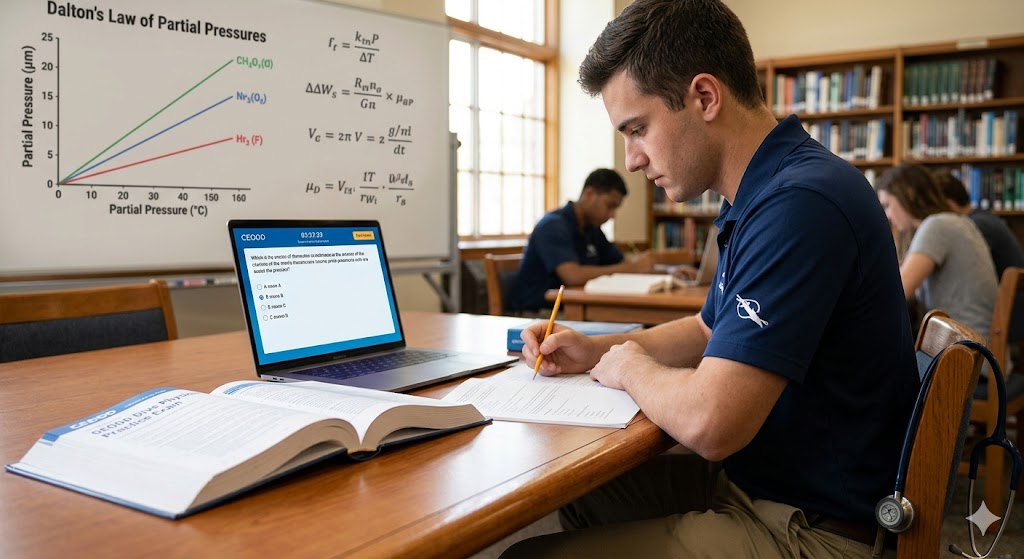
Additional Information
What the Course Entails and Exam Details
This specialized exam focuses intently on the mathematics and physical laws that govern the diving environment, requiring rapid, accurate calculations. The syllabus for the CEODD Dive Physics Practice Exam is challenging but essential.
Candidates are typically tested on:
Gas Laws: Boyle’s Law (pressure and volume), Dalton’s Law (partial pressures), Charles’s Law (temperature and volume), Henry’s Law (gas absorption), and General Gas Law applications.
Pressure and Buoyancy: Ambient pressure calculations (gauge vs. absolute), partial pressure problems, and Archimedes’ principle.
Physiological Effects: Applying gas physics to physiological responses (e.g., decompression sickness, gas toxicities at depth).
Thermodynamics: Practical application of heat transfer in hyperbaric chambers and gas storage.
Mixed Gas Physics: Advanced calculations for Nitrox, Heliox, and Trimix mixing and analysis.
What to Expect in the Final Exam
The actual final exam for the CEODD Dive Physics Certification is a controlled, high-stakes assessment that usually serves as a critical prerequisite for advanced roles.
Here’s what you should prepare for:
Format: Typically administered as a multiple-choice examination. Questions are often multi-part problems that require translating word scenarios into specific formulas.
Question Count: Expect between 50 and 75 specialized physics questions.
Passing Score: The required passing score is generally 75% or higher on this specific physics module.
Time Limit: Candidates are usually allotted 2 hours to complete the examination.
Specific Rules: Most versions of the exam allow an approved, basic, non-programmable calculator, but formula sheets and outside materials are strictly prohibited, demanding complete formula memorization.
How to Study and Exam Centers
Preparation for the CEODD Dive Physics Practice Exam must be structured and mathematically rigorous. Passive reading is insufficient; active problem-solving is the key to success. Actionable strategies include taking the official CEODD Dive Physics Practice Exam repeatedly to simulate the test environment and identify knowledge gaps, creating exhaustive flashcards for all key physics formulas, and reviewing relevant chapters in standard textbooks like the U.S. Navy Diving Manual.
The final exam is administered in professional testing environments. Candidates typically register for the test through authorized portals managed by the certifying organization. These exams are often available via secure online proctoring, allowing you to test remotely. Alternatively, physical examination centers, such as Pearson VUE locations, or authorized commercial and military diving schools, are used for physical, proctored testing. Always confirm current, approved testing locations directly with the official certifying body.
Job Opportunities from the Course
A CEODD Dive Physics Certification is not just a safety requirement; it is a vital credential that distinguishes professionals in highly technical fields. This specific certification unlocks advanced job opportunities where expertise in hyperbaric physics is paramount.
Career paths and roles that value this certification include:
Commercial Diver (especially Saturation Diving)
Diving Medical Technician (DMT)
Scientific Diver
Hyperbaric Chamber Technician
Diving Supervisor
Offshore Safety Officer
Regulatory Inspector (Diving)
Military Dive Specialist
Frequently Asked Questions
Reviews
5.0
Based on 0 reviews
Leave a Review
No reviews yet. Be the first to review!