
SQA Higher Chemistry Practice Exam
$69.00
- Buy to unlock unlimited access to all Quiz questions.
- After purchase you can print a PDF of the whole quiz at any point. The PDF will contain the questions and the correct answers.
About this Exam
The Scottish Qualifications Authority (SQA) Higher Chemistry course is an advanced secondary qualification designed for students who have successfully completed National 5 Chemistry or equivalent. This course is specifically built for young scientists who want to deepen their understanding of chemical theories, explore practical applications, and develop their investigative skills. It provides the foundational knowledge necessary for progression into Further and Higher Education, unlocking opportunities in degrees such as medicine, engineering, pure sciences, and countless others. Taking an SQA Higher Chemistry Practice Exam is not just about testing your knowledge; it's about simulating the actual test conditions to build stamina, refine your timing, and reduce anxiety before the high-stakes final assessment.
Ready to test your knowledge?
Buy Now to Access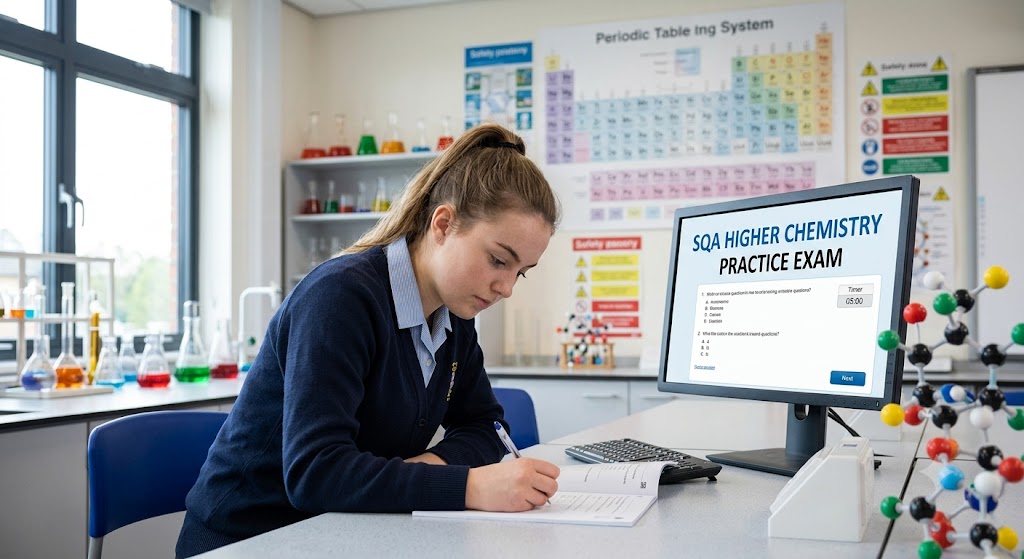
Additional Information
What the Course Entails and Exam Details
The SQA Higher Chemistry course provides a comprehensive exploration of key chemical principles. The current curriculum is structured around three main units, which are tested in the final examination:
Chemical Changes and Structure: This unit focuses on key concepts of chemical kinetics and periodicity, structure, and bonding, enabling students to understand and predict chemical behavior based on fundamental particle interactions.
Nature's Chemistry: Students will explore the world of organic chemistry, including compounds found in nature, systematic carbon chemistry, alcohols, esters, and proteins, connecting the world around us to the chemistry that drives it.
Chemistry in Society: This unit investigates the applications of chemistry in industrial processes, the concept of the mole, and techniques used to calculate manufacturing yields, equilibria, and reaction rates, with a strong focus on practical techniques and analytical skills.
Throughout these units, the course develops vital transferable skills, including experimental design, critical evaluation of data, problem-solving, and scientific communication. A dedicated SQA Higher Chemistry Practice Exam must contain questions that accurately represent all three units and test this broad spectrum of skills, ensuring your preparation is exhaustive.
What to Expect in the Final Exam
The SQA Higher Chemistry final external assessment is not one test, but multiple components that contribute to your overall grade. To achieve a comprehensive preparation, a valid SQA Higher Chemistry Practice Exam should replicate this structure as closely as possible. The external assessment consists of:
Question Paper 1 (Multiple Choice): This paper contains 25 independent multiple-choice questions, covering content from all three main units. You will have 40 minutes to complete this paper, and it is worth 25 marks (approximately 21% of your final grade). The time pressure on this paper is intense, so practicing for it with a timed simulation is crucial.
Question Paper 2 (Extended Response): This is the longer, more challenging paper. It contains extended-response and free-response questions that require in-depth explanations, calculations, and the application of knowledge to novel scenarios. You will have 2 hours and 20 minutes to complete this paper, which is worth 95 marks (approximately 79% of your final grade).
Coursework Assignment: In addition to the external papers, students must complete an independent scientific assignment, which is externally marked and makes up about 20% of the total final grade. This is a separate practical investigation done during the course.
The combined marks from Paper 1 and Paper 2 dictate your exam result. To pass, you typically need to achieve around a certain percentage of the combined total, but grade boundaries are set annually by the SQA based on that year's performance. Timing on Paper 2, in particular, requires careful management, a skill that can only be mastered through repetitive, full-length SQA Higher Chemistry Practice Exam sessions.
How to Study and Exam Centers
Preparing for Higher Chemistry demands more than just re-reading notes. Effective study strategies are essential for success. Here are actionable methods that work:
Timing Practice Exams: This is non-negotiable. Don't just answer questions; answer them within the strict SQA time limits. This builds essential exam-taking stamina and ensures you know when to move on from a difficult question. Use any high-quality SQA Higher Chemistry Practice Exam as a simulation.
Use the SQA Past Paper Bank: The SQA's official website holds five years of past papers and their official marking instructions. Use these extensively. They are the gold standard for practice materials and provide the closest possible experience to the official exam. Analyze the marking instructions to understand exactly what examiners are looking for.
Active Recall with Flashcards: Don't passively review. Create flashcards for key definitions, equations, the functional groups of organic molecules, and industrial processes. Test yourself regularly.
Focus on the SQA Data Booklet: You are provided with a data booklet in the final exam. Learn how to use it efficiently to find periodic table data, relative atomic masses, and other vital information quickly. A good SQA Higher Chemistry Practice Exam will provide you with a digital or physical copy to use during the simulation.
Identify and Bridge Knowledge Gaps: After completing a practice test, use the marking scheme to identify the exact topics where you struggled. Go back to your textbook, notes, or a teacher to re-learn that material before attempting another paper.
Exam Centers and Registration:
You do not take the official SQA Higher Chemistry final exam online or in private Pearson VUE test centers. Because it is a qualification for school-age students in Scotland, the exams are administered by the SQA and are almost always taken at the physical location where you studied the course: either your secondary school or a further education college. Private candidates must be sponsored by an SQA-approved center to sit the examination. You must be registered by your school or college, so always discuss your examination arrangements directly with your course provider. Accessing the SQA Higher Chemistry Practice Exam materials, however, is flexible; they can be found online through various educational platforms, school department websites, or in dedicated revision guides.
Job Opportunities from the Course
While many students take Higher Chemistry to access university, the qualification itself signifies a strong aptitude in science, analytical thinking, and quantitative skills, which are highly valued by a wide range of employers. It is an ideal entry point for modern apprenticeships and foundational roles in the following careers:
Chemist (Analytical, Medicinal, Environmental, or Industrial)
Chemical Engineer
Pharmacist / Pharmacy Technician
Research Scientist (in academia or industry)
Forensic Scientist / Crime Scene Investigator
Environmental Consultant / Environmental Scientist
Biotechnologist / Microbiologist
Teacher (Secondary School Science or Chemistry)
Science Writer / Communicator
Food Scientist / Technologist
Radiology Technician / Laboratory Technician
For those planning further study, SQA Higher Chemistry is a core requirement for a vast array of degrees, including Medicine, Dentistry, Veterinary Medicine, Pharmacology, Biochemistry, Chemical Engineering, and all pure and applied chemistry fields. Succeeding on your SQA Higher Chemistry Practice Exam is the first, crucial step toward this inspiring professional future.
Frequently Asked Questions
Reviews
5.0
Based on 0 reviews
Leave a Review
No reviews yet. Be the first to review!