
A Level Chemistry OCR Practice Exam
$69.00
- Buy to unlock unlimited access to all Quiz questions.
- After purchase you can print a PDF of the whole quiz at any point. The PDF will contain the questions and the correct answers.
About this Exam
The A Level Chemistry OCR specification is a challenging and
rewarding qualification designed for students in the UK and internationally who
aim to excel in science-based fields or secure entry into competitive
university courses. This rigorous course explores the fundamental principles of
chemistry, including atomic structure, chemical bonding, organic reactions,
thermodynamics, and analytical techniques. Achieving a high grade is essential
for pursuing careers in medicine, pharmacy, chemical engineering, and research.
The A Level Chemistry OCR Practice Exam serves as crucial
preparation, allowing candidates to assess their understanding, build
confidence, and identify key areas for revision. It simulates the real exam
environment, testing both knowledge recall and the application of complex
scientific concepts. Utilizing this practice exam is an invaluable step for any
student committed to maximizing their potential in the final assessment.
Ready to test your knowledge?
Buy Now to Access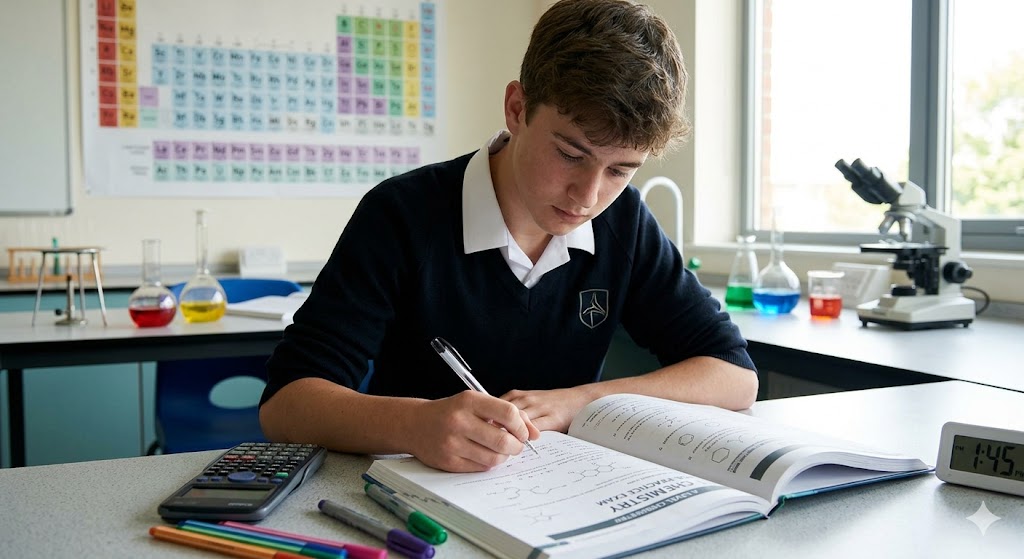
Additional Information
What the Course Entails and Exam Details
The A Level Chemistry OCR course is divided into a series of
modules that build upon foundational knowledge. Students will develop deep
theoretical understanding alongside practical skills that are essential for any
chemist.
Core topics typically covered include:
- Foundations
in Chemistry: Atomic structure, bonding, quantitative chemistry (moles
and calculations).
- The
Periodic Table and Energy: Trends, periodicity, qualitative analysis,
enthalpy, and redox.
- Core
Organic Chemistry: Hydrocarbons, alcohols, halogenoalkanes, and basic
synthetic routes.
- Physical
Chemistry and Transition Elements: Rates, equilibrium, pH, buffers,
redox potentials, entropy, and complex ions.
- Organic
Chemistry and Analysis: Carbonyls, carboxylic acids, aromatic
compounds, amines, amino acids, polymers, synthesis, and modern analytical
techniques (NMR, IR, MS).
The final assessment tests students' ability to recall
information, solve mathematical problems, analyze data, and evaluate practical
procedures. Practical skills are also assessed throughout the course via a
Practical Endorsement (a separate pass/fail element based on experimental work
performed throughout the two years), but written papers also contain questions
on practical applications.
What to Expect in the Final Exam
For the linear A Level qualification, students typically sit
three separate written papers at the end of their final year. The structure
usually follows a format similar to this:
Paper 1: Periodic Table, Elements and Physical Chemistry
- Assesses:
Specific core modules (e.g., Foundations, Periodic Table, Physical
Chemistry and Transition Elements).
- Format:
A mix of multiple-choice and structured, longer-answer questions.
- Weighting
& Duration: Often around 37% of the final mark and lasting 2 hours
15 minutes.
Paper 2: Synthesis and Analytical Techniques
- Assesses:
Specific core modules (e.g., Foundations, Core Organic, Organic and
Analysis).
- Format:
Similar to Paper 1, combining multiple-choice with structured response
questions.
- Weighting
& Duration: Often around 37% of the final mark and lasting 2 hours
15 minutes.
Paper 3: Unified Chemistry
- Assesses:
Content from across the entire syllabus. This paper tests synthesis
of knowledge from different modules and synoptic understanding.
- Format:
Structured, longer-answer questions focusing on comprehensive
understanding and practical applications.
- Weighting
& Duration: Often around 26% of the final mark and lasting 1 hour
30 minutes.
Grade boundaries for passing scores (A* to E) vary annually
based on the performance of all candidates, so there is no fixed percentage to
guarantee a specific grade. Excellent mathematical ability and strong practical
skills are essential for achieving higher marks across all papers.
How to Study and Exam Centers
Successfully preparing for the A Level Chemistry OCR exam
requires a dedicated and multifaceted approach. Strong performance in a
practice exam should be a key milestone in this process.
Top Study Strategies:
- Understand
the Specification: Download the official OCR syllabus and use it as a
checklist to ensure every topic is covered during revision.
- Practice
with Past Papers: Complete as many previous real exam papers and mark
schemes as possible. This is the most effective way to understand the
exam's style, time management, and exactly what examiners are looking for.
- Use
Active Recall: Create flashcards (using apps like Anki or physically)
for definitions, equations, reaction conditions, and color changes. Test
yourself frequently.
- Master
Calculations: Practice mole calculations, equilibrium constants, pH
determinations, and titration calculations regularly. Mathematics often
accounts for a significant portion of marks.
- Draw
Diagrams: Practice drawing skeletal structures, reaction mechanisms
with curly arrows, and experimental setups clearly.
- Review
Practical Work: Ensure you fully understand the key experiments you
performed throughout the course. Be ready to evaluate methods, explain
procedures, and analyze resulting data in written questions.
Exam Centers:
Students typically take the actual A Level Chemistry OCR
exams in person at their registered school, college, or an authorized private
examination center.
For home-schooled students or private candidates, the
process involves finding an OCR-approved exam center well in advance. These can
be located through the OCR website or lists provided by government educational
services. Private candidates are responsible for all associated fees and must
register within set deadlines. The final formal examinations cannot be taken
via an online portal or remotely.
Job Opportunities from the Course
Achieving a strong grade in A Level Chemistry OCR is highly
valued and opens doors to a vast range of prestigious and lucrative career
paths. Many of these careers require further specialized study at the degree
level, for which this qualification is typically a mandatory entry requirement.
Key job opportunities and fields unlocked by this course
include:
- Medicine:
Doctor, Surgeon, General Practitioner, Specialist Physician.
- Dentistry:
Dentist, Orthodontist.
- Pharmacy
& Pharmacology: Pharmacist (Community or Hospital),
Pharmacologist, Drug Developer.
- Chemical
Engineering: Process Engineer, Chemical Plant Manager.
- Research
& Development: Academic Researcher (University), Industrial
Chemist, Biotechnologist.
- Analytical
Chemistry: Forensic Scientist, Quality Control Analyst, Toxicologist.
- Material
Science: Developing new materials for electronics, aerospace, and
energy storage.
- Healthcare
Science: Biomedical Scientist, Clinical Biochemist.
- Environmental
Science: Environmental Consultant, Water Quality Analyst, Conservation
Scientist.
- Education:
Chemistry Teacher (Secondary School or College), Science Communicator.
- Other
Fields: Patent Attorney (requiring a science background), Science
Writer/Journalist. The analytical and logical skills developed are also
highly valued in sectors like finance, management, and law.
Frequently Asked Questions
Reviews
5.0
Based on 0 reviews
Leave a Review
No reviews yet. Be the first to review!