
SNHD EMS Protocol Exam EMT Basic Level Practice Exam
$69.00
- Buy to unlock unlimited access to all Quiz questions.
- After purchase you can print a PDF of the whole quiz at any point. The PDF will contain the questions and the correct answers.
About this Exam
The SNHD EMS Protocol Exam for EMT-Basics is a critical stepping stone for anyone who has completed their initial EMT-Basic certification and wishes to operate within the Southern Nevada Health District. This examination is designed to verify that entry-level EMS providers possess the specific, up-to-date knowledge required to administer medical care according to the unique protocols established for Clark County and the surrounding areas. It is tailored exclusively for EMT-Basics, ensuring they understand the limitations, procedures, and standing orders that define their scope of practice when serving the Southern Nevada community.
Ready to test your knowledge?
Buy Now to Access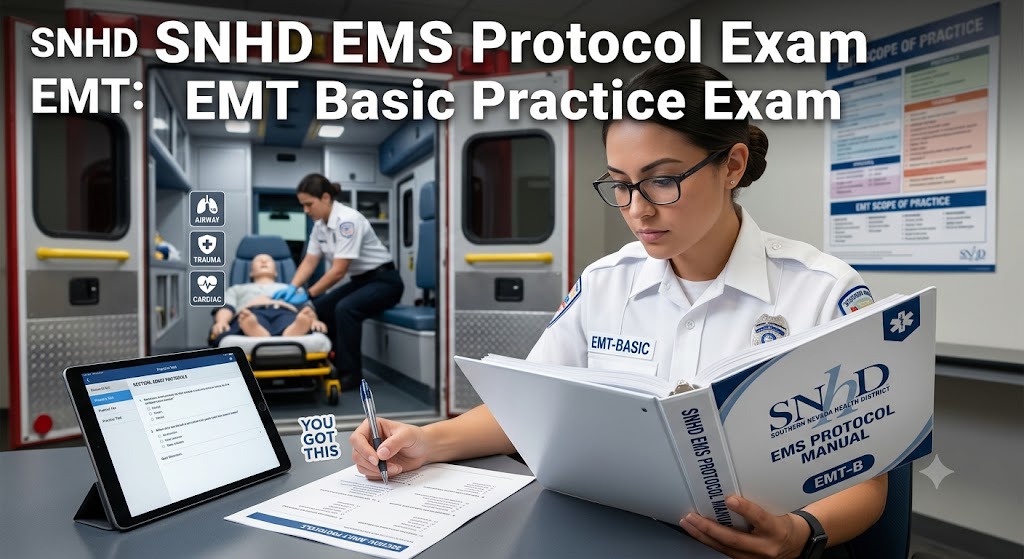
Additional Information
What the Course Entails and Exam Details
This examination focuses entirely on the content of the official Clark County EMS System Emergency Medical Care Protocols manual. Mastering this information is essential. The core topics, syllabus, and skills covered are extensive and critical, including, but not limited to:
Adult and Pediatric Treatment Protocols: Detailed pathways for managing a wide array of medical emergencies, from cardiac arrest and respiratory distress to trauma and environmental injuries.
Operations Protocols: Guidelines on scene management, communications, patient destination decisions, and documentation.
Procedures Protocols: Specific steps for performing authorized EMT-Basic skills, such as airway management, spinal motion restriction, and bleeding control.
Formulary: The complete list of medications EMT-Basics are authorized to administer, including indications, dosages, and routes.
What to Expect in the Final Exam
The SNHD EMS Protocol Exam for EMT-Basic level is typically a multiple-choice examination. While specific rules can vary slightly depending on the testing entity, students should expect a scenario-based or knowledge-direct format. A passing score is strictly enforced, often set at 80% or higher for all levels of licensure.
The examination is usually computer-based. Students must be prepared to answer questions that test not just rote memorization, but the ability to apply the protocols to real-world patient care scenarios. According to SNHD information, applicants are allowed three attempts to pass. If the third attempt is unsuccessful, remedial training with a Clark County endorsed EMS Instructor is required before any further attempts, which are capped at six.
How to Study and Exam Centers
Effective study requires immersive and consistent application. We recommend a multi-faceted approach:
Official SNHD Protocol Manual: The single most important resource is the current edition of the Clark County EMS System Emergency Medical Care Protocols, available on the SNHD website. Read it cover-to-cover and understand every detail.
Practice Exams: Utilize official SNHD practice materials, endorsed study guides, or high-quality simulators, like this one, to identify knowledge gaps.
Flashcards and Scenario-Based Practice: Create flashcards for dosages and procedure key points. Practice scenarios with peer EMTs, requiring them to state the specific SNHD protocol phrase or number for each decision.
Testing for the SNHD EMS Protocol Exam usually takes place at approved locations in Southern Nevada. This includes:
Authorized EMS Agencies: If you are being hired, your new employer might administer the test.
Educational Institutions: Entities like the College of Southern Nevada (CSN) or other approved private EMS training centers often facilitate testing.
SNHD Main Facility: At 280 S. Decatur Blvd., Las Vegas, NV. Check their website for current availability and scheduling.
Job Opportunities from the Course
Mastery of the SNHD EMS protocols and passing this exam are prerequisites to obtaining your attendant license, unlocking specific employment pathways within Southern Nevada. The knowledge validated by this certification opens doors to several high-impact roles, such as:
911 Emergency Medical Technician-Basic: Responding to emergency calls, providing immediate pre-hospital care, and transporting patients.
Private Ambulance EMT-Basic: Working for inter-facility transport companies.
Fire Department EMT-Basic: Often part of dual-role fire and EMS agencies.
Special Event EMT: Providing medical coverage at sports venues, concerts, and conventions.
Hospital Emergency Room Technician (ER Tech): Assisting in a busy hospital setting, often with specific SNHD-related duties for receiving EMS traffic.
Casino EMT/Security Officer: Dual-role positions in the hospitality industry, a common path in the Las Vegas area.
Frequently Asked Questions
Reviews
5.0
Based on 0 reviews
Leave a Review
No reviews yet. Be the first to review!