
ServSafe Practice Test Chapter 9 – Safe Facilities and Pest Management.
$69.00
- Buy to unlock unlimited access to all Quiz questions.
- After purchase you can print a PDF of the whole quiz at any point. The PDF will contain the questions and the correct answers.
About this Exam
The ServSafe Food Protection Manager Certification is the industry standard for food safety, recognized by more jurisdictions than any other. It is designed specifically for managers and supervisors within the foodservice and hospitality industry, equipping them with the essential knowledge to protect public health and prevent foodborne illness outbreaks. This certification demonstrates a high level of understanding of food safety principles, from personal hygiene to facility management. The practice test for Chapter 9, "Safe Facilities and Pest Management," is an invaluable study tool for candidates preparing to take the comprehensive, final ServSafe Food Protection Manager Exam. It focuses on the crucial environmental factors that can impact the safety of food preparation.
Ready to test your knowledge?
Buy Now to Access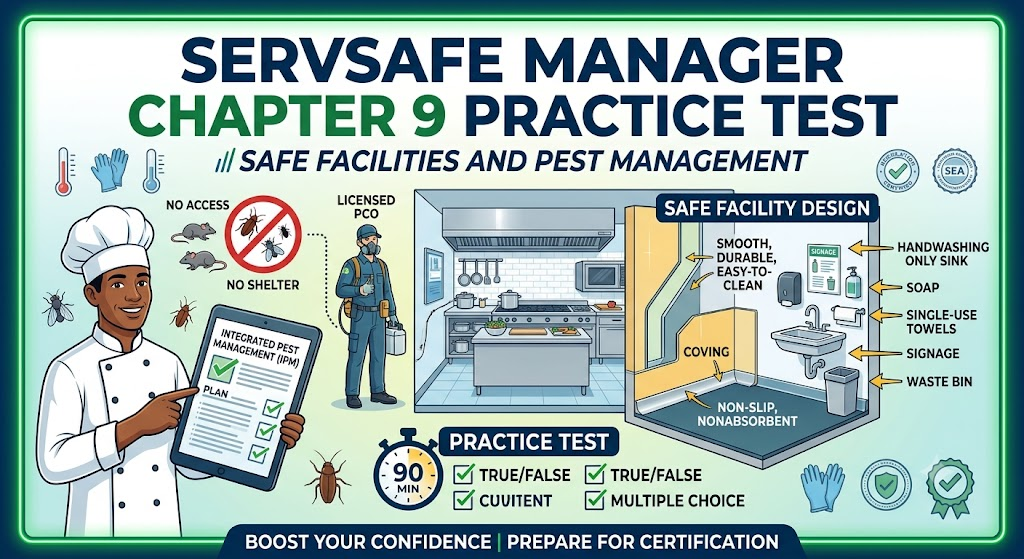
Additional Information
What the Course Entails and Exam Details
The comprehensive ServSafe Manager course covers a wide range of topics that are critical to running a safe and compliant food operation. The central themes include the microbiology of foodborne illness, the proper flow of food—from purchasing and receiving to preparation, service, and storage—employee training, and active managerial control principles like HACCP. When preparing with a study guide for Chapter 9, candidates drill down into the intricate details of maintaining a safe facility and preventing pest infestations. The course details for this specific segment involve understanding:
Facility Design: Creating a kitchen layout that supports safe food practices, including guidelines for smooth, durable, and easy-to-clean floors, walls, and ceilings.
Equipment Standards: Selecting and installing food-contact and non-food-contact equipment that is nonabsorbent, corrosion-resistant, and installed correctly (e.g., six inches off the floor or sealed) for thorough cleaning.
Handwashing Stations: The exact requirements for the location and contents of mandatory handwashing sinks to ensure employee compliance.
Utilities: Requirements for safe water supply, electricity, gas, sewage disposal, and the prevention of backflow.
Lighting and Ventilation: Standards for appropriate lighting intensity to promote cleaning and ventilation systems to prevent grease and condensation buildup.
Pest Management: The principles of Integrated Pest Management (IPM), including the three fundamental rules: deny pests access, deny them food, water, and shelter, and work with a licensed Pest Control Operator (PCO).
What to Expect in the Final Exam
While the Chapter 9 practice test is an excellent way to gauge your knowledge on this specific topic, it is crucial to understand the structure of the final, official ServSafe Food Protection Manager Exam. The real certification exam is a comprehensive assessment covering all 10 chapters of the ServSafe Manager curriculum. It is a closed-book, multiple-choice exam consisting of 90 questions. Out of these 90, 80 are scored questions, while 10 are unscored, "pilot" questions used to evaluate the test items themselves; you will not know which is which. To successfully earn your certification, you must achieve a minimum passing score of 75 percent. Candidates are given a time limit of two hours to complete the exam. The questions are frequently scenario-based, requiring you to apply your food safety knowledge to real-world situations, rather than simply recalling definitions. The final exam must be administered by a registered ServSafe Instructor or Proctor.
How to Study and Exam Centers
Effective preparation is key to passing the ServSafe Manager Exam on your first attempt. Utilize the Chapter 9 practice test iteratively, not just once; this will help you identify weak points and solidify your understanding of facility design and pest control rules. To maximize your study efforts, read the entire ServSafe Manager textbook, focusing on the concepts rather than just memorization. Pay close attention to scenario-based questions in study materials, as these mirror the actual exam format. Many candidates benefit from full-length, timed practice tests that cover the entire curriculum. Once you are confident in your knowledge, you need to schedule your official exam through a authorized channel. ServSafe exams can be taken via:
Registered ServSafe Instructors: Many community colleges, vocational schools, and industry associations offer instructor-led classes followed by the proctored exam.
Pearson VUE Testing Centers: You can take the online exam in a controlled environment at one of thousands of Pearson VUE locations globally.
Online Remote Proctoring: Service providers such as ProctorU allow you to take the online exam from your home or office, provided you meet the technical and environmental requirements for a remote proctor.
Job Opportunities from the Course
Earning the ServSafe Food Protection Manager Certification is a decisive step that unlocks numerous career advancement opportunities within the vast hospitality and foodservice sector. This credential is often a prerequisite for management roles, as it demonstrates a commitment to regulatory compliance and guest safety. By successfully completing the course and exam, you become qualified for positions with significant responsibility. The following is a list of job titles and career paths that a ServSafe Manager Certification can help you unlock:
Restaurant Manager
Kitchen Manager
General Manager
Banquet Manager
Food & Beverage Director
Catering Manager
Executive Chef
Sous Chef
Food Service Director (in healthcare or corporate settings)
Hospitality Supervisor
Food Safety Auditor
Franchise Owner
Cafeteria Manager
Dietary Manager
Frequently Asked Questions
Reviews
5.0
Based on 0 reviews
Leave a Review
No reviews yet. Be the first to review!