
School Bus Pre‑Trip Inspection Practice Test
$69.00
- Buy to unlock unlimited access to all Quiz questions.
- After purchase you can print a PDF of the whole quiz at any point. The PDF will contain the questions and the correct answers.
About this Exam
The School Bus Pre‑Trip Inspection is a critical component of obtaining a Commercial Driver's License (CDL) with a School Bus (S) endorsement, often in conjunction with a Passenger (P) endorsement and Air Brake qualification. It is designed for aspiring school bus drivers, existing CDL holders adding the 'S' endorsement, and individual transportation providers who wish to prove their competence in ensuring the safety of children. This practice test prepares you for the rigorous visual and practical skills examination where you must demonstrate your ability to identify and verbalize the condition of a vehicle's crucial components before it goes into service, adhering to stringent Federal Motor Carrier Safety Regulations (FMCSRs) and state-specific guidelines. A correct pre-trip inspection is not just a test; it is the first line of defense for student safety every single day.
Ready to test your knowledge?
Buy Now to Access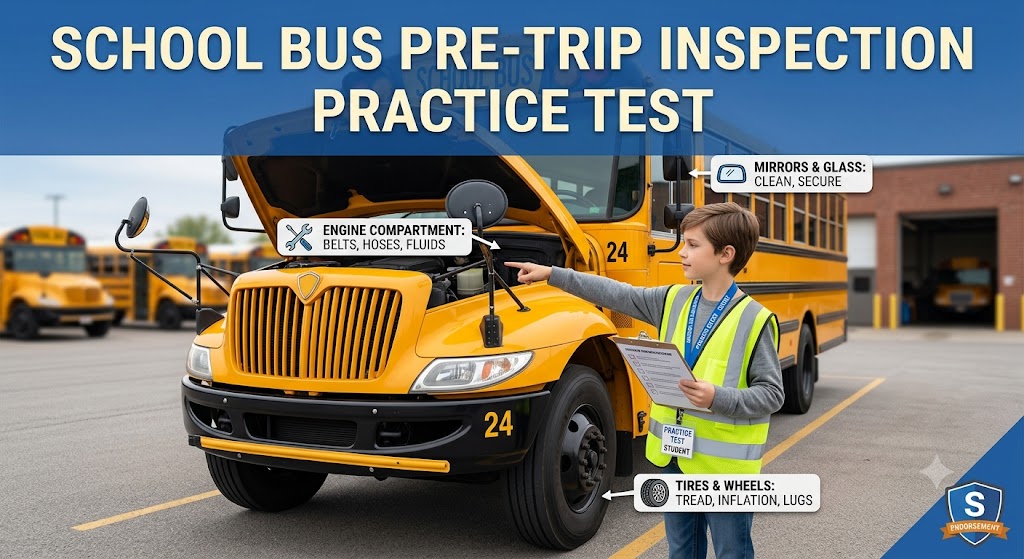
Additional Information
What the Course Entails and Exam Details
While distinct, the knowledge from a school bus driver training course and the skills tested in the pre-trip inspection are highly integrated. The course typically entails both theoretical study (CDL manual) and extensive behind-the-wheel practice. The Pre‑Trip Inspection Practice Test mirrors the final skills examination, covering the comprehensive list of components you must inspect.
The core areas of a "full form" school bus pre-trip inspection include:
Engine Compartment: Fluid levels (oil, coolant, power steering, windshield washer), leaks, condition of all belts (fan, alternator, water pump, air compressor, if applicable), hoses, wiring, and steering linkage.
Front of Vehicle: Lights, lenses, and windshield.
Suspension (Front and Rear): Springs, spring mounts, shock absorbers, U-bolts, and airbags (if equipped).
Braking System (Front and Rear): Drums, linings, chambers, hoses, and slack adjusters (including identifying manual or automatic).
Tires and Wheels (All Axles): Tread depth (e.g., 4/32” front, 2/32” rear), inflation pressure, sidewall condition, rims, lug nuts, and hub oil seals.
Side of Vehicle: Mirrors, doors, fuel tank, and frame.
Rear of Vehicle: Lights, lenses, and emergency exit.
School Bus Specifics: The 8-way warning light system (alternately flashing amber and red lights), student mirrors, stop arm, crossing gate, and first-aid/body fluid cleanup kits.
In-Cab and Safe Start: Verification of gauges, horns, heaters/defrosters, windshield wipers, seatbelts, and a full demonstration of the Air Brake System Check (Static Leak, Applied Leak, Low Air Warning, and Emergency Spring Brake Pop-Out) which is mandatory for passing.
The exam details are that this is not a written test. It is a one-on-one physical skills test where you must "walk, point, touch, and verbalize."
What to Expect in the Final Exam
When you arrive at the testing site for your final examination, you should expect a structured, formal assessment. It is the first section of your three-part CDL skills test (followed by Basic Control Skills and the Road Test). If you fail the pre-trip, you cannot proceed to the next parts.
Format: A practical evaluation. You will perform the inspection on a school bus while an examiner, holding a formal score sheet, observes and listens.
Verbalization is Key: You must clearly name every component you inspect and describe its condition, using the correct terminology. It is not enough to just look; you must state, "The alternator is securely mounted, not cracked or broken, and the belt has no more than ¾ inch of play."
Required Sequences: You must perform the engine compartment, in-cab (including the air brake check), and a pre-determined walk-around form (Form A, B, C, or Full), determined randomly or by your testing center. The in-cab air brake check has zero tolerance for error and must be performed in the correct order to avoid an automatic failure.
Time Limits: While there isn't a strict "time's up" buzzer, examiners assess efficiency. You should aim to complete a full, detailed inspection (depending on the form) within 30 to 45 minutes, without rushing or omitting parts.
Passing Score: The exam is scored on a points system based on correct identification and description of key safety items. In many jurisdictions, to pass, you must earn approximately 80% to 100% of the possible points, with critical "must-have" items (like steering and air brakes) requiring perfect execution.
How to Study and Exam Centers
Preparation for the pre-trip is all about memory and repetition. You cannot "cram" a physical skill.
Actionable Study Strategies:
Master the CDL Manual: The official state CDL manual is your Bible. Photocopy or print the pre-trip section and convert it into a personalized checklist.
Use Acronyms: Develop mnemonic devices. For rubber, use ABCL (Abrasions, Bulges, Cuts, Leaks). For metal, use BBC (Bent, Broken, Cracked) or BBCM (plus Securely Mounted). For brakes, use CABS (Chambers, Air Hoses, Brake Drums, Slack Adjusters).
Practice with an Actual Bus: This is essential. Go to your training location or garage. Use your checklist. Walk the vehicle, touch every part, and say the descriptions out loud every time.
Record Yourself: Video or audio record yourself performing a mock test. Compare it to study guides to find your gaps and stutter points.
Simulate the In-Cab: Even without a bus, sit in a chair and practice the in-cab air brake sequence. Announce every step: "Now, I am building air pressure to governor cut-out..."
Practice with a Partner: Have a fellow student act as the examiner. Switching roles forces you to think about what a correct answer sounds like.
Exam Centers:
The final, official skills exam is administered by your state’s Department of Motor Vehicles (DMV) or its equivalent (e.g., Department of Public Safety, Bureau of Motor Vehicles).
Testing is conducted at specific CDL testing locations or authorized third-party testers, which often include certified truck and bus driving schools.
You must schedule an appointment in advance. Ensure you bring all required documentation, your commercial learner's permit (CLP), and a safe, representative school bus for the test.
Job Opportunities from the Course
A school bus driver's role is complex and involves much more than just driving. Successfully mastering the pre-trip inspection, as proven by your practice and final exam, is the fundamental requirement for multiple career paths. Proficiency here leads to job security in a growing field.
Your CDL with a School Bus Endorsement unlocks these opportunities:
School Bus Driver (Public and Private): The most direct path. Drivers are needed for daily routes (morning and afternoon), mid-day runs, and specialized runs.
Activities/Field Trip Driver: Focuses specifically on transporting students for athletic events, educational field trips, and competitions.
Shuttle Bus Driver: Operates smaller shuttle buses for school districts, private academies, or university systems, handling routes that do not require a full 65-passenger bus but still fall under school bus regulations.
Bus Mechanic/Inspector (Intermediate): Many maintenance departments require mechanics and inspector staff to have an 'S' endorsement so they can perform mandated, periodic, and comprehensive annual safety inspections, as well as test-drive and recover vehicles.
Driver Trainer/Examiner: After gaining experience, you can advance to a role where you train new drivers or become a certified examiner for school bus skills tests, including the pre-trip.
Pupil Transportation Supervisor: The management side of school transportation, where understanding the practical side of pre-trip inspections is vital for managing safety compliance, fleet maintenance, and driver performance.
Frequently Asked Questions
Reviews
5.0
Based on 0 reviews
Leave a Review
No reviews yet. Be the first to review!