
Schleswig Holstein Zentralabitur Exam Prep | Germany
$69.00
- Buy to unlock unlimited access to all Quiz questions.
- After purchase you can print a PDF of the whole quiz at any point. The PDF will contain the questions and the correct answers.
About this Exam
The Zentralabitur in Schleswig-Holstein is the standardized final examination that leads to the German Hochschulreife (the Abitur).
This prestigious qualification is the primary prerequisite for admission to universities and universities of applied sciences throughout Germany.
It is designed for students completing their upper secondary education at a Gymnasium or Gesamtschule, typically around ages 18-19.
Achieving the Abitur is a significant academic milestone, marking the culmination of school education and opening doors to further academic and professional opportunities.
Ready to test your knowledge?
Buy Now to Access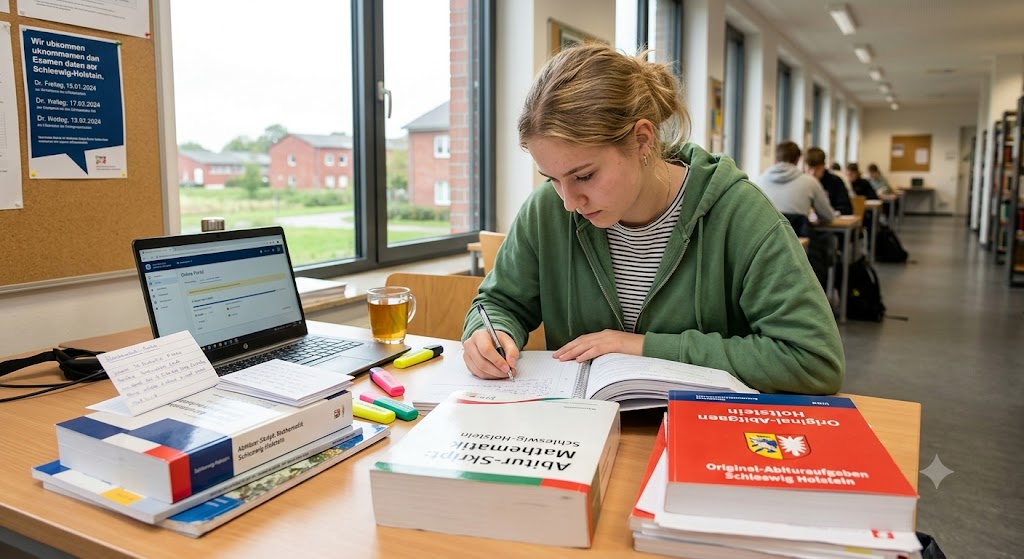
Additional Information
What the Course Entails and Exam Details
Preparation for the Zentralabitur isn’t a single "course" but the entire two-to-three-year upper secondary phase (known as the Qualifikationsphase).
During this time, students choose specialization subjects (Leistungskurse) and basic subjects (Grundkurse) across various fields, including German, mathematics, foreign languages, natural sciences (physics, chemistry, biology), and social sciences (history, geography, politics).
The Abitur examination itself assesses comprehension and analytical skills in four or five specific subjects, reflecting the state-wide curriculum and educational standards set by the Ministry of Education in Schleswig-Holstein.
What to Expect in the Final Exam
The final Zentralabitur assessment consists of a combination of centralized written examinations and decentralized school-based assessments (including oral exams).
Students typically take written exams in their two Leistungskurse and one Grundkurs.
These written exams are comprehensive, lasting several hours each, and usually involve complex essay questions, problem-solving tasks, or source analysis.
A fourth or fifth subject is typically assessed via a mandatory oral exam (Präsentationsprüfung or classical Mündliche Prüfung), which evaluates verbal communication and in-depth knowledge in a specific topic.
The final Abiturnote (overall grade point average) is calculated based on points accumulated over the last two years of school plus the scores from these final exams.
How to Study and Exam Centers
Success in the Zentralabitur requires a structured and consistent study plan.
Key strategies include actively participating in classes and thoroughly reviewing all coursework materials.
Analyzing and solving past exam papers (Original-Abituraufgaben) is crucial, as this familiarizes students with the expected format, question types, and time constraints.
Utilizing official preparation books (like those from Stark Verlag) and online resources provided by the Institute for Quality Development in Schools Schleswig-Holstein (IQSH) is highly recommended.
Form study groups with classmates to discuss complex topics.
The written and oral Abitur examinations are administered locally at the students' respective high schools (Gymnasien or Gesamtschulen) under standardized state regulations.
Job Opportunities from the Course
While the Abitur itself is an academic qualification rather than direct vocational training, achieving it unlocks vast career and educational possibilities.
The Hochschulreife is the standard entry requirement for undergraduate degree programs (Bachelor’s) at all German universities and universities of applied sciences in every discipline, from medicine and law to engineering, business, and humanities.
It also grants access to competitive dual vocational training programs (Duales Studium), which combine university studies with practical work experience at leading companies.
The analytical and critical thinking skills developed while preparing for the Abitur are highly valued in any professional environment.
Frequently Asked Questions
Reviews
5.0
Based on 0 reviews
Leave a Review
No reviews yet. Be the first to review!