
SBOLC Security Fundamentals Practice Test
$69.00
- Buy to unlock unlimited access to all Quiz questions.
- After purchase you can print a PDF of the whole quiz at any point. The PDF will contain the questions and the correct answers.
About this Exam
The Signal Basic Officer Leaders Course (SBOLC) Security Fundamentals segment is a vital training component designed for newly commissioned United States Army Signal Officers. This course equips these leaders with the essential cybersecurity knowledge and practical skills required to plan, install, operate, and, most importantly, secure the Army's portion of the Department of Defense Information Network (DoDIN). Successful completion validates an officer’s foundational ability to protect sensitive military information and maintain the integrity of critical communications systems in diverse and challenging operational environments.
Ready to test your knowledge?
Buy Now to Access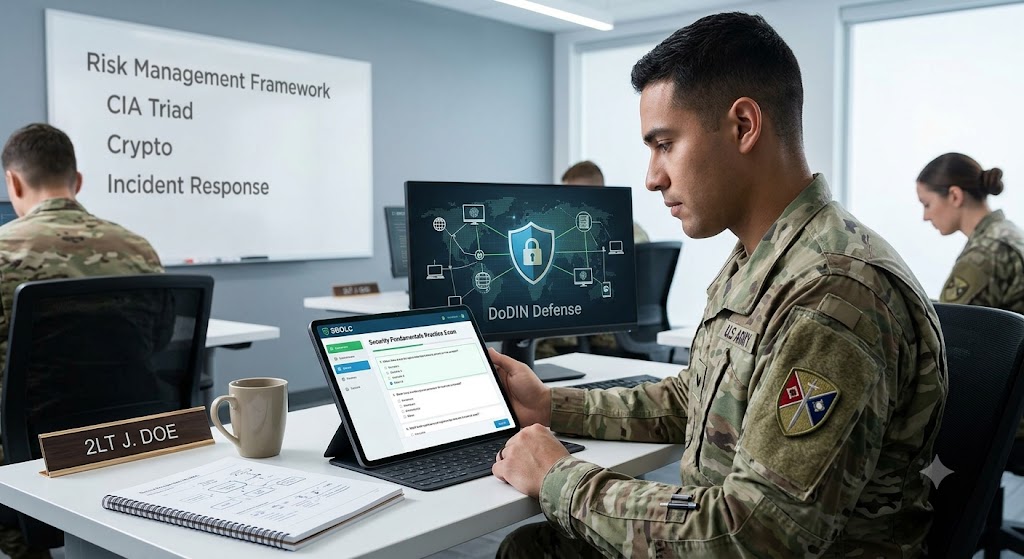
Additional Information
What the Course Entails and Exam Details
The SBOLC Security Fundamentals curriculum focuses heavily on established Department of Defense (DoD) cybersecurity directives and information assurance principles. Key areas covered include the implementation of the Risk Management Framework (RMF), understanding the principles of the CIA Triad (Confidentiality, Integrity, and Availability), mastering network security architecture and secure protocols, and the deployment of identity and access management (IAM) systems. The course ensures officers can identify and analyze modern cyber threats, implement effective security controls, and manage incident response procedures in accordance with Army regulations. It also places a strong emphasis on compliance with the DoDI 8570.01-M requirements, ensuring all personnel have the necessary certifications for their designated cybersecurity roles.
What to Expect in the Final Exam
The final evaluation for SBOLC Security Fundamentals is a rigorous assessment of both theoretical knowledge and practical application. Students should prepare for a comprehensive exam that includes a high volume of multiple-choice and scenario-based questions requiring the analysis of realistic security dilemmas. Additionally, a significant portion may feature performance-based questions, where candidates must use virtual labs or simulated interfaces to configure security settings, analyze network traffic, or troubleshoot a security vulnerability. The exam typically enforces a strict time limit, often around 90 to 120 minutes, with a high passing score threshold to ensure mastery. Candidates must adhere to all official testing protocols, including the prohibition of unauthorized materials and maintaining the academic integrity expected of a military officer.
How to Study and Exam Centers
Effective preparation for this exam requires a strategic approach. Candidates should prioritize the systematic review of all official SBOLC course materials, technical manuals, and DoD information assurance publications. Utilizing multiple high-quality practice tests is crucial to build speed and accuracy while identifying specific knowledge gaps. Candidates must dedicate time to hands-on practice within the provided virtual lab environments to ensure confidence in performance-based tasks. The official examination is administered within controlled military training facilities or at authorized Pearson VUE testing centers for commercial certifications that may be substituted, such as CompTIA Security+. Officers must schedule their exams in advance through their chain of command or designated testing coordinators.
Job Opportunities from the Course
Graduating from SBOLC with a strong foundation in security fundamentals is a critical step that unlocks a variety of key leadership positions within the Army Signal Corps and the broader joint force. The skills acquired are directly applicable to numerous roles, enabling officers to lead teams responsible for the army's most sensitive cyber infrastructure. The certification often acts as a prerequisite for additional advanced cybersecurity training and certifications, such as CISSP or CISM.
Signal Operations Officer (25A)
Information Assurance Manager (IAM)
Network Operations Officer
Cybersecurity Officer
Cyber Warfare Officer (17A - with branch transfer)
S6 Officer (Battalion or Brigade Level)
DoD Cybersecurity Contractor
Frequently Asked Questions
Reviews
5.0
Based on 0 reviews
Leave a Review
No reviews yet. Be the first to review!