
Safety Council Module 1-8 Practice Test
$69.00
- Buy to unlock unlimited access to all Quiz questions.
- After purchase you can print a PDF of the whole quiz at any point. The PDF will contain the questions and the correct answers.
About this Exam
The Safety Council Module 1-8 Practice Test is designed for individuals seeking to validate their knowledge of fundamental safety principles, often as part of a multi-module professional certification program.
This comprehensive curriculum is a benchmark for employees, supervisors, and managers across various industries, including transportation, manufacturing, and construction. It ensures a standardized level of safety competence, focusing on critical areas such as hazard recognition, risk assessment, and defensive practices. Whether you are aiming for a defensive driving certificate or an occupational health and safety credential, this test confirms you have mastered the essential core knowledge required to prevent accidents and promote a culture of safety within your organization.
Ready to test your knowledge?
Buy Now to Access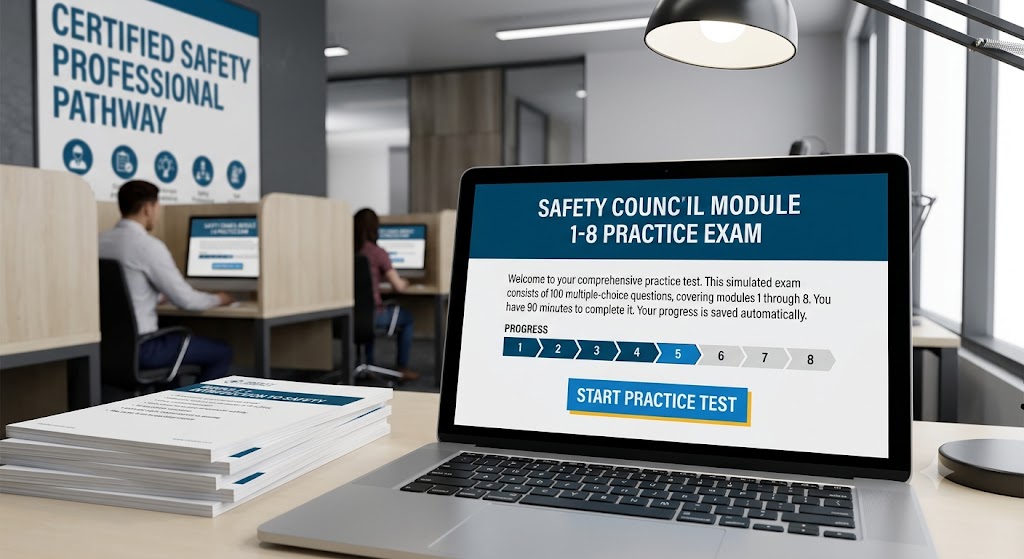
Additional Information
What the Course Entails and Exam Details
This modular training program typically divides extensive safety knowledge into eight focused, manageable units, providing a deep dive into crucial topics.
A standardized Safety Council Module 1-8 course might cover the following core areas:
Module 1: Introduction to Safety and Hazard Recognition — Foundations of safety management and identification of workplace/environmental hazards.
Module 2: Speed Management and Defensive Driving Principles — Techniques for managing speed in all conditions and avoiding preventable collisions.
Module 3: Intersections and Right-of-Way — Safe navigation of intersections and proper right-of-way procedures.
Module 4: Lane Management and Safe Passing — Best practices for maintaining lane discipline and performing safe maneuvers.
Module 5: Avoiding Impaired and Distracted Driving — The impact of substances and distractions, and strategies to remain focused.
Module 6: Avoiding Aggressive and Fatigued Driving — Recognizing and managing behaviors that increase risk on the road or job.
Module 7: Weather and Road Conditions — Adapting driving and working practices to adverse environmental challenges.
Module 8: Backing, Parking Lot Strategies, and Fixed Object Collision Prevention — Techniques for safe slow-speed maneuvering and preventing common object strikes.
What to Expect in the Final Exam
The final step in your certification journey, the core assessment, tests your comprehensive understanding of all eight modules.
While specific formats may vary by the issuing Safety Council, candidates can generally expect:
Exam Format: A proctored, computer-based exam consisting of multiple-choice questions.
Number of Questions: Between 50 and 100 questions, covering all eight modules proportionally.
Passing Score: Typically 80% or higher. Some programs may require a minimum score on individual modules before the cumulative score is considered.
Time Limit: You will usually have a set time, such as 60 to 90 minutes, to complete the exam.
Rules: The exam is closed-book. Electronic devices are not permitted, and strict identification verification is enforced.
How to Study and Exam Centers
Preparation is the key to success. A structured study plan will help you recall complex information under pressure.
Actionable Study Strategies:
Review the Official Study Guide: Your course-provided materials are your best resource. Dedicate focused time to every module.
Create a Modular Study Schedule: Break your preparation into segments, spending equal time on each of the eight modules. Do not rush.
Take Multiple Practice Tests: Use simulated exams like this practice test to familiarize yourself with the question style and time constraints. Focus on your weakest areas.
Teach a Concept: Explaining safety principles, such as intersection rules or the effects of fatigue, to another person reinforces your own understanding.
Review Incorrect Answers: Understand why an answer is correct, not just that you missed it. This deepens conceptual learning.
Exam Centers:
You can complete the final exam in two primary ways:
Online Portals: Many professional Safety Councils offer the option to take the exam remotely through a secured, proctored online learning management system (LMS).
Authorized Physical Centers: You may also take the exam in person at a designated testing center, which can include local Safety Council offices, partner educational institutions, or authorized schools.
Check with your course provider to find the authorized testing methods available to you.
Job Opportunities from the Course
A Safety Council Module 1-8 certification is highly valued and opens doors to various safety-focused career paths. The specialized knowledge and recognized credential make you a strong candidate for positions across multiple sectors.
This certification is particularly beneficial for, and often unlocks, the following roles:
Commercial Driver (e.g., Delivery, Long-Haul, specialized transport)
Fleet Manager or Coordinator
Occupational Health and Safety (OHS) Assistant or Coordinator
Warehouse or Distribution Supervisor
Construction Site Safety Officer
Transit or Bus Driver
Risk Management Analyst
Safety Training Instructor
The structured modular knowledge gained is adaptable, positioning you for growth and leadership in any organization that prioritizes employee well-being and regulatory compliance.
Frequently Asked Questions
Reviews
5.0
Based on 0 reviews
Leave a Review
No reviews yet. Be the first to review!