
SACA Motor Control Practice Exam
$69.00
- Buy to unlock unlimited access to all Quiz questions.
- After purchase you can print a PDF of the whole quiz at any point. The PDF will contain the questions and the correct answers.
About this Exam
The SACA (Smart Automation Certification Alliance) Motor Control certification is a crucial industry credential designed for students and professionals seeking to validate their knowledge in industrial motor systems. This certification confirms an individual's competency in understanding, installing, and troubleshooting fundamental electric motors, motor control circuits, and dynamic braking systems. It is ideally suited for technicians, engineers, maintenance personnel, and students enrolled in advanced manufacturing or industrial technology programs who need a recognized standard to advance their careers in automated environments.
Ready to test your knowledge?
Buy Now to Access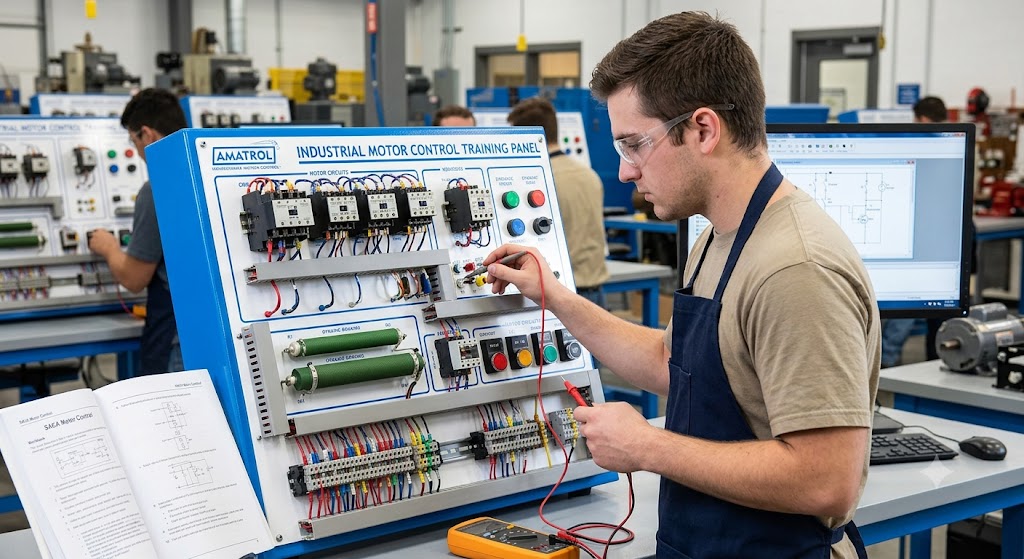
Additional Information
What the Course Entails and Exam Details
The SACA Motor Control course, or the knowledge covered by this certification, entails a deep dive into electrical safety, motor theory, and advanced control configurations. Candidates must master a diverse syllabus that covers the selection and installation of standard industrial motors and controllers. Key topics include understanding the operation of DC motors, single-phase AC motors, and three-phase AC motors. You will learn about basic control circuits using pushbuttons, selector switches, and relays, as well as complex logic control. A critical component involves troubleshooting dynamic and regenerative braking systems, and understanding the integration of motor control with modern automation systems like PLCs and networked drives. The course details the specific requirements for identifying components, interpreting electrical schematics, and performing hands-on wiring of motor circuits to meet industry standards.
What to Expect in the Final Exam
The final SACA Motor Control examination is designed to be a rigorous assessment of practical application and technical knowledge. Candidates can expect a hybrid format involving both a timed multi-choice assessment and a practical hands-on evaluation. The practical portion is a significant differentiator for SACA certifications, requiring you to demonstrate your skills on a real-world motor control trainer, often under the observation of a proctor. You might be asked to wire a complex three-phase reverse-start circuit or diagnose a fault in a safety interlock system. The passing score varies but generally reflects a high level of proficiency, typically requiring at least 80% to achieve the SACA 'Silver' level, and higher for gold. Strict adherence to safety protocols is mandatory, and failure to observe safety during the practical component often results in automatic disqualification.
How to Study and Exam Centers
Effectively preparing for the SACA Motor Control exam requires a balance of theory and practical practice. To study successfully, we recommend:
Mastering the official SACA curriculum and review guides provided by your educational institution.
Spending extensive time on a motor control training system, practicing the wiring, configuration, and troubleshooting of all core circuit types repeatedly.
Forming study groups to discuss complex motor logic and practice circuit building under timed conditions.
Utilizing online simulations of circuit faults to enhance your diagnostic skills.
Reviewing all safety procedures and lockout/tagout (LOTO) protocols until they are second nature.
The SACA Motor Control exams are administered primarily through authorized SACA testing centers, often located within participating high schools, community colleges, technical schools, and universities. Many centers utilize specific, approved training hardware for the practical assessment.
Job Opportunities from the Course
Achieving the SACA Motor Control certification significantly enhances your resume and opens doors to diverse career paths in advanced manufacturing, logistics, and automated systems maintenance. It validates essential skills that employers value in dynamic technical environments. The career paths this certification unlocks include:
Industrial Maintenance Technician
Automation Technician
Electromechanical Technician
Electrical Maintenance Worker
Mechatronics Specialist
Plant Maintenance Engineer
Robot Maintenance Technician
Equipment Installation Specialist
Control Systems Technician
Maintenance Supervisor (with experience)
Frequently Asked Questions
Reviews
5.0
Based on 0 reviews
Leave a Review
No reviews yet. Be the first to review!