
SACA Electric Motor Control Systems 1 (C-202) Practice Test
$69.00
- Buy to unlock unlimited access to all Quiz questions.
- After purchase you can print a PDF of the whole quiz at any point. The PDF will contain the questions and the correct answers.
About this Exam
The SACA Electric Motor Control Systems 1 (C-202) certification validates an individual's ability to operate, install, analyze, and troubleshoot basic AC electric motor control circuits. This exam is specifically designed for industrial maintenance technicians, mechatronics engineers, and students in advanced manufacturing programs who need to demonstrate job-ready competencies in controlling industrial motors.
Ready to test your knowledge?
Buy Now to Access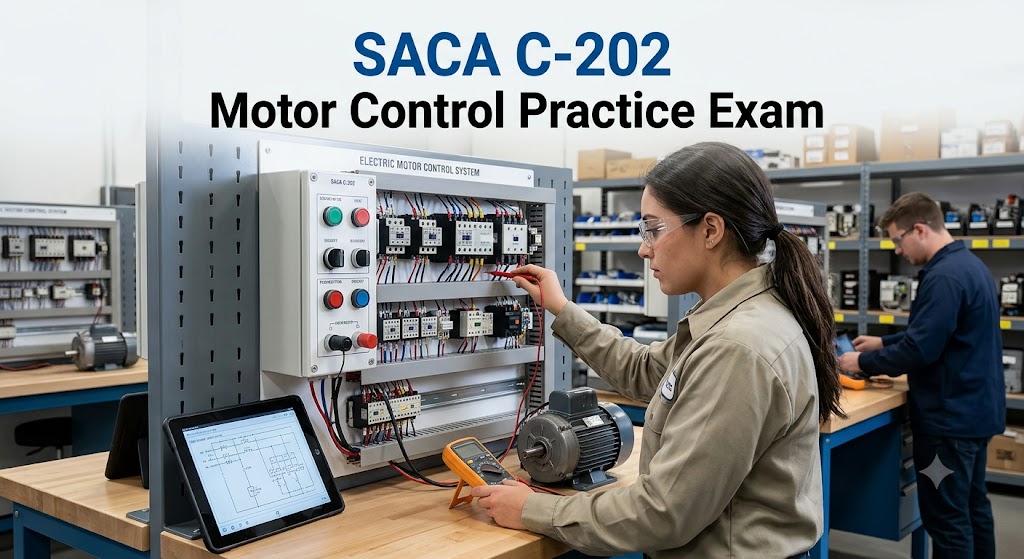
Additional Information
What the Course Entails and Exam Details
The course and exam cover fundamental concepts and practical skills required for managing industrial motor systems. Key topics in the syllabus typically include:
Motor Control Fundamentals: Understanding the principles of operation for AC motors and the need for control circuits.
Manual Motor Control: Operating and troubleshooting manual starters and switches.
Magnetic Motor Control: The use of magnetic contactors and starters, control relays, and timing relays.
Control Pilot Devices: Integrating and wiring pushbuttons, selector switches, and limit switches.
Circuit Layout and Wiring: Reading and designing ladder diagrams, schematic diagrams, and implementing standardized wiring practices.
Basic Control Circuits: Implementing logic such as start/stop control, jogging, and basic interlocking methods.
Troubleshooting: Utilizing systematic approaches and test instruments to diagnose and repair motor control circuit faults.
What to Expect in the Final Exam
The SACA C-202 assessment is rigorous and designed to test both theoretical knowledge and practical application. Candidates should expect:
Written Knowledge Assessment: This section typically utilizes multiple-choice and true/false questions to evaluate understanding of electrical theory, component function, and schematic reading.
Performance Assessment (Hands-on): A significant portion of SACA certification involves a performance-based test. Candidates must successfully troubleshoot or wire a specific motor control circuit on a standardized training system within a set time limit, strictly adhering to safety procedures.
Passing Requirements: While specific scores can vary by institution, a 70-80% minimum is often required for the knowledge portion, and 100% successful completion of safety and key functional requirements is mandatory for the performance portion.
How to Study and Exam Centers
Preparation should balance academic study with practical lab time. We recommend the following strategies:
Utilize SACA eLearning: If available, complete all modules associated with the C-202 curriculum, paying close attention to the interactive simulations.
Review Practice Tests: Use targeted practice exams to identify knowledge gaps in motor control theory and schematic interpretation.
Hands-on Lab Practice: This is crucial. Spend extensive time wiring and troubleshooting real components on an industrial training panel. Practice identifying common faults like loose connections or failed components.
Focus on Safety: Ensure you know lock-out/tag-out (LOTO) procedures and multimeter safety rules perfectly; infractions on the performance exam can result in automatic failure.
Exam Centers: SACA exams are administered through SACA-member educational institutions (such as community colleges and technical schools) or authorized corporate training centers. Candidates typically take the exam at the location where they completed their training.
Job Opportunities from the Course
Successfully obtaining the SACA C-202 certification demonstrates a concrete level of proficiency that is highly valued by employers in the manufacturing and automation sectors. This certification can unlock numerous career paths and job titles, including:
Industrial Maintenance Technician
Automation Technician
Mechatronics Technician
Electrical Technician
Plant Maintenance Mechanic
Control Systems Technician
Field Service Technician
Frequently Asked Questions
Reviews
5.0
Based on 0 reviews
Leave a Review
No reviews yet. Be the first to review!