
Rutgers Organic Chemistry Laboratory Practice Exam
$69.00
- Buy to unlock unlimited access to all Quiz questions.
- After purchase you can print a PDF of the whole quiz at any point. The PDF will contain the questions and the correct answers.
About this Exam
The Rutgers Organic Chemistry Laboratory Practice Exam is designed for students enrolled in or preparing for the challenging organic chemistry laboratory courses at Rutgers University. This comprehensive practice tool is specifically crafted to mirror the format, difficulty, and core concepts tested in the actual final laboratory exams for courses such as Chem 311 (Organic Chemistry Laboratory I) or Chem 312 (Organic Chemistry Laboratory II). It aims to assess a student's proficiency in practical lab techniques, data analysis, mechanism identification, and the interpretation of spectroscopic data (IR, NMR, UV-Vis), crucial for success in these demanding courses.
The course itself is an essential component for science majors, pre-medical students, and aspiring researchers. The practice exam provides a low-stakes environment for students to gauge their understanding, build confidence, and identify areas needing further study before the high-stakes final assessment.
Ready to test your knowledge?
Buy Now to Access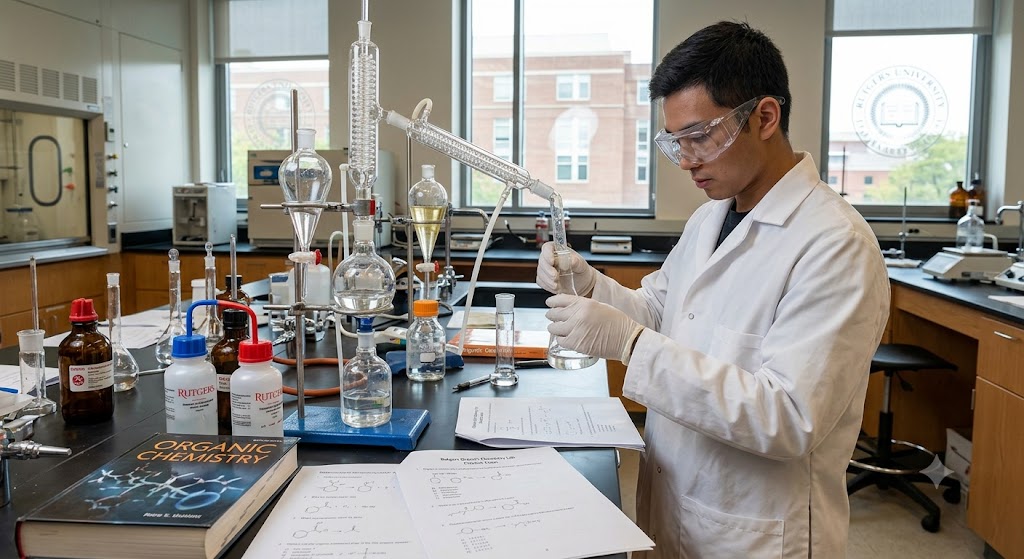
Additional Information
What the Course Entails and Exam Details
The Rutgers Organic Chemistry Laboratory courses, and by extension, this practice exam, cover a wide range of fundamental techniques and reactions. Key areas include:
Core Lab Techniques: Recrystallization, distillation (simple and fractional), extraction (liquid-liquid), chromatography (TLC, column), and melting point determination.
Safety and Notebooks: Strict adherence to safety protocols and maintaining a precise, well-organized laboratory notebook.
Spectroscopy Interpretation: Analyzing Infrared (IR) and Nuclear Magnetic Resonance (NMR) spectra to determine chemical structures of organic compounds.
Synthesis and Reactions: Execution of specific organic reactions (e.g., nucleophilic substitutions, eliminations, electrophilic aromatic substitution, carbonyl chemistry) and mechanism determination.
Data Analysis: Interpreting experimental results, calculating percent yields, and understanding source of error.
The actual final laboratory exam is generally taken at the conclusion of the semester and is proctored in a physical classroom or designated exam hall. It usually consists of a mixture of multiple-choice questions, short-answer questions requiring explanations or mechanism drawings, and problems focused on data interpretation and spectroscopy.
What to Expect in the Final Exam
While the exact structure might vary slightly by instructor, students taking the Rutgers Organic Chemistry Laboratory Final Exam can typically expect:
Format: The exam is often primarily written, blending multiple-choice, matching, structural identification, and short-answer questions. Some sections may require drawing reaction mechanisms and predicting product structures.
Focus: A significant portion of the exam will test your ability to interpret spectroscopic data (predicting structures from IR/NMR) and troubleshoot experimental setups or understand the why behind each step in the assigned experiments.
Practical Component: There is usually no in-lab "practical" on the day of the written exam, but the questions will rigorously test your practical knowledge gained throughout the semester (e.g., "Which solvent is best for recrystallizing compound X?").
Time Limit: The final written exam typically has a time limit of 90 to 120 minutes.
Score Requirements: There is no single "passing score" for the final exam itself; your score is a critical component that contributes heavily to your overall letter grade for the laboratory course (Chem 311/312).
How to Study and Exam Centers
Preparation is key. Here are some actionable strategies:
Review Your Lab Notebook: This is your most valuable resource. Study your pre-lab assignments, experimental procedures, observations, and calculations for every single experiment.
Understand the "Why": For every technique (e.g., extraction), understand the underlying chemical principles (solubility, acidity/basicity). Know why you added each reagent.
Master Spectroscopy: Practice interpreting IR and NMR spectra incessantly. Many points are lost here. Learn the characteristic peak ranges and splitting patterns.
Use Past Exams: Obtain official past exams if made available by the department or your instructor, and take them under timed conditions.
Review Course Lectures/Handouts: If your instructor provided any lectures or review sheets, study them thoroughly.
Exam Centers:
The final written exam for Rutgers laboratory courses is typically held on-campus in large lecture halls during the scheduled final exam period. You will not register for this separately; your enrollment in the course automatically places you for the final exam. For the online component or specific alternative assessments, Rutgers often uses its established learning management system (Canvas) with online proctoring tools if required, but the primary method for this specific lab exam remains a supervised, in-person, on-campus examination.
Job Opportunities from the Course
A strong foundation in organic chemistry lab skills, demonstrated through success in this Rutgers course, can lead to numerous career opportunities:
Research Assistant (Academic/Industrial)
Pre-medical/Dental/Veterinary School Candidate
Quality Control (QC) Chemist
Pharmaceutical Laboratory Technician
Analytical Chemist
Chemical Sales Representative
High School Chemistry Teacher (requires certification)
Forensic Science Technician
Process Development Chemist
Frequently Asked Questions
Reviews
5.0
Based on 0 reviews
Leave a Review
No reviews yet. Be the first to review!