
Rutgers Anatomy & Physiology Test Practice
$69.00
- Buy to unlock unlimited access to all Quiz questions.
- After purchase you can print a PDF of the whole quiz at any point. The PDF will contain the questions and the correct answers.
About this Exam
The Rutgers Anatomy & Physiology Test Practice resource is expertly designed for students currently enrolled in or preparing for the rigorous Human Anatomy and Physiology course sequence at Rutgers University.
This comprehensive practice material is tailored specifically to mirror the level of depth, question style, and conceptual challenge encountered in official Rutgers assessments.
It is an essential tool for undergraduates pursuing degrees in nursing, exercise science, physical therapy, and various pre-med and allied health pathways.
Ready to test your knowledge?
Buy Now to Access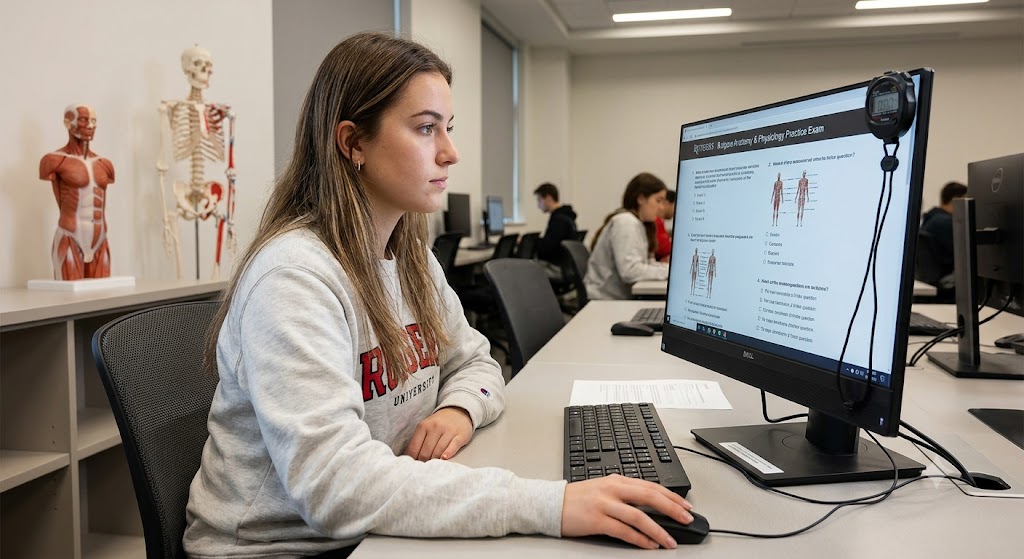
Additional Information
What the Course Entails and Exam Details
This course typically provides an in-depth exploration of the structure and function of the human body. It is often divided into two consecutive semesters (A&P I and II).
The curriculum covers the eleven major organ systems: integumentary, skeletal, muscular, nervous, endocrine, cardiovascular, lymphatic, respiratory, digestive, urinary, and reproductive.
Practice resources often include multiple modules focusing on cellular physiology, histology (tissue types), biochemical processes, and the integration of these systems for homeostasis.
The primary objective is to build a foundational understanding requisite for advanced clinical studies.
What to Expect in the Final Exam
Final exams at Rutgers for Anatomy & Physiology typically follow a combined format.
The theoretical component is commonly a multiple-choice examination, which is time-limited and requires high precision.
Students can expect complex situational questions demanding knowledge application rather than simple recall.
The practical component, crucial in A&P, usually involves a 'bell-ringer' style identification lab exam, where students rotate through timed stations identifying structures on pinned models, dissected specimens, and histological slides.
Passing scores generally align with university grading policies (often requiring 70% or higher, depending on the specific program's rigor).
How to Study and Exam Centers
Effective preparation requires a multi-faceted approach combining active recall and spaced repetition.
Students should utilize the practice exams to identify knowledge gaps, create detailed flashcards (digital or physical) for terminology, and engage in study groups for collaborative problem-solving.
Practical components demand significant time spent in the biology or anatomy lab interacting with physical models.
This specific practice resource is designed for self-assessment and can be accessed online, usually through the university's learning management system.
Official course exams are conducted in authorized Rutgers University testing centers, specified lecture halls, or dedicated anatomy laboratory spaces.
Job Opportunities from the Course
A strong performance in the Rutgers Anatomy and Physiology sequence is not a certification in itself, but it is a critical prerequisite that unlocks several highly sought-after career paths.
Success in this foundational course is essential for admission into specialized programs leading to the following job titles:
Registered Nurse (RN)
Physical Therapist (PT)
Occupational Therapist (OT)
Physician Assistant (PA)
Exercise Physiologist
Dental Hygienist
Medical Doctor (MD/DO - often required pre-med course)
Cardiovascular Technologist
Radiologic Technologist
Surgical Technologist
Frequently Asked Questions
Reviews
5.0
Based on 0 reviews
Leave a Review
No reviews yet. Be the first to review!