
Arizona State University (ASU) BIO201 Human Anatomy and Physiology I Exam 3 Practice Study Guide
$69.00
- Buy to unlock unlimited access to all Quiz questions.
- After purchase you can print a PDF of the whole quiz at any point. The PDF will contain the questions and the correct answers.
About this Exam
This comprehensive study guide and accompanying practice
materials are specifically tailored for students currently enrolled in Arizona
State University's BIO201: Human Anatomy and Physiology I. This practice resource
is strategically designed to help students preparing for their critical third
major exam, providing targeted support and assessment. Anyone seeking
additional, focused preparation to reinforce their understanding of key
concepts, gauge their readiness, and ultimately boost their confidence before
the actual assessment will find immense value here.
Ready to test your knowledge?
Buy Now to Access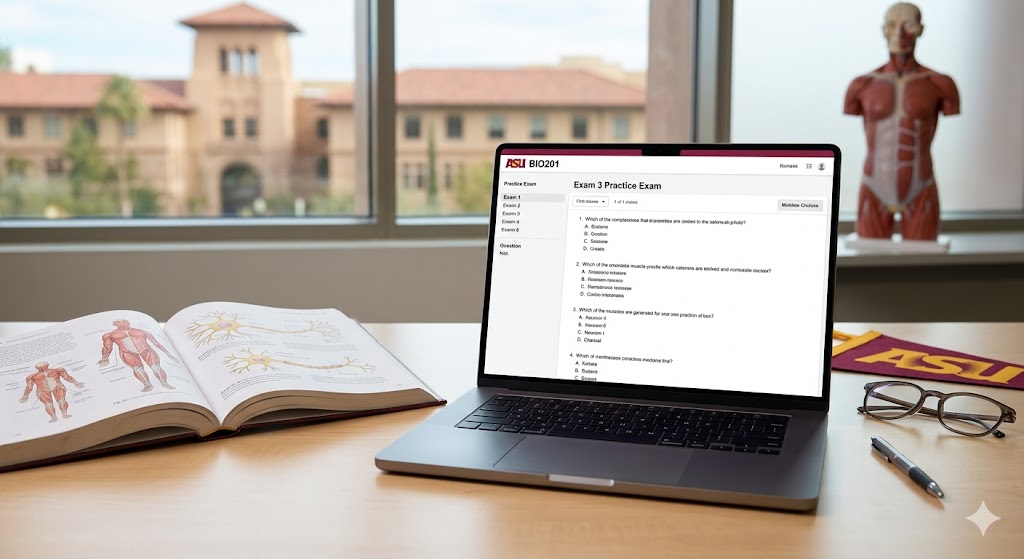
Additional Information
What the Course Entails and Exam Details
ASU's BIO201 explores the intricate details of human
structure and function, laying a vital foundation for numerous healthcare and
scientific fields. The third exam typically covers a significant portion of the
course material, likely delving deeply into crucial systems. Students can
generally expect Exam 3 to focus intensely on the muscular system—including
muscle tissue, major muscles, and mechanisms of contraction—as well as the
complexities of the nervous system, potentially encompassing neurons, the
central and peripheral nervous systems, and sensory integration. Precise topics
will depend on the specific instructor and semester, but thorough knowledge of
musculoskeletal and neural function is paramount.
What to Expect in the Final Exam
While specific exam formats are at the discretion of
individual instructors and may vary, ASU BIO201 exams are traditionally
rigorous and predominantly multiple-choice. Students should anticipate numerous
questions designed to test both factual recall of anatomical terms and deeper
conceptual understanding of physiological processes. Some questions may involve
the identification of structures from diagrams or models. The actual passing
score requirements and time limits for the real ASU BIO201 Exam 3 are determined
each semester and clearly stated in the official course syllabus, which
students must consult for precise details. Exams are typically proctored, and
adherence to all university and instructor-defined rules is mandatory.
How to Study and Exam Centers
Study Strategies: Achieving success requires
dedication and effective study habits. Actively engage with lecture materials
and textbook chapters, paying particular attention to the muscular and nervous
systems. Utilize diverse learning tools: create detailed flashcards for
anatomical terms, physiological mechanisms, and key concepts; form or join
study groups to discuss complex topics and test each other; and make extensive
use of visual aids like labeled diagrams and anatomical models to reinforce spatial
relationships and structure. Practice identifying structures and explaining
physiological processes aloud to deepen understanding.
Practice Methods: Consistent practice is key.
Dedicate focused time to taking simulated practice exams like this one. Mimic
actual testing conditions as closely as possible—time yourself strictly, avoid
using external resources, and review both correct and incorrect answers
thoroughly afterwards. Identify areas where you struggle and dedicate extra
study time to those specific topics. Repeatedly testing yourself reinforces
knowledge and improves recall under pressure.
Exam Locations: The official ASU BIO201 exams are
generally administered either online through specific university-approved
platforms with proctoring services or, for in-person course sections, in
designated classrooms or testing centers on ASU campuses. Be sure to check your
course syllabus or communicate directly with your instructor to confirm the
precise scheduling, location, and proctoring requirements for your specific
exam.
Job Opportunities
from the Course
Successfully completing BIO201, especially as part of a
relevant degree program in health sciences, biology, or related fields, unlocks
a diverse array of exciting career paths and further educational opportunities.
While not exhaustive, here are many potential trajectories:
Job Titles and Career Paths
Entry-Level Healthcare & Support Roles:
- Patient
Care Technician
- Medical
Scribe
- Dental
Assistant (may require additional quick certification)
- Home
Health Aide (often requires minimal further training)
Research & Laboratory:
- Research
Assistant (in academic, biomedical, or pharmaceutical settings)
- Laboratory
Technician (various specialties)
Foundational for Advanced Healthcare Professions
(Requires significant further education):
- Nurse
(Registered Nurse, Nurse Practitioner)
- Physician
Assistant (PA)
- Physical
Therapist (PT)
- Occupational
Therapist (OT)
- Medical
Doctor (MD) or Doctor of Osteopathic Medicine (DO)
- Dentist
(DDS/DMD)
- Veterinarian
(DVM)
- Optometrist
(OD)
- Pharmacist
(PharmD)
Related Fields:
- Pharmaceutical
Sales Representative
- Medical
Device Sales Representative
- Health
Educator
- Wellness
Coach (with appropriate certifications)
- Exercise
Physiologist (typically requires specific degree/certification)
As you can see, strong performance in foundational courses
like BIO201 is truly the first crucial step toward a rewarding career dedicated
to health, science, and the well-being of others. Leverage this practice
resource to enhance your preparation and confidently take that important next
step!
Frequently Asked Questions
Reviews
5.0
Based on 0 reviews
Leave a Review
No reviews yet. Be the first to review!