
Rutgers Anatomy & Physiology II Practice Exam
$69.00
- Buy to unlock unlimited access to all Quiz questions.
- After purchase you can print a PDF of the whole quiz at any point. The PDF will contain the questions and the correct answers.
About this Exam
The Rutgers Anatomy & Physiology II Practice Exam is designed to support students currently enrolled in or preparing for the Rutgers University A&P II course. It is an essential tool for future healthcare professionals, including nursing students, pre-med candidates, and allied health majors, who must demonstrate a comprehensive understanding of human biological systems. This course follows the foundational knowledge from A&P I, diving deeper into complex, interconnected systems, and this practice exam is your best resource to simulate the final assessment and gauge your readiness.
Ready to test your knowledge?
Buy Now to Access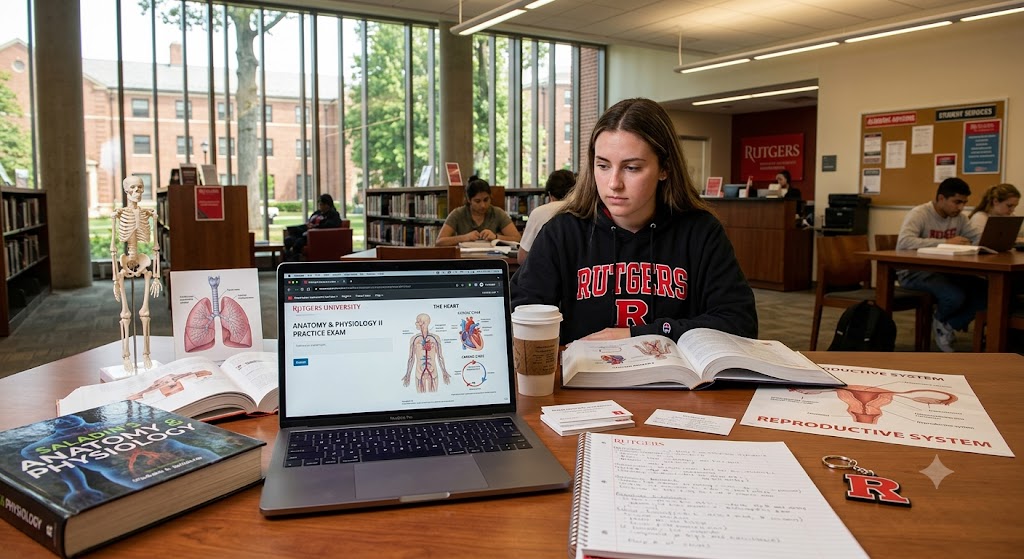
Additional Information
What the Course Entails and Exam Details
This comprehensive course, often required for entry into competitive medical and nursing programs, focuses on physiological systems and how they integrate to maintain human life. The practice exam mirrors the rigorous syllabus, covering these core topics in detail:
Cardiovascular System: Heart anatomy, blood flow, the cardiac cycle, and blood vessel physiology.
Lymphatic and Immune Systems: Structure and function of the lymphatic system and the body's defense mechanisms.
Respiratory System: Anatomy, mechanics of breathing, and gas exchange.
Digestive System: The GI tract, chemical digestion, and nutrition.
Urinary System: Kidney function, nephron structure, and urine formation.
Reproductive Systems: Male and female anatomy and physiology.
Fluid, Electrolyte, and Acid-Base Balance: Understanding homeostasis.
Endocrine System: Gland function, hormone control, and metabolism.
What to Expect in the Final Exam
You can expect the practice exam to realistically simulate the structure and style of the actual Rutgers final, preparing you for success on game day.
Exam Format: Like the actual university assessment, the test typically includes multiple-choice questions, matching exercises, anatomical labeling of diagrams, and critical-thinking short-answer scenarios.
Time Limits: It is designed to be completed within the same timeframe allowed for the final exam (e.g., two to three hours).
Passing Score: A passing score often aligns with the minimum prerequisite required by professional programs, such as a 70% or better (a 'C' in many cases).
Difficulty: Questions are rigorous, focusing not just on recall but on applying physiological concepts to clinical situations.
How to Study and Exam Centers
The key to passing Rutgers A&P II is consistent, active study, and our practice exam is central to that strategy.
Effective Study Strategies:
Utilize Practice Exams: Take our full-length practice tests under timed, simulated exam conditions multiple times. Analyze every error.
Active Recall and Spaced Repetition: Don’t just re-read notes; use flashcards for complex physiological pathways and anatomical terms.
Draw Diagrams: If you can't draw the cardiac cycle or the nephron, you don't know it. Practice labeling blank diagrams.
Join Study Groups: Teaching concepts to others is the highest level of mastery. Rutgers learning centers often facilitate these.
Review Lecture Materials: Focus heavily on materials provided by your instructors, as exam content is derived directly from class.
Exam Centers:
While the final, comprehensive exam for the course is typically scheduled and administered directly on the relevant Rutgers University campuses (e.g., New Brunswick, Newark, Camden) within university facilities, our high-quality practice exams are available online. This allows you to prepare on your own schedule from anywhere, providing the targeted practice needed to excel when you sit for the actual proctored test.
Job Opportunities from the Course
A strong foundation in Anatomy & Physiology II is the non-negotiable gateway to virtually all high-impact, in-demand careers in healthcare. A high score on this Rutgers exam validates your preparation for professional school, unlocking paths such as:
Registered Nurse (RN)
Physician Assistant (PA)
Physical Therapist (PT)
Occupational Therapist (OT)
Medical Doctor (MD/DO)
Dentist (DDS/DMD)
Pharmacist (PharmD)
Veterinarian (DVM)
Nurse Practitioner (NP)
Clinical Research Coordinator
Diagnostic Medical Sonographer
Respiratory Therapist
Speech-Language Pathologist
Frequently Asked Questions
Reviews
5.0
Based on 0 reviews
Leave a Review
No reviews yet. Be the first to review!