
Routing Identifier Code (RIC) Board Practice Exam
$69.00
- Buy to unlock unlimited access to all Quiz questions.
- After purchase you can print a PDF of the whole quiz at any point. The PDF will contain the questions and the correct answers.
About this Exam
The RAN Intelligent Controller (RIC) Board Practice Exam is an essential tool designed for professionals striving to master the complexities of modern 5G and Open RAN (O-RAN) architectures. As the telecommunications industry shifts towards disaggregated, intelligent, and virtualized networks, the RIC plays a pivotal role by bringing programmability and automation to the Radio Access Network.
This practice exam is tailored for 5G network engineers, RAN architects, software developers building xApps and rApps, and system integrators who need to demonstrate a deep understanding of RIC functionality and O-RAN standards. Passing this practice test validates your readiness to configure, optimize, and manage the intelligent controller that is shaping the future of wireless communication.
Ready to test your knowledge?
Buy Now to Access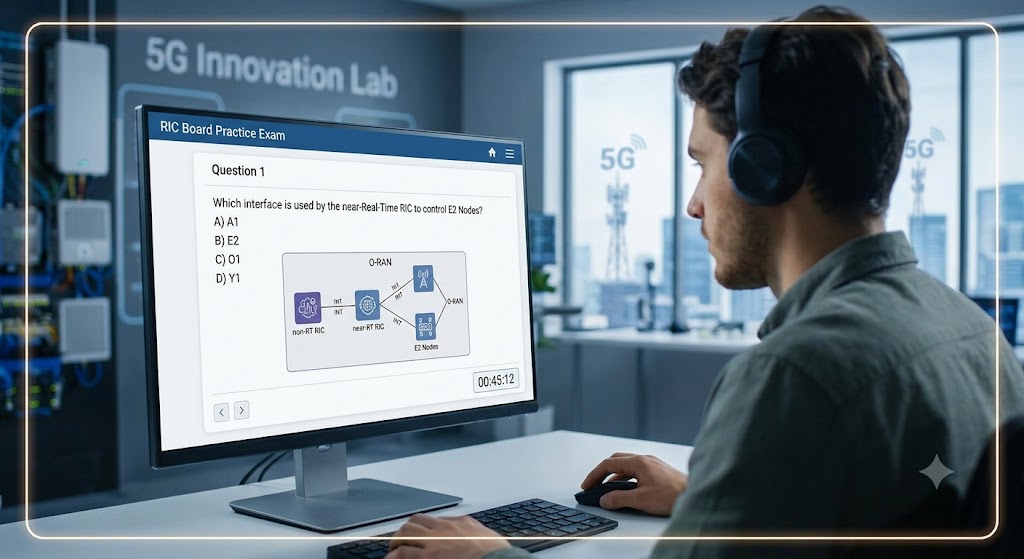
Additional Information
What the Course Entails and Exam Details
This course provides a complete overview of the RIC's function within the O-RAN Alliance architecture, covering both the non-Real-Time RIC (non-RT RIC) and the near-Real-Time RIC (near-RT RIC). The curriculum focuses on understanding how these components use artificial intelligence and machine learning to optimize network performance.
Core topics covered in the RIC Board Practice Exam include:
O-RAN Architecture and RIC Integration
Near-Real-Time RIC and xApp Development (E2 Interface)
Non-Real-Time RIC and rApp Development (A1 Interface)
The O1 and O2 Interfaces for Management and Orchestration
AI/ML Workflows for RIC-driven RAN Optimization
Use cases for RIC, such as Traffic Steering, Mobility Management, and Network Slicing
What to Expect in the Final Exam
The final certification exam is a rigorous assessment of both theoretical knowledge and practical application. Candidates should be prepared for a timed, proctored environment that simulates real-world troubleshooting and design scenarios.
The exam details are as follows:
Exam Format: 60 Multiple-Choice Questions (MCQ) and Scenario-Based Problems
Time Limit: 90 Minutes
Passing Score: 75% or higher
Specific Rules: This is a closed-book exam. No external reference materials are allowed. Candidates must complete the test in a single session without breaks.
How to Study and Exam Centers
Effective preparation is key to success on the RIC Board Practice Exam. Given the niche and evolving nature of O-RAN standards, a multi-faceted study approach is required.
Actionable Study Strategies:
Analyze the O-RAN Specifications: The most critical resource is the official documentation from the O-RAN Alliance, specifically the Working Group 2 (non-RT RIC) and Working Group 3 (near-RT RIC) specifications.
Use Practice Exams: Take this practice exam multiple times. Analyze your results to identify knowledge gaps. This exam is designed to mimic the difficulty and style of the actual test.
Explore Open-Source Platforms: Gain hands-on experience by exploring open-source RIC implementations, such as those from the O-RAN Software Community (OSC) or ONF's SD-RAN.
Join Industry Forums: Engage with professionals in the O-RAN and 5G communities on platforms like LinkedIn and specialized telecommunications forums to discuss use cases and deployment challenges.
Exam Centers:
The exam can be taken through two main channels. First, standard online portals and physical testing centers managed by global proctoring services, such as Pearson VUE. Second, through authorized O-RAN training partners and specialized telecommunications academies that offer both the coursework and the final certification.
Job Opportunities from the Course
A certification in RIC operations opens doors to advanced roles within the telecommunications and network software sectors. Companies are actively seeking professionals who can bridge the gap between traditional RAN hardware and modern, cloud-native network intelligence.
Job opportunities include:
Open RAN Engineer
5G Network Architect
RIC Systems Integrator
xApp / rApp Developer
RAN Automation Specialist
Network Intelligence Engineer
Principal O-RAN Solutions Architect
Frequently Asked Questions
Reviews
5.0
Based on 0 reviews
Leave a Review
No reviews yet. Be the first to review!