
Robotics Education & Competition Foundation (RECF) Fundamentals Practice Exam
$69.00
- Buy to unlock unlimited access to all Quiz questions.
- After purchase you can print a PDF of the whole quiz at any point. The PDF will contain the questions and the correct answers.
About this Exam
The Robotics Education & Competition Foundation (RECF) Fundamentals certification is an industry-recognized credential designed for students, particularly at the middle school and high school levels, who are interested in demonstrating their foundational knowledge in robotics and STEM concepts.
This certification serves as an excellent entry point for students participating in competition robotics, validating their understanding of core engineering and technology principles.
It provides tangible proof of proficiency to educators and future employers, showcasing a commitment to learning the essentials of robotics design, construction, and operation.
Ready to test your knowledge?
Buy Now to Access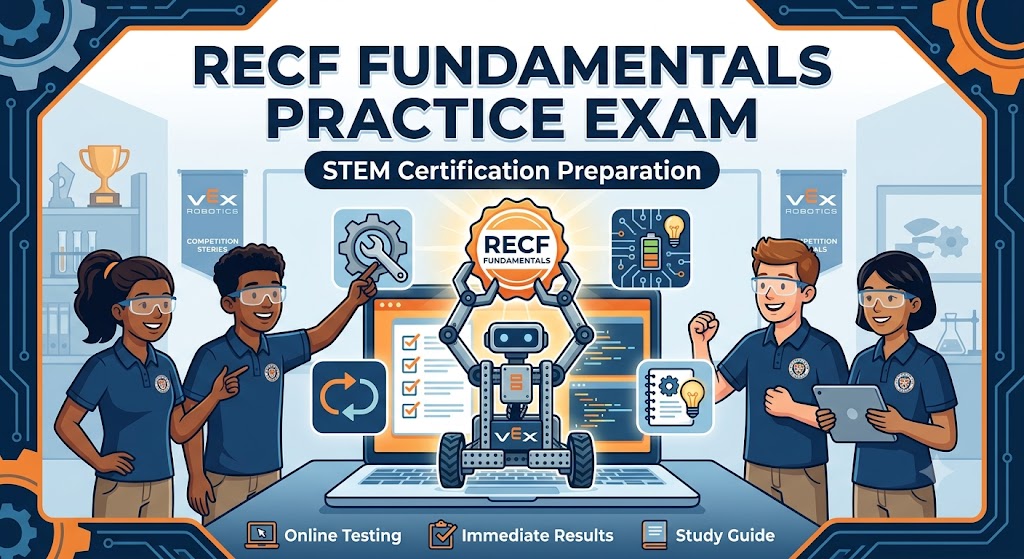
Additional Information
What the Course Entails and Exam Details
This comprehensive course and the associated exam cover a broad spectrum of fundamental concepts essential for anyone beginning their journey in robotics.
The curriculum is structured around several key areas that form the backbone of robotics education, ensuring candidates have a well-rounded understanding of the field.
Key topics included in the syllabus and covered in the exam are:
The Engineering Design Process: Understanding the iterative steps of brainstorming, designing, building, testing, and refining a robotic system.
Safety Practices: Crucial safety protocols for working with robotic components, tools, and electronics in a lab or competition environment.
Mechanical Systems: Fundamental concepts related to gears, linkages, drivetrains, and structure, and how they contribute to robot movement.
Electronics and Electricity: Basic understanding of circuits, sensors, motors, voltage, current, and power management within a robot.
Programming Concepts: Introductions to computational thinking, logic, loops, and conditional statements necessary for controlling robotic autonomous behaviors.
Robotics Terminology: Mastering the standard vocabulary used in the robotics and engineering industries.
What to Expect in the Final Exam
The final RECF Fundamentals certification exam is typically administered online through a designated testing portal.
Candidates should expect a multiple-choice format, designed to test theoretical knowledge and practical application of the core concepts learned throughout the course.
The exam is usually timed, requiring students to answer a set number of questions within a specified period (e.g., 60 to 90 minutes).
While the exact number of questions and passing score requirements can vary, a minimum score (often around 70-80%) is required to earn the certification.
The exam is often proctored by an educator or an approved testing administrator at the student's school or organization to ensure academic integrity.
How to Study and Exam Centers
Preparation is key to succeeding in the RECF Fundamentals exam, and several effective study strategies can help students build the necessary knowledge.
The most effective approach combines theoretical review with hands-on experience, often gained through participation in programs like VEX Robotics competitions.
Recommended study methods include:
Review Official Curriculum Materials: Thoroughly study any curriculum resources provided by RECF or your robotics program, focusing on the key knowledge areas mentioned above.
Utilize Practice Exams: Taking practice tests, including this one, is crucial for familiarizing yourself with the question format, timing, and identify areas where you need further review.
Hands-on Robotics Experience: Actively participating in designing, building, and programming competition robots provides invaluable practical reinforcement of the concepts.
Review Key Terminology: Create flashcards or study guides for essential robotics and engineering terms.
Join Study Groups: Collaborating with peers can help clarify complex topics and reinforce learning.
Regarding exam centers, the RECF Fundamentals exam is typically taken online, often within the classroom or school environment. It is not usually administered at large, third-party testing centers like Pearson VUE.
Educators or competition coaches act as the proctors and facilitate the testing process for their students through the official RECF certification platform.
Job Opportunities from the Course
While the RECF Fundamentals certification is an entry-level credential primarily focused on students, it provides a strong foundation and validates key skills that are highly relevant to future educational and career paths in STEM fields.
Earning this certification demonstrates a level of commitment and understanding that can be beneficial when applying for internships, technical programs, or relevant entry-level positions.
Potential career paths and entry-level opportunities that this certification helps prepare students for include:
Robotics Technician (Entry-Level): Assisting engineering teams with assembling, testing, and maintaining robotic systems.
Manufacturing Technician: Utilizing knowledge of automation, electronics, and mechanics in modern manufacturing environments.
Engineering Assistant/Intern: Providing support to engineers in research, design development, and testing phases.
CAD Draftsman (Introductory): Using computer-aided design software to create technical drawings for robotic and mechanical components.
Preparation for Post-Secondary Education: Providing a head start and strong foundation for students pursuing degrees in Mechanical Engineering, Electrical Engineering, or Computer Science.
Frequently Asked Questions
Reviews
5.0
Based on 0 reviews
Leave a Review
No reviews yet. Be the first to review!