
OAT Physics Practice Test OLD
$69.00
- Buy to unlock unlimited access to all Quiz questions.
- After purchase you can print a PDF of the whole quiz at any point. The PDF will contain the questions and the correct answers.
About this Exam
The Optometry Admission Test (OAT) is a rigorous standardized examination designed to evaluate the academic potential of applicants to optometry schools. This specialized study guide focuses specifically on a practice test for the Physics section, which is a critical component of the overall exam. The guide is designed for prospective optometry students who have completed their undergraduate science prerequisites and are actively preparing to achieve a competitive score.
Ready to test your knowledge?
Buy Now to Access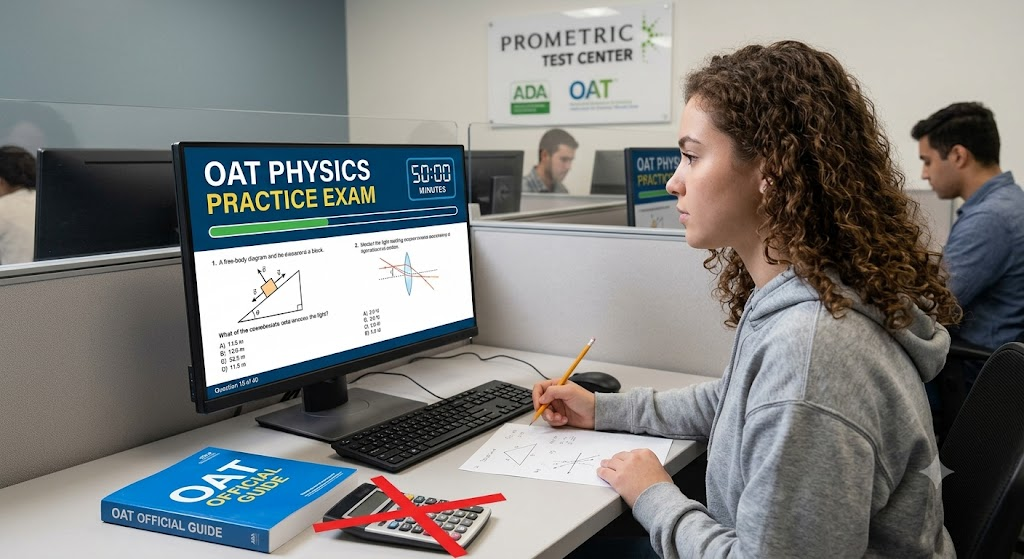
Additional Information
What the Course Entails and Exam Details
This OAT Physics practice resource replicates the core topics found in the official exam. It assesses your understanding of fundamental principles across multiple domains of physics. The content covered includes, but is not limited to: Units and vectors, linear kinematics, statics, dynamics, rotational motion, energy and momentum, simple harmonic motion, waves, fluid statics, thermal energy and thermodynamics, electrostatics, DC circuits, and optics. Special emphasis is often placed on optics due to its direct application in the field of optometry.
What to Expect in the Final Exam
The actual Physics section of the OAT is a computer-based test containing 40 multiple-choice questions. Test-takers are allotted exactly 50 minutes to complete this section. It is crucial to know that a calculator is not permitted; all numerical problems are designed with clean numbers to allow for rapid, precise mental arithmetic. While there is no universal "passing score" for the OAT, competitive results for admission typically range from a scaled score of 300 to over 350 on a scale of 200 to 400.
How to Study and Exam Centers
Effective preparation for the OAT Physics section requires a multifaceted strategy. Combine a thorough conceptual review using resources like the official ADA OAT Guide with high-quality third-party test preparation materials. Create comprehensive flashcards for essential formulas and principles. Engage in frequent practice under timed conditions to improve speed and accuracy.
To take the official OAT, you must first register with the American Dental Association (ADA) to obtain a DENTPIN. Once you have received your eligibility confirmation, you must schedule an appointment at a Prometric testing center. These physical testing centers are located across the United States and Canada and maintain strict security protocols for a controlled examination environment.
Job Opportunities from the Course
Successfully preparing for and achieving a competitive score on the OAT, particularly in the Physics section, is a vital step toward a rewarding career. The primary career path this leads to is becoming an Optometrist. Specific job titles and roles within this field include:
Doctor of Optometry (OD)
Licensed Optometrist
Pediatric Optometrist
Geriatric Optometrist
Contact Lens Specialist Optometrist
Low Vision Rehabilitation Specialist
Research Optometrist
Public Health Optometrist
Frequently Asked Questions
Reviews
5.0
Based on 0 reviews
Leave a Review
No reviews yet. Be the first to review!