
OAT Organic Chemistry Practice Test OLD
$69.00
- Buy to unlock unlimited access to all Quiz questions.
- After purchase you can print a PDF of the whole quiz at any point. The PDF will contain the questions and the correct answers.
About this Exam
The OAT Organic Chemistry Practice Test OLD refers to historical and retired versions of the organic chemistry section of the Optometry Admission Test (OAT). While the current exam follows a contemporary format, these past materials are an invaluable resource for applicants to optometry school. This study guide is designed to help students maximize the educational value of these older tests to master the concepts required for admission to a Doctor of Optometry (OD) program.
Ready to test your knowledge?
Buy Now to Access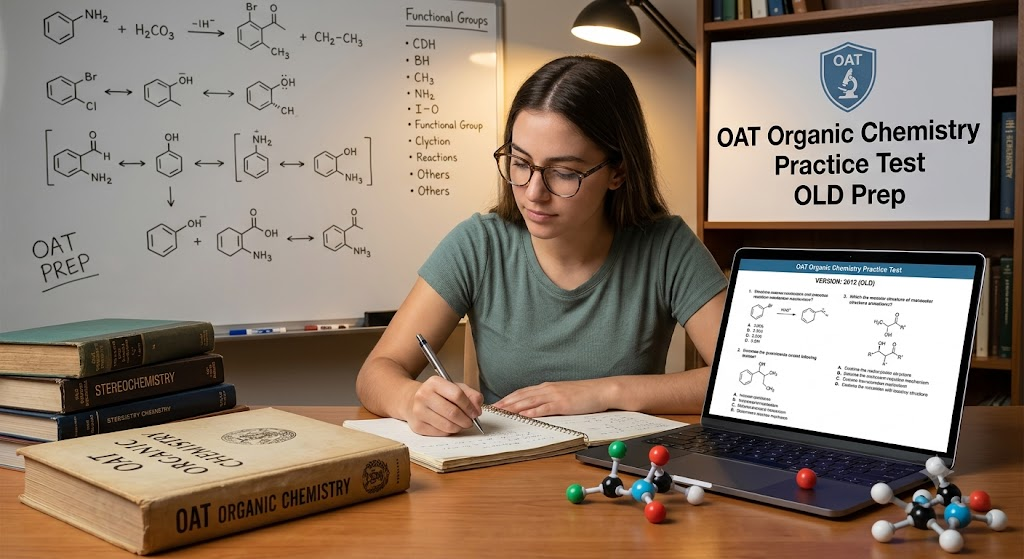
Additional Information
What the Course Entails and Exam Details
A structured OAT prep course, effectively utilizing these old practice tests, covers a broad range of core organic chemistry topics. The curriculum includes detailed study of functional groups, their nomenclature, properties, and characteristic reactions. You will explore stereochemistry, including chirality and R/S configurations, as well as the mechanisms of major reaction types like SN1, SN2, E1, E2, electrophilic addition, and nucleophilic acyl substitution. A current OAT Organic Chemistry section requires proficiency in the chemistry of alkanes, alkenes, alkynes, aromatics, alcohols, ethers, aldehydes, ketones, and carboxylic acids and their derivatives. Understanding acidity and basicity, along with spectroscopy techniques like IR and H-NMR, is also essential for success.
What to Expect in the Final Exam
The present-day OAT is a comprehensive exam that includes a "Survey of the Natural Sciences" section, which consists of 100 multiple-choice questions with 30 of them dedicated to organic chemistry. You are given 90 minutes to complete this entire section. While "OLD" practice tests may have slight variations in question numbers, they remain excellent tools for simulating the types of questions and difficulty level of the current exam. The OAT does not have a single "passing" score; instead, each optometry school establishes its own competitive benchmarks. Your raw score is converted to a scaled score ranging from 200 to 400. All questions are multiple-choice with no points deducted for incorrect answers, making guessing a viable strategy when unsure.
How to Study and Exam Centers
To optimize your study, integrate the OAT Organic Chemistry Practice Test OLD into a broader prep plan. First, establish a solid understanding of the concepts using current OAT prep books and textbooks. Use the OLD practice tests primarily to apply your knowledge and diagnose weaknesses. Take these tests under timed conditions to improve your pacing. Afterward, thoroughly review every question you missed, understanding not just the correct answer but why the incorrect choices were wrong. This process will help you bridge knowledge gaps effectively. The official OAT is administered through computerized testing centers managed by Pearson VUE, which are located throughout the United States and Canada. You must register for the exam online through the Association of Schools and Colleges of Optometry (ASCO) or the American Dental Association (ADA).
Job Opportunities from the Course
Achieving a competitive score on the OAT, bolstered by strong performance in the organic chemistry section, is the primary gateway to admission into an accredited optometry program. Successfully completing this educational path leads to a diverse array of professional opportunities.
Job opportunities include:
Optometrist
Doctor of Optometry (OD) in private practice
Retail optometrist (e.g., in an optical chain)
Academic or teaching faculty at a school of optometry
Researcher in vision science or ophthalmology
Consultant for the ophthalmic or pharmaceutical industry
Health policy advisor specializing in vision care
Frequently Asked Questions
Reviews
5.0
Based on 0 reviews
Leave a Review
No reviews yet. Be the first to review!