
NCLEX Safety and Infection Control Questions Answers
$69.00
- Buy to unlock unlimited access to all Quiz questions.
- After purchase you can print a PDF of the whole quiz at any point. The PDF will contain the questions and the correct answers.
About this Exam
The NCLEX (National Council Licensure Examination) is the crucial final hurdle for aspiring nurses, determining their eligibility for licensure as a Registered Nurse (RN) or Licensed Practical/Vocational Nurse (LPN/LVN). It is a demanding assessment designed to evaluate a candidate's readiness for safe and effective practice. A major component focuses heavily on safety and infection control principles, crucial for delivering quality care and preventing harm to both patients and staff. This guide is crafted specifically for nursing students preparing to conquer this critical section and achieve a high score, moving them closer to their dreams of a rewarding nursing career.
Ready to test your knowledge?
Buy Now to Access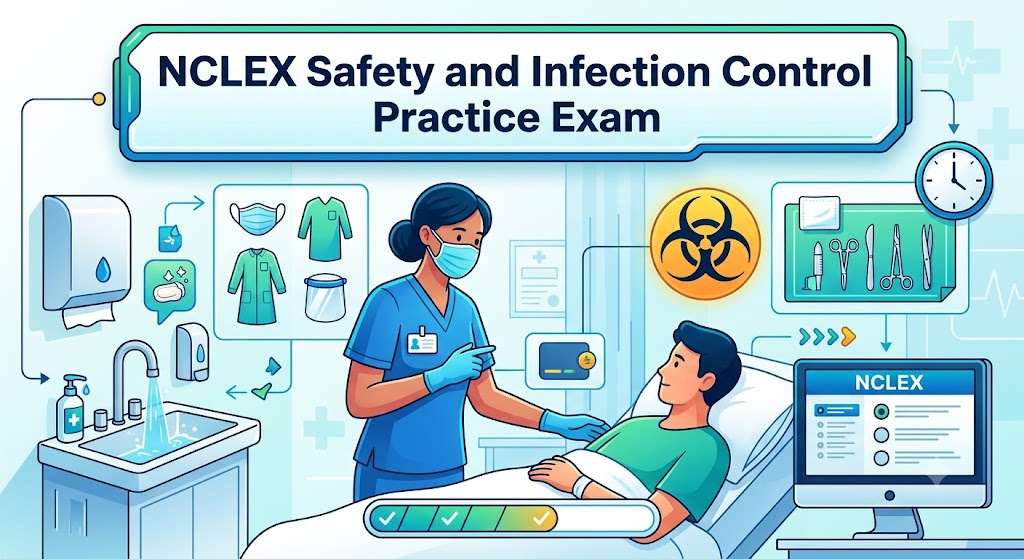
Additional Information
What the Course Entails and Exam Details
While the NCLEX itself isn't a course, the Safety and Infection Control portion thoroughly assesses a candidate's knowledge across several essential domains. These core areas typically include: following standard precautions; implementing correct hand hygiene practices; utilizing appropriate personal protective equipment (PPE); understanding isolation procedures for different infectious diseases; handling and disposing of sharps safely; managing hazardous materials and waste; maintaining a sterile environment during procedures; preventing complications; and responding effectively to emergencies and disaster scenarios. This sub-category tests practical application of fundamental nursing skills and clinical reasoning in maintaining a safe environment.
What to Expect in the Final Exam
The NCLEX is not a traditional linear exam but utilizes Computerized Adaptive Testing (CAT). This means the difficulty of questions adjusts to the test-taker's performance. The Safety and Infection Control content will be integrated with other client needs categories within this dynamic structure. The total number of questions can vary for RNs (75-265) or PN/VNs (85-205), including unscored pretest items. There is a maximum testing time of six hours for RNs and five hours for PNs, with specific rules for breaks. Candidates will encounter multiple-choice questions, but also alternative formats like "select all that apply," drag-and-drop, fill-in-the-blank, and more. A high passing score requires correctly answering enough questions at a higher difficulty level.
How to Study and Exam Centers
Achieving success demands comprehensive preparation. Candidates should dedicate consistent time to reviewing core principles of safety and infection control using accredited resources, textbooks, and online reviews. Actively working through practice questions from various NCLEX preparatory materials is absolutely vital to reinforce concepts and develop critical thinking skills. It's crucial to understand the rationale for each correct answer and identify specific areas for improvement. Studying with peers and joining study groups can offer diverse perspectives and enhance retention. Many effective prep courses and resources are available through various online portals. When ready, the exam itself is administered by authorization at specific Pearson VUE professional testing centers located globally. These secure environments provide specialized equipment to maintain test integrity. Candidates must register and schedule their appointments through the Pearson VUE website after receiving their eligibility confirmation.
Job Opportunities from the Course
Earning licensure by passing the NCLEX, including demonstrating competence in Safety and Infection Control, opens doors to a wide range of exciting job opportunities in healthcare. This credential unlocks career paths like:
Registered Nurse (RN)
Licensed Practical Nurse (LPN)
Licensed Vocational Nurse (LVN)
Nurse Educator
Nurse Manager
Travel Nurse
Pediatric Nurse
Intensive Care Unit (ICU) Nurse
Emergency Room (ER) Nurse
Community Health Nurse
Clinical Research Nurse
The critical safety and infection control knowledge is a fundamental requirement across all these diverse nursing roles.
Frequently Asked Questions
Reviews
5.0
Based on 0 reviews
Leave a Review
No reviews yet. Be the first to review!