
Mecklenburg Vorpommern Abitur Exam Prep | Germany
$69.00
- Buy to unlock unlimited access to all Quiz questions.
- After purchase you can print a PDF of the whole quiz at any point. The PDF will contain the questions and the correct answers.
About this Exam
The Mecklenburg Vorpommern Abitur, often referred to simply as the Abitur, is the definitive secondary school exit qualification in this German state.
This rigorous exam serves as the gateway to higher education, certifying that students have achieved the necessary academic maturity and depth of knowledge required for university studies.
It is designed primarily for students in their final years of Gymnasium (the university-preparatory school track) or equivalent educational pathways.
The Abitur is not just a single test, but the culmination of two years of qualification-phase coursework (the Oberstufe) and several final central examinations.
A high Abitur score is crucial as it determines a student’s Numerus Clausus (NC), which is the primary criterion for admission into competitive university programs across Germany.
Ready to test your knowledge?
Buy Now to Access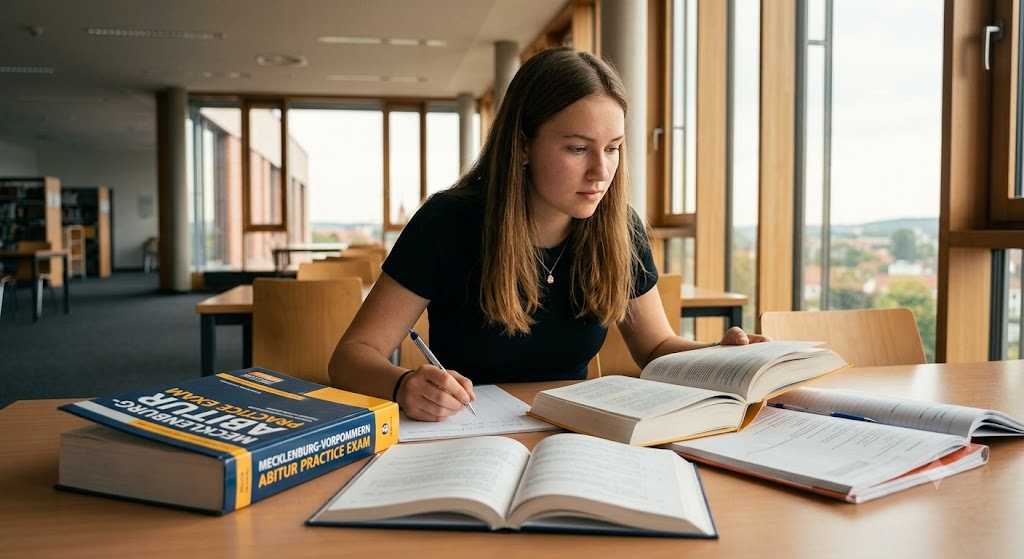
Additional Information
What the Course Entails and Exam Details
Preparing for the Abitur involves a deep dive into multiple subject areas over a two-year period.
Students must select a combination of courses from specific subject fields, typically including core areas like German, Mathematics, and a foreign language.
They must also choose Leistungskurse (advanced, intensive courses) and Grundkurse (basic courses) from the humanities, social sciences, natural sciences, and arts.
The core curriculum is dictated by the Ministry of Education in Mecklenburg Vorpommern, ensuring state-wide standards.
The final examination phase itself covers four or five subjects, depending on the student's chosen profile and regulations.
These final assessments test not only factual recall but also critical thinking, complex problem-solving, and the ability to synthesize information across different disciplines.
What to Expect in the Final Exam
The final Abitur exam in Mecklenburg Vorpommern consists of both written and oral components.
Most subjects involve comprehensive written examinations that require essay writing, extensive problem-solving, or critical analysis of provided materials.
Subjects like German, History, and Mathematics always have mandatory written central exams.
Oral exams (Prüfungen in mündlicher Form) are also a key component, typically required in one or more subjects where a student did not take a written exam.
The time limit for written exams varies by subject and whether it is an advanced (Leistungskurs) or basic (Grundkurs) level, ranging from 180 to 300 minutes.
The passing grade depends on the cumulative score achieved from both the final exams and the qualifying coursework over the previous two years, with a specific minimum required in core subjects.
How to Study and Exam Centers
Effective study strategies are essential for success. Students should create a structured study plan early, focusing on consolidating understanding from the entire qualification phase.
Active recall, practice with past Abitur papers (available from the Ministry), and joining study groups are highly effective.
Consistent review of class notes and textbooks is crucial, especially for advanced subjects.
Many students also utilize supplementary Abiturvorbereitungskurse (prep courses) or tutoring.
Crucially, the Mecklenburg Vorpommern Abitur is a school-based qualification; students sit the final exams at their own secondary schools (Gymnasium, Gesamtschule, etc.).
There are no external testing centers like Pearson VUE; the entire process is managed and administered by authorized schools within the state.
Job Opportunities from the Course
Achieving the Abitur is the primary academic milestone that unlocks access to most universities in Germany and many institutions abroad. It opens doors to countless career paths, including:
Medical Doctor / Dentist
Lawyer / Jurist
Engineer (Mechanical, Civil, Electrical)
Architect
University Professor
Secondary School Teacher
Psychologist
Business Administrator / CEO
Scientist (Biologist, Physicist, Chemist)
Computer Scientist / Software Engineer
Pharmacist
Veterinarian
Politician / Public Administrator
Journalist
Frequently Asked Questions
Reviews
5.0
Based on 0 reviews
Leave a Review
No reviews yet. Be the first to review!