
MCAT Chemistry Practice Test 2026 (59 Questions Answers)
$69.00
- Buy to unlock unlimited access to all Quiz questions.
- After purchase you can print a PDF of the whole quiz at any point. The PDF will contain the questions and the correct answers.
About this Exam
The MCAT Chemistry section is a critical component of the Medical College Admission Test, specifically found within the "Chemical and Physical Foundations of Biological Systems" section. This essential examination is designed for aspiring medical students seeking admission to allopathic (MD) and osteopathic (DO) medical schools across the United States and Canada. Achieving a high score demonstrates foundational knowledge in general and organic chemistry necessary for success in medical education and future practice. The [MCAT Chemistry Practice Test 2026 (59 Questions Answers)] provides a targeted opportunity for candidates to assess their readiness and familiarize themselves with the challenging, passage-based format of this section.
Ready to test your knowledge?
Buy Now to Access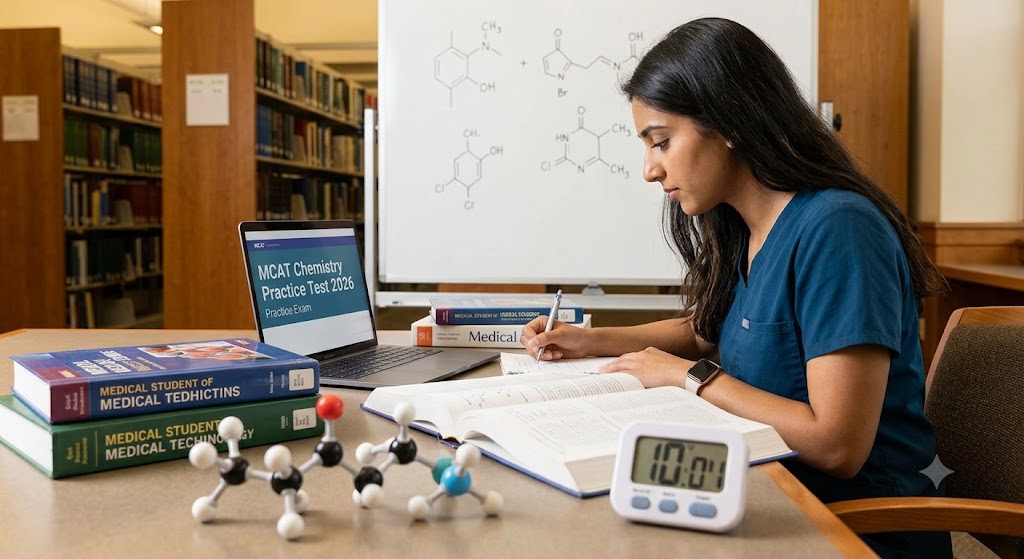
Additional Information
What the Course Entails and Exam Details
The exam focuses on fundamental chemical principles and
their application within biological contexts. Key areas covered include:
- General
Chemistry: Atomic structure, molecular bonding, stoichiometry, gas
laws, thermodynamics, kinetics, equilibrium, acids and bases, and
electrochemistry.
- Organic
Chemistry: Nomenclature, isomerism, functional groups, reaction
mechanisms (such as nucleophilic substitution and elimination), synthesis,
purification techniques, and spectroscopy (NMR, IR, UV). The [MCAT
Chemistry Practice Test 2026] itself mirrors the structure candidates will
encounter in the real exam, containing 59 passage-based and discrete
questions that require critical thinking and the application of chemical
concepts to solve complex biological problems.
What to Expect in
the Final Exam
The MCAT is a computerized, standardized test administered
globally at authorized Pearson VUE professional testing centers. It is a long
and rigorous exam, taking approximately 7.5 hours including breaks. The content
related to chemistry is primarily assessed in the "Chemical and Physical
Foundations of Biological Systems" section. This section consists of 59
multiple-choice questions, which must be completed within a time limit of 95
minutes. These questions are typically grouped around detailed scientific
passages that require data analysis and critical reasoning, alongside several
"discrete" questions that are independent of passages. There is no
simple "passing score" for the MCAT; instead, total scores range from
472 to 528. Each section is scored from 118 to 132. Candidates receive scores
percentile rankings, with medical schools considering scores within the context
of the entire application. Competitive scores vary by institution but generally
fall above the 80th percentile. The exam environment is strictly controlled,
with robust security measures and strict identification requirements. No
external resources, calculators, or aids are permitted.
How to Study and
Exam Centers
Successful preparation requires a combination of conceptual
mastery and strategic practice.
- Master
Concepts First: Avoid memorization in favor of deep conceptual
understanding. Focus on how general and organic chemistry principles
intersect with physiology and cell biology.
- Active
Learning: Use spaced repetition flashcards (like Anki), teach concepts
to others, and create connection diagrams between chemical structures and
biological functions.
- Simulate
the Exam: The most crucial study method is taking timed, full-length
practice examinations in an environment that mimics the actual test day.
Utilize official resources from the Association of American Medical
Colleges (AAMC) as your primary study material. Leverage the [MCAT
Chemistry Practice Test 2026] and other simulated tests to build stamina,
refine time management, and identify weak areas for targeted review. Analyze
every incorrect answer thoroughly to understand the underlying
misconception.
- Exam
Centers: To take the official MCAT, you must register through the AAMC
website. The exam is administered exclusively at authorized Pearson VUE
professional testing centers. These centers are located worldwide,
primarily in the United States, Canada, and various international
locations. It is highly recommended to schedule your exam date well in
advance, as popular dates and locations fill quickly.
Job Opportunities from the Course
Mastering the content in the MCAT Chemistry section and
achieving a competitive score on the complete MCAT exam is an indispensable
prerequisite for following essential health career paths:
- Medical
Doctor (MD): The primary path to licensure and practice as an
allopathic physician in any medical specialty.
- Doctor
of Osteopathic Medicine (DO): The path to licensure as an osteopathic
physician, focusing on a holistic approach to patient care.
- Physician-Scientist
(MD-PhD): A dual-degree program preparing graduates for careers that
combine clinical practice with biomedical research.
- Podiatrist
(DPM): The specialized study of foot, ankle, and lower extremity
healthcare, often requiring MCAT scores for admission.
- Veterinarian
(DVM): While most veterinary schools prefer the GRE, some may accept
the MCAT.
- Medical
Educator: Successful performance on the MCAT is often the first step
towards a career in academic medicine and teaching at medical schools.
Frequently Asked Questions
Reviews
5.0
Based on 0 reviews
Leave a Review
No reviews yet. Be the first to review!