
Gaokao Practice Test & Exam Prep | China
$69.00
- Buy to unlock unlimited access to all Quiz questions.
- After purchase you can print a PDF of the whole quiz at any point. The PDF will contain the questions and the correct answers.
About this Exam
The Gaokao, formally known as the National College Entrance Examination (普通高等学校招生全国统一考试), is the single most critical academic event for high school students across mainland China. It is designed to evaluate a student's entire foundational knowledge accumulated over twelve years of schooling and, crucially, its results are the primary determinant for admission to almost all higher education institutions in the country. This rigorous standardized test is a gateway, sorting millions of participants into university tiers, thereby significantly influencing their future educational trajectories and career prospects.
For many families, Gaokao preparation represents a multi-year journey of dedication and focus. The exam is typically taken by students in their final year of senior high school. While primarily for domestic students, an increasing number of international students who wish to pursue undergraduate degrees at top-tier Chinese universities also prepare for and sit this exam or its equivalent international variant.
Ready to test your knowledge?
Buy Now to Access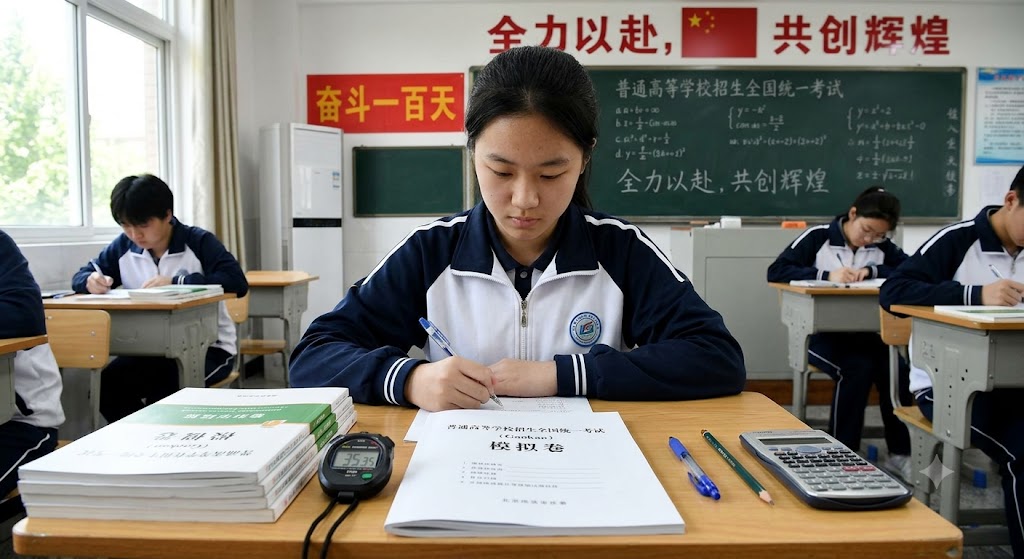
Additional Information
What the Course Entails and Exam Details
The Gaokao is renowned for its breadth and depth, assessing a wide range of analytical, problem-solving, and critical thinking skills. The core curriculum is standardized nationwide, though specific provinces may have slight variations in the elective subject structures. A proper Gaokao practice course and exam prep program must cover all compulsory subjects and provide tailored support for chosen electives.
The general structure often follows a standard pattern, although recent reforms, commonly referred to as the '3+1+2' model in many regions, have introduced more flexibility:
Compulsory Subjects:
Chinese Language and Literature (语文): Focusing on reading comprehension (modern and classical), classical poetry, and essay writing.
Mathematics (数学): A comprehensive test covering algebra, calculus, geometry, probability, and mathematical reasoning.
Foreign Language (外语): Usually English, but sometimes alternatives like Japanese, Russian, German, or French are permitted. It tests listening, grammar, reading, and writing.
Elective Subjects (Depending on the model): Students generally choose between a Science Track (自然科学) and a Humanities/Social Science Track (人文社会科学).
Science Track often includes: Physics, Chemistry, and Biology.
Humanities Track often includes: History, Geography, and Political Science.
In the '3+1+2' reform regions: Students must take the three compulsory subjects, choose either Physics or History, and then choose two more subjects from Chemistry, Biology, Geography, and Politics.
A full practice regimen includes comprehensive reviews of each subject syllabus, breakdown of key concepts, and extensive drilling on past paper question types. The total score, often out of 750 points (e.g., 150 each for the three core, 100 each for the three electives), determines a student’s rank within their province.
What to Expect in the Final Exam
The official Gaokao is a massive, highly synchronized event that takes place annually over two to four days, typically in early June. The atmosphere is quiet, strict, and intensely focused. Understanding the environment and format is essential for minimizing anxiety.
1. Exam Format and Question Types: The exam uses a diverse range of question formats to measure different cognitive levels:
Multiple Choice Questions (MCQs): Prevalent across all subjects to test foundational knowledge quickly and accurately.
Fill-in-the-blank: Requiring precise recall and application of definitions or formulas.
Short Answer and Calculation Questions: Common in Math and Science subjects, requiring students to show their work and logical steps.
Comprehensive Analytical Questions: Long-form answers in Humanities, requiring synthesis of information and reasoned argumentation.
Essays (作文): A cornerstone of the Chinese subject, demanding high-level language proficiency, structured thinking, and often, cultural or philosophical depth.
2. Time Limits and Strictness: Each subject has a strict time limit, typically ranging from 90 to 150 minutes. Time management is crucial, as many students report the exam is a race against the clock. The exam is administered under rigorous security protocols to prevent cheating, with cell phones and unauthorized materials strictly banned.
3. Scoring and University Admission: The Gaokao is not a "pass/fail" exam. Rather, a student's raw score is used to rank them within their home province. Universities set their admission 'cutoff lines' (分数线) based on these rankings. Scoring well opens doors to elite Project 985 and Project 211 universities, while lower scores might lead to second- or third-tier institutions, or vocational colleges.
How to Study and Exam Centers
Effective Gaokao prep is less about "cramming" and more about consistent, strategic effort over time. Students must build stamina, speed, and accuracy alongside deep conceptual understanding.
Study Strategies:
Master the Syllabus: Obtain and meticulously review the official exam outline (考试大纲) for each subject in your province.
Intensive Past Paper Practice: This is the most critical strategy. Work through official past papers from the last 5–10 years under timed conditions to familiarize yourself with question formats, common traps, and difficulty levels.
Simulated Mock Exams: Regularly participate in full-scale mock exams (模拟考试) offered by schools or prep centers to simulate the pressure and timing of the real event.
Analyze Mistakes: Keep a 'mistake notebook' (错题本). Don't just find the correct answer; analyze why you got a question wrong to prevent repeating the error.
Balanced Well-being: Ensure adequate sleep, nutrition, and exercise. Burnout is a real risk, and maintaining a healthy mind and body is essential for sustained peak performance.
Exam Centers: The Gaokao is administered by provincial and municipal education examination authorities under the guidance of the Ministry of Education.
Designated Test Centers: The exam does not take place online. It is held in designated physical test centers, which are typically local high schools or other standard educational facilities converted for the duration.
Registration: Students must register for the exam through their high schools or local education bureaus well in advance, usually in the preceding autumn or winter. International students must follow specific registration protocols for international applicants to Chinese universities.
Job Opportunities from the Course
The Gaokao itself is not a professional certification that unlocks a specific job title. Instead, it is the fundamental platform that unlocks a university education, which in turn provides specialized training and credentials for almost any professional career path in China. The prestige of the university attended—directly determined by the Gaokao score—often correlates strongly with entry-level job opportunities and long-term career trajectory.
Below are some examples of specific career paths and job opportunities typically accessed after completing specific university majors made possible by a strong Gaokao performance:
Post-University Career Examples:
Software Engineer / Data Scientist: (Unlocked by a strong Gaokao Science track score leading to a Computer Science or Data Major at a top university)
Medical Doctor / Surgeon: (Requires exceptional overall Gaokao Science track scores to enter competitive Medical programs)
Civil / Mechanical / Electrical Engineer: (Requires strong performance in Physics and Math for entry into key Engineering programs)
Investment Banker / Financial Analyst: (Achievable through Economics, Finance, or Math majors at elite business schools)
Lawyer / Legal Consultant: (Requires strong scores, often in the Humanities track, to enter specialized Law schools)
University Professor / Researcher: (Accessible through strong scores in the relevant field, leading to advanced degrees)
Diplomat / Foreign Service Officer: (Highly competitive, often requiring specialized training in Foreign Languages and International Relations at prestigious institutions like China Foreign Affairs University)
High School Teacher: (Requires strong subject knowledge and often a degree from a Normal (Teacher Training) University)
A high Gaokao score essentially gives a student more choices and better odds of entering high-growth, prestigious, and lucrative fields.
Frequently Asked Questions
Reviews
5.0
Based on 0 reviews
Leave a Review
No reviews yet. Be the first to review!