
AP Comparative Government (AP COGO) China Practice Test
$69.00
- Buy to unlock unlimited access to all Quiz questions.
- After purchase you can print a PDF of the whole quiz at any point. The PDF will contain the questions and the correct answers.
About this Exam
The AP Comparative Government (AP COGO) China Practice Test is a crucial tool designed to assess a student's preparedness for the specific section of the AP Comparative Government and Politics exam that focuses on the People's Republic of China. This exam is primarily intended for high school students enrolled in an AP Comparative Government and Politics course who seek to achieve a high score on the official College Board exam, potentially earning college credit. It provides a simulated testing experience that targets one of the six core countries covered in the curriculum, helping students identify areas of strength and weakness in their understanding of Chinese politics, government structure, political culture, and international relations. A strong performance on this practice test demonstrates a deep comprehension of one of the world's most influential and unique political systems.
Ready to test your knowledge?
Buy Now to Access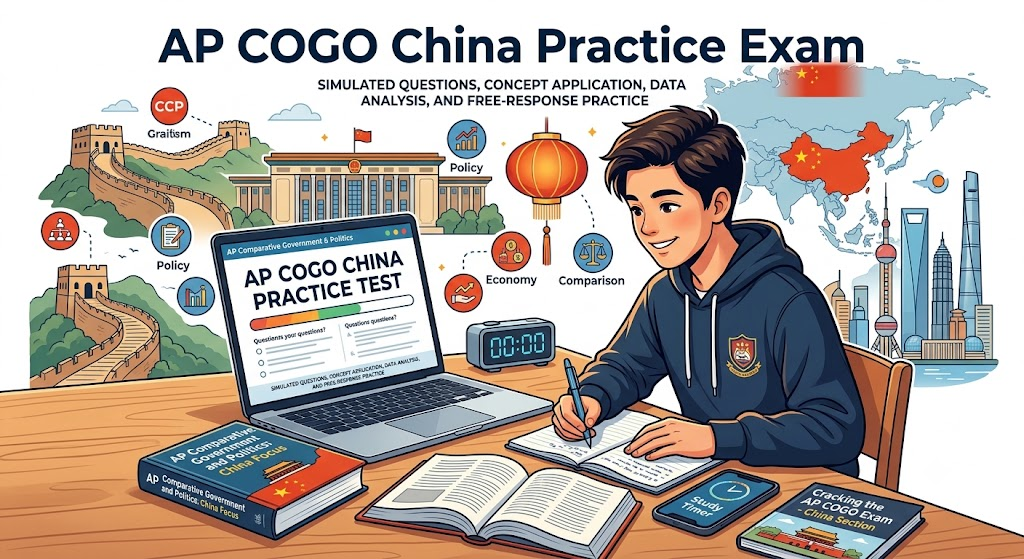
Additional Information
What the Course Entails and Exam Details
The AP Comparative Government and Politics course provides students with a foundational understanding of different political structures, behaviors, and institutions across six specific countries: the United Kingdom, Russia, China, Nigeria, Mexico, and Iran. While the overall course covers general comparative concepts, the AP COGO China Practice Test specifically concentrates on the Chinese political system.
The curriculum for the China section entails a detailed examination of:
Political Structure and Institutions: Analyzing the roles of the Communist Party of China (CCP), the government hierarchy, including the National People's Congress and the State Council, and the central role of the party-state.
Political Culture and Socialization: Investigating the ideological foundations, history, the impact of traditional Confucian values, and how political culture is shaped and transmitted.
Citizens, Society, and the State: Examining the relationship between the state and its citizens, political participation, the role of social movements, civil society, and the management of dissent.
Political and Economic Change: Studying China's transition from a command economy to a market-oriented "socialist market economy," and the consequences for political power and social structure.
Public Policy: Evaluating key policy challenges such as environmental sustainability, population control, economic inequality, and human rights.
The entire AP Comparative Government and Politics Exam, including the China section, is structured into two main parts: Multiple Choice (MCQ) and Free Response (FRQ). The practice test will mimic this breakdown, focusing its questions specifically on Chinese context within these formats.
What to Expect in the Final Exam
The full, official AP Comparative Government and Politics Exam is approximately 2 hours and 25 minutes long and is divided into two equally weighted sections.
Section I: Multiple Choice Questions (MCQ)
Time: 1 hour
Number of Questions: 55
Description: Students must answer 55 multiple-choice questions. These questions are designed to assess the student's ability to apply political concepts, analyze data, and understand political relationships and trends. A significant portion of these questions will directly relate to the specific characteristics of the Chinese political system.
Section II: Free Response Questions (FRQ)
Time: 1 hour and 25 minutes
Number of Questions: 4
Description: This section requires students to write four essays. These consist of:
One Concept Application question, asking to explain political concepts in context.
One Data Analysis question, requiring interpretation of quantitative data in a political context.
One Comparison question, asking students to compare the political systems of different core countries (including potentially China with another).
One Argument question, requiring the student to construct an evidence-based argument about a political concept or institution. A specific prompt might ask to build an argument relating directly to Chinese governance or policy.
Scoring: The AP exam is scored on a 1 to 5 scale, with 5 being the highest and indicating being extremely well qualified. To receive college credit, students typically need a score of 3, 4, or 5, depending on the individual college's policy. The practice test aims to simulate this structure and guide students toward achieving a top score.
How to Study and Exam Centers
Preparation for the AP COGO China Practice Test, and ultimately the real exam, demands a consistent and strategic study plan.
Comprehensive Review: Start by reviewing your course notes, textbooks, and any official College Board curriculum materials. Pay close attention to key terms, political definitions, and significant historical events specific to Chinese political development. Understanding the detailed structure of the CCP and its overlap with government functions is paramount.
Targeted Study Guides: Use AP Comparative Government review books and online resources that offer detailed sections on China. Create flashcards for critical concepts such as the "Mandate of Heaven," "Hundred Flowers Campaign," "Great Leap Forward," "Cultural Revolution," "reform and opening up," "one-party state," and specific government institutions like the Politburo.
Practice with Past Exams: The most effective study method is practicing with previous years' official AP exams and practice questions. Analyze the College Board's scoring guidelines and sample student responses to understand what constitutes a high-quality answer, particularly for the free-response questions. This practice test provides a similar simulation.
Analyze Practice Test Results: After taking this practice test, carefully review the explanations for each answer. Identify specific areas where you missed questions (e.g., economic policy, social movements, central-local relations). Focus your subsequent studying on these specific gaps.
Exam Centers: The AP Comparative Government and Politics Exam is typically administered on a specific date in May through authorized high schools that have an AP program. Students should register for the exam through their high school's AP coordinator. While most students take the exam at their own school, homeschooled students or students whose schools do not offer the AP program can still arrange to take the exam at a nearby high school that does. It is important to confirm the exact location and procedures with your coordinator.
Job Opportunities from the Course
A high score on the AP Comparative Government and Politics exam and a deep understanding of Chinese governance provides a strong foundation for various academic and professional paths. While the exam score itself does not directly grant a job certification, it is highly valued by universities and sets students on a path toward careers that require global awareness and analytical skills.
Potential career fields and roles include:
International Relations Specialist: Analyzing global political trends and representing governmental or non-governmental organizations internationally.
Foreign Service Officer (Diplomat): Representing the interests of your country abroad and managing diplomatic relations.
Intelligence Analyst: Gathering and analyzing information related to foreign countries and global security issues.
Political Scientist: Conducting research on political systems, behavior, and public policy.
Academic Researcher/Professor: Specializing in comparative politics, East Asian studies, or Chinese government.
Global Business Consultant: Advising multinational corporations on navigating political risks and regulatory environments in international markets.
International Journalist: Reporting on global events, politics, and social issues.
Policy Analyst for Think Tanks: Researching and proposing solutions to international policy challenges.
Taking and excelling in the AP Comparative Government course, and specifically performing well on the China section, equips students with critical thinking abilities and crucial knowledge for success in a globalized world.
Frequently Asked Questions
Reviews
5.0
Based on 0 reviews
Leave a Review
No reviews yet. Be the first to review!