
Chicago Emergency Medical Technician
$69.00
- Buy to unlock unlimited access to all Quiz questions.
- After purchase you can print a PDF of the whole quiz at any point. The PDF will contain the questions and the correct answers.
About this Exam
The Emergency Medical Technician (EMT) certification is a
crucial credential for individuals seeking to provide emergency medical care in
pre-hospital settings. This certification path, specifically tailored for the
Chicago area, is designed for compassionate individuals who possess strong
critical thinking skills and a desire to help others during medical
emergencies. EMTs are trained to provide basic life support (BLS), including
patient assessment, airway management, cardiopulmonary resuscitation (CPR), and
basic medication administration. This practice exam and the subsequent official
licensure are essential for starting a career in Emergency Medical Services
(EMS) within Chicago's diverse and demanding emergency response system.
Ready to test your knowledge?
Buy Now to Access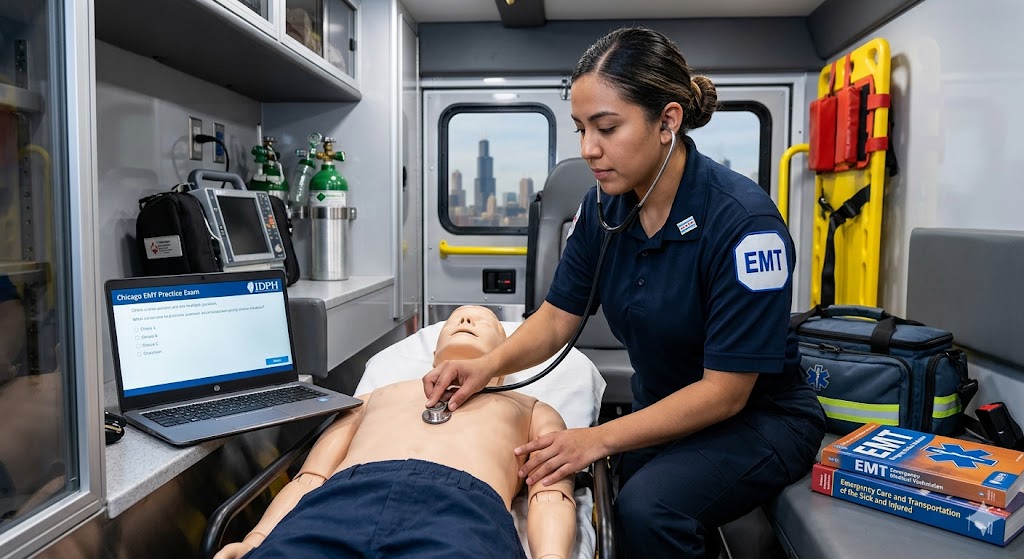
Additional Information
- What the Course
Entails and Exam Details
Preparing for the EMT certification involves completing a
robust training program approved by the Illinois Department of Public Health
(IDPH) and, often, specifically aligned with Chicago EMS system requirements.
The curriculum covers a wide array of critical topics, including patient
assessment (both medical and trauma), airway management and ventilation,
cardiovascular emergencies, medical emergencies (such as seizures, diabetic
reactions, and allergic reactions), trauma care (including bleeding control and
shock management), obstetrics and pediatric emergencies, EMS operations, and
relevant legal and ethical considerations. In addition to classroom learning,
programs usually incorporate extensive hands-on skills practice in labs and
clinical rotations in emergency departments or on ambulances to provide
real-world experience.
What to Expect in
the Final Exam
The culmination of your EMT training involves successfully
passing both a cognitive exam and a psychomotor (practical) skills exam. The
cognitive exam is typically a multiple-choice test that evaluates your
knowledge of EMT principles and practices. While specific details can vary
slightly depending on the testing provider (often the National Registry of
Emergency Medical Technicians - NREMT, recognized by Illinois), you can expect
a comprehensive exam covering the core curriculum. The psychomotor exam, on the
other hand, is a hands-on assessment where you must demonstrate proficiency in
several critical skills, such as patient assessment, spinal immobilization,
bleeding control, BVM ventilation, and oxygen administration. Passing scores
are required for both components to obtain licensure. The cognitive exam often
has a time limit, which you should confirm with your testing agency.
How to Study and
Exam Centers
Effective preparation for both the cognitive and practical
exams is paramount. Start by thoroughly reviewing your course materials,
including textbooks, lecture notes, and practical skill sheets. Utilize
practice exams to familiarize yourself with the type of multiple-choice
questions you will encounter and to identify areas where you need additional
study. For the psychomotor exam, practice your skills relentlessly, both
individually and with classmates, using the specific skill sheets provided by
your training program or testing agency. Pay close attention to detail and
strive for seamless execution of each step. The NREMT cognitive exam is
typically administered at Pearson VUE testing centers throughout the Chicago
area and Illinois. You will need to create an account on the NREMT website and
schedule your exam slot. Information regarding the practical skills exam
schedule and locations will be provided through your IDPH-approved EMT training
program.
Job Opportunities
from the Course
Obtaining your EMT licensure in Chicago opens the door to a
challenging and rewarding career dedicated to helping others. This
certification is a fundamental requirement for many positions within the
emergency services and healthcare sectors. Graduates with this credential
frequently find employment in various roles, including:
- EMT
for private ambulance services throughout Chicago
- Firefighter/EMT
within the Chicago Fire Department or surrounding suburban fire
departments
- Emergency
Department Technician (ER Tech) in Chicago area hospitals
- EMT
for event medical services at concerts, sporting events, and festivals
- Industrial
or corporate EMT for large manufacturing facilities or corporate campuses
- EMT
on transport teams for stable patient transfers
- EMT
in specialized rescue units or search and rescue teams
- EMT
as a stepping stone to further medical education, such as Paramedic,
Nurse, or Physician Assistant programs
Frequently Asked Questions
Reviews
5.0
Based on 0 reviews
Leave a Review
No reviews yet. Be the first to review!