
CEODD Dive Physics Practice
$69.00
- Buy to unlock unlimited access to all Quiz questions.
- After purchase you can print a PDF of the whole quiz at any point. The PDF will contain the questions and the correct answers.
About this Exam
Welcome to the ultimate guide for the CEODD Dive Physics Practice Exam. This certification is a crucial milestone for serious diving professionals, designed for aspiring Divemasters, Assistant Instructors, and anyone seeking a deep understanding of the physiological and physical principles of scuba diving.
This exam isn't just about memorizing formulas; it's about ensuring you possess the critical thinking skills to keep yourself and your future students safe underwater. Mastery of dive physics is what separates recreational divers from certified leaders who can calculate gas consumption, manage decompression obligations, and understand equipment function on a fundamental level.
This study guide will walk you through what to expect, how to prepare, and the incredible career opportunities that unlock once you pass.
Ready to test your knowledge?
Buy Now to Access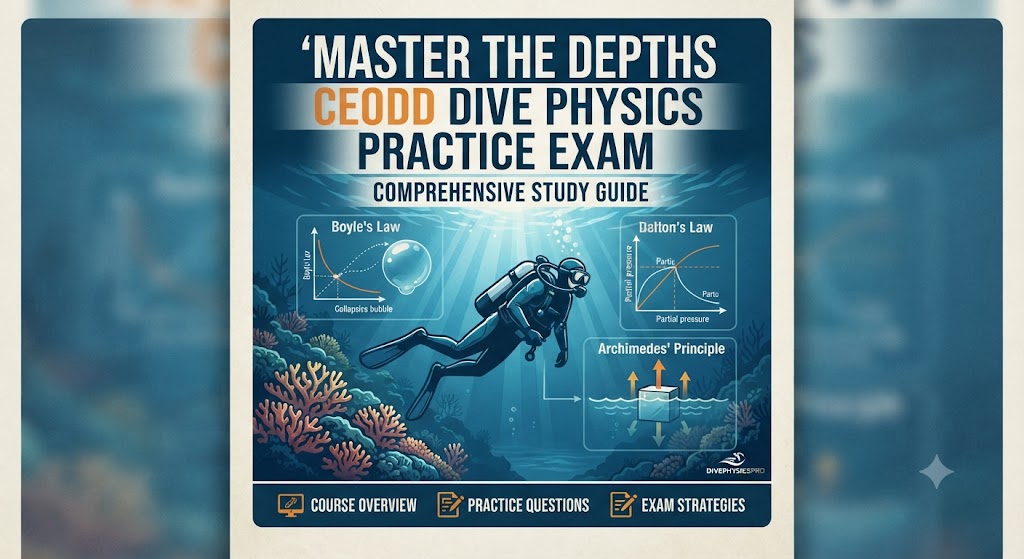
Additional Information
What the Course Entails and Exam Details
The CEODD Dive Physics course and subsequent exam cover a
specific body of knowledge essential for diving leadership. The curriculum is
built around the practical application of physical laws in an underwater
environment.
Core topics you must master include:
- The
Gas Laws: This is the heart of dive physics. You will be tested
extensively on Boyle's Law (pressure-volume relationship), Dalton's Law
(partial pressures of gas mixtures), Henry's Law (gas solubility in
liquids), Charles's Law and the General Gas Law (temperature-pressure-volume
relationships).
- Buoyancy
and Archimedes' Principle: You must be able to calculate the buoyant
force acting on submerged objects, determine the lift requirements for
salvage operations, and understand the principles of weighting and
buoyancy control.
- Pressure:
A thorough understanding of absolute, gauge, and ambient pressure is
required. You'll calculate pressure changes at depth in both saltwater and
freshwater.
- Light
and Sound Underwater: Questions may cover refraction (why things look
closer and larger) and the speed and directionality of sound transmission
in water compared to air.
- Heat
Transfer: You'll need to understand conduction, convection, and
radiation in the context of thermal protection (wetsuits vs. drysuits) and
the risk of hypothermia.
The final exam is a rigorous assessment of these topics. It
typically consists of 50 to 75 multiple-choice questions. You should also
expect several practical, open-ended calculation problems where you must show
your work.
What to Expect in
the Final Exam
Preparation is key to success. Knowing the format and rules
of the CEODD Dive Physics Practice Exam will help you manage your time and
anxiety effectively.
Format: The exam is almost always a proctored,
closed-book test. It combines standard multiple-choice questions with a
significant portion dedicated to calculation problems.
Passing Score: The standard passing score for the
CEODD Dive Physics Exam is a minimum of 75%. This high threshold ensures that
certified professionals have a comprehensive and reliable grasp of the
material.
Time Limit: You will typically have 3 hours to
complete the exam. While this may seem generous, the calculation problems
require careful thought and multiple steps, so time management is crucial.
Rules and Materials: You will not be allowed to use
any personal study notes or textbooks. However, you will be provided with the
following materials:
- A
clean, erasable slate and marker for calculations.
- A
non-programmable calculator.
- The
CEODD standard dive tables and/or an equivalent dive computer simulator.
How to Study and Exam Centers
Passing the CEODD Dive Physics Exam requires a multi-faceted
study approach. Relying solely on reading the course manual is rarely enough.
Actionable Study Strategies:
Master the Formulas:
Create flashcards for every major gas law formula. Don't just memorize them;
understand the relationship between the variables (e.g., pressure increases,
volume decreases).
Practice Calculation Problems
Daily: The best way to prepare is to work through practice problems every
single day. Start with simple conversions and gradually move to complex word
problems involving multiple gas laws and buoyancy calculations.
Use the
"Known/Unknown" Method: For every practice problem, clearly write
down what the problem gives you (Knowns) and what it is asking for (Unknowns).
This helps prevent errors in setting up the equation.
Form a Study Group:
Explaining complex physics concepts to others is one of the most effective ways
to solidify your own understanding. Challenge each other with new problems.
Take Timed Practice Exams:
Simulate the real testing environment. Find a quiet space, set a timer, and
work through a full practice exam without interruption.
Where and How to Take the Exam: The CEODD Dive
Physics Exam is administered through authorized channels only.
- Online
Portal: For remote candidates, CEODD may offer the exam via a secure,
proctored online platform. This requires a reliable webcam, microphone,
and lockdown browser software.
- Authorized
Dive Centers and Schools: The most common method is to take the exam
in person at an authorized CEODD Dive Center or through a registered
Instructor Trainer. This often happens as part of a scheduled Divemaster
or Instructor Development Course (IDC).
- Special
Testing Events: CEODD sometimes hosts large-scale testing events at
dive expos or regional headquarters.
To schedule your exam, you must first register on the
official CEODD website and provide proof of prerequisite certifications (e.g.,
Rescue Diver). Once approved, you can locate a proctor or testing center near
you.
Job Opportunities from the Course
Earning the CEODD certification with a strong pass on the
physics exam is a major asset to your professional diving resume. It
demonstrates a level of academic rigor and safety consciousness that employers
value highly.
This certification is a direct pathway to the following
careers:
- Certified
PADI/NAUI/SSI Divemaster: You can lead certified divers on underwater
tours, assist instructors in training, and conduct specific programs like
the Discover Scuba Diving experience.
- Scuba
Diving Instructor: The Dive Physics exam is a prerequisite for
entering an Instructor Training Course (ITC/IDC). As an instructor, you
will teach these very principles to new generations of divers.
- Technical
Diving Support Team: Advanced technical diving operations, including
deep CCR (Closed Circuit Rebreather) diving and cave exploration, require
surface support personnel who understand gas management and decompression
physics at an expert level.
- Commercial
Diver (Tender/Diver): While commercial diving has its own specific
training, a strong background in dive physics provides a significant
advantage for roles in offshore oil and gas, marine construction, and
underwater inspection.
- Dive
Center Manager or Operator: Owning or managing a dive operation
requires a deep understanding of equipment maintenance, compressor
operation, and gas blending, all of which are rooted in dive physics.
Frequently Asked Questions
Reviews
5.0
Based on 0 reviews
Leave a Review
No reviews yet. Be the first to review!