
CDC Services EMRE Readiness (Module 4) Practice
$69.00
- Buy to unlock unlimited access to all Quiz questions.
- After purchase you can print a PDF of the whole quiz at any point. The PDF will contain the questions and the correct answers.
About this Exam
Welcome to the comprehensive guide for the CDC Services EMRE Readiness (Module 4) Practice Exam. This critical assessment is designed for healthcare professionals, emergency responders, and public health personnel who are integral to managing medical logistics during public health crises. This module specifically focuses on the Electronic Medical Resource Exchange (EMRE), a vital digital tool used for tracking, requesting, and deploying critical medical countermeasures and assets. By mastering Module 4, you demonstrate your readiness to utilize this system effectively under pressure, ensuring that life-saving resources reach the populations that need them most efficiently.
Ready to test your knowledge?
Buy Now to Access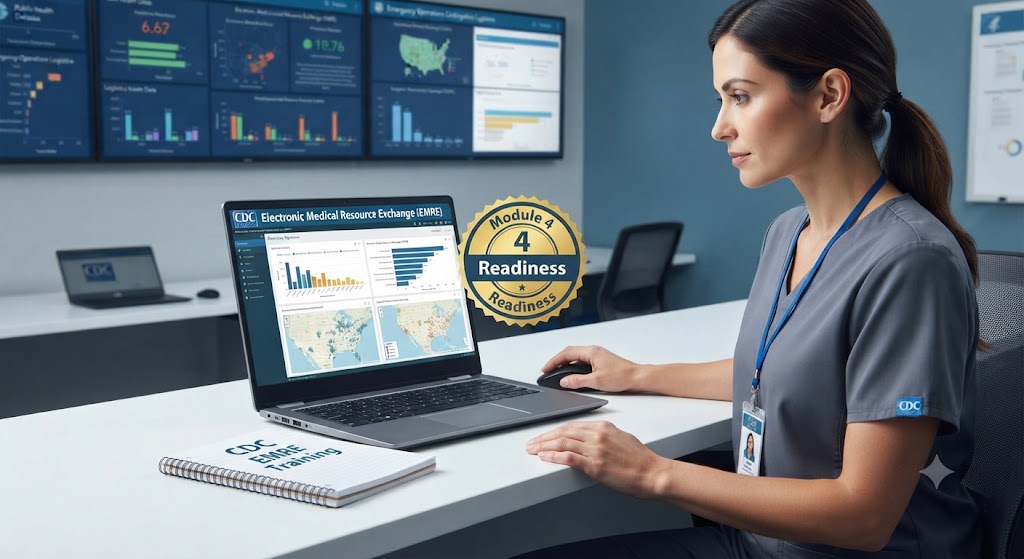
Additional Information
What the Course
Entails and Exam Details
The CDC Services EMRE Readiness Module 4 course provides an
in-depth look into the digital ecosystem of medical logistics management. It
moves beyond theory, offering practical, scenario-based training. The
curriculum is structured to ensure you understand not just how to use
the software, but why specific data inputs and requests are critical for
national stockpiling and distribution strategies.
Key topics covered in this module include:
- System
Navigation and Access: Understanding user roles, security protocols,
and navigating the EMRE dashboard.
- Resource
Requesting and Validation: Learning the precise steps to submit
requests for countermeasures, PPE, and medical equipment, including how to
validate these requests at the local, state, and federal levels.
- Inventory
Tracking and Visibility: Mastering the tools for real-time monitoring
of asset locations, quantities, and status throughout the supply chain.
- Reporting
and Data Analytics: Utilizing EMRE’s reporting features to generate
situation reports (SITREPS) and analyze data to predict future needs.
- Downtime
Procedures: Understanding critical manual backup processes and data
recovery protocols in the event of a system or network failure during an
emergency.
The final exam rigorously tests your ability to apply these
concepts. It is not merely a memory test of definitions; it is a simulation of
your operational capability within the EMRE system.
What to Expect in the Final Exam
The CDC Services EMRE Readiness (Module 4) Final Exam is
typically administered in a secure, proctored environment, either online via a
secure browser or at an authorized testing facility. The exam format is a blend
of question types designed to test both your theoretical knowledge and your
practical application skills.
- Format:
The exam includes traditional multiple-choice questions, multiple-response
questions (select all that apply), and complex scenario-based simulations.
The simulations will require you to navigate a replica of the EMRE
interface, make decisions based on provided data, and troubleshoot common
logistical bottlenecks.
- Number
of Questions: The exam generally consists of 60 to 75 questions.
- Time
Limit: You will be allotted 120 minutes (2 hours) to complete the
exam. This time limit is designed to be sufficient but requires you to
work efficiently, especially during the simulation sections.
- Passing
Score: A minimum score of 80% is required to pass and receive
certification for this module.
- Rules:
This is a closed-book exam. No external materials, unauthorized software,
or communication devices are permitted in the testing area.
How to Study and
Exam Centers
Success in the EMRE Readiness Module 4 Exam requires a
strategic and disciplined study plan. Relying solely on course materials may
not be enough to master the practical simulation components.
- Utilize
the Official Study Guide: Begin with the official participant guide
and any supplemental checklists provided by the CDC. Pay close attention
to the "Key Actions" and "Standard Operating
Procedures" (SOPs) outlined for each scenario.
- Engage
in Active Recall: Do not just re-read the material. Create flashcards
for key terms, acronyms (e.g., SNS, JIT, CBRNE), and system navigation
steps.
- Master
the Simulations: If the course provides practice scenarios or a demo
version of the EMRE software, use it repeatedly. Practice requesting
assets, running reports, and navigating downtime procedures until these
actions become second nature.
- Form
Study Groups: Discussing complex logistical scenarios with peers can
uncover gaps in your understanding. Challenge each other with "What
if?" questions related to resource allocation during a crisis.
- Take
the Official Practice Exam: The most valuable resource is the official
CDC Services EMRE Readiness (Module 4) Practice Exam. Treat this practice
test as if it were the real thing. Analyze your results, not just to see
what you got wrong, but to understand why the correct answer is
right and why the other options are wrong.
Exam Centers and Registration:
The exam is primarily administered online through the CDC's
designated Learning Management System (LMS) or an authorized third-party
testing portal. Upon completing the required coursework, you will receive
instructions and an authorization code to register for the exam. While most
candidates take the exam remotely using a proctored service (such as ProctorU
or Pearson VUE OnVUE), some organizations may require candidates to sit for the
exam at a designated physical testing center (e.g., an authorized hospital
training room or a Pearson VUE Professional Center). Ensure you have a reliable
high-speed internet connection and a quiet environment if taking the exam
remotely.
Job Opportunities
from the Course
Earning the CDC Services EMRE Readiness (Module 4)
Certification validates your expertise in a highly specialized and critical
field. This qualification is often a prerequisite or a significant advantage
for roles responsible for the strategic national stockpile (SNS), medical
countermeasure (MCM) distribution, and public health emergency preparedness.
This certification unlocks career opportunities in federal,
state, and local government agencies, as well as within healthcare systems and
private sector organizations that contract with public health entities.
Specific job titles and career paths include:
- Public
Health Program Manager (Logistics): Overseeing the planning,
development, and execution of public health emergency response programs, specifically
focusing on medical materiel management.
- SNS
Coordinator (Strategic National Stockpile Coordinator): Managing the
receipt, staging, storage, and distribution (RSS) of SNS assets within a
jurisdiction, using EMRE for tracking.
- Medical
Countermeasures (MCM) Specialist: Coordinating the operational aspects
of dispensing or administering medical countermeasures during an emergency
event.
- Emergency
Preparedness Coordinator: Developing and implementing emergency
response plans for hospitals, healthcare coalitions, or public health
departments.
- Public
Health Analyst (Logistics): Analyzing data related to resource
requests, inventory levels, and distribution timelines to optimize public
health logistics.
- Healthcare
Logistics Manager: Leading the supply chain operations within a
hospital system, ensuring integration with public health emergency
response systems.
- Disaster
Preparedness Consultant: Advising organizations on best practices for
medical logistics and emergency readiness.
Frequently Asked Questions
Reviews
5.0
Based on 0 reviews
Leave a Review
No reviews yet. Be the first to review!