
CDC Pumper Driver/Operator (D/O) Practice Exam
$69.00
- Buy to unlock unlimited access to all Quiz questions.
- After purchase you can print a PDF of the whole quiz at any point. The PDF will contain the questions and the correct answers.
About this Exam
Welcome to your essential resource for conquering the CDC Pumper Driver/Operator (D/O) certification. This program is a cornerstone for firefighters seeking to elevate their careers and take on the critical responsibility of operating and maintaining fire apparatus. Designed for dedicated fire service personnel, this certification validates a candidate’s cognitive and practical skills as defined by the NFPA 1002 Standard. Successfully passing this exam means you are not only a skilled driver but also a proficient technician capable of delivering life-saving water flow to the scene of an emergency. This comprehensive guide and practice exam are your first steps toward achieving this key professional milestone and ensuring the safety of your crew and community.
Ready to test your knowledge?
Buy Now to Access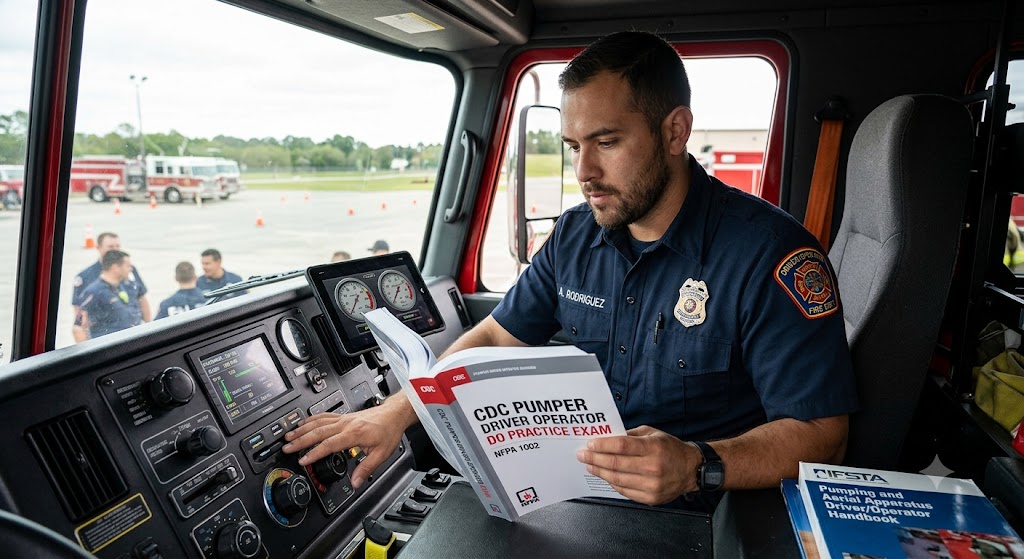
Additional Information
What the Course Entails and Exam Details
The CDC Pumper Driver/Operator (D/O) course is a rigorous
program that blends theoretical knowledge with hands-on practice. It
meticulously covers a wide range of topics essential for the safe and effective
operation of a pumping apparatus. The curriculum is typically structured around
key areas, beginning with comprehensive training on preventative maintenance,
vehicle inspection, and the legal and safety aspects of emergency vehicle
operation. Students gain a deep understanding of water supply systems, the
principles of hydraulics, and the science behind fire streams. A significant
portion of the course is dedicated to mastering the complexities of the fire
pump itself, including various types of pumps, their construction, and how to
operate them from both pressurized sources, such as hydrants, and static
sources, such as lakes or portable tanks. Advanced topics often include foam
application systems and the testing of pumping apparatus.
The examination component of this certification is
dual-faceted, consisting of both a written and a practical evaluation to ensure
a candidate's holistic competence. The process is designed to be thorough and
fair, strictly adhering to the job performance requirements (JPRs) outlined by
the NFPA.
What to Expect in
the Final Exam
When you arrive at the final exam for the CDC Pumper
Driver/Operator (D/O) certification, you should be prepared for a comprehensive
test of your knowledge and skills.
The written portion of the exam typically features a
randomly generated series of multiple-choice questions. A common format
includes 50 to 100 questions, and candidates are generally allocated a time
limit, often around 1 hour and 15 minutes, to complete it. This part of the
exam focuses on evaluating your cognitive understanding of the material, from
hydraulic calculations to safety protocols and maintenance procedures. A score
of 70% or higher is a standard requirement for a passing grade, demonstrating a
strong grasp of the essential concepts. For those who are unsuccessful, a
retest policy is usually in place, allowing individuals to retake the exam
within a specified timeframe.
The practical examination is equally vital and is designed
to assess your ability to apply your knowledge in a real-world setting. You
will be evaluated on your performance of key practical skills, or JPRs.
Evaluators may select a percentage of total skills for testing, but candidates
must achieve 100% competency in all the tested skill stations. These practical
tests often include driving exercises such as the serpentine course, alley
dock, and diminished clearance maneuvers, as well as hands-on pump operations,
requiring you to efficiently and accurately transition from driving to pumping,
and to produce effective fire streams from various sources.
How to Study and
Exam Centers
Preparation is the absolute key to success in the CDC Pumper
Driver/Operator (D/O) exam. To ensure you are fully equipped to excel, it is
highly recommended to follow a structured study plan.
First, gain a thorough command of the primary text, such as
the International Fire Service Training Association (IFSTA) Pumping and Aerial
Apparatus Driver/Operator Handbook. Attend all training sessions diligently and
engage actively with the material. Make sure to complete any pre-course work,
as it forms the foundation for your practical learning.
Utilization of practice exams, like the one associated with
this guide, is incredibly beneficial. They help familiarize you with the types
of questions and the overall format of the written test. Focus on mastering
theoretical and fireground hydraulic calculations, as this is often a challenging
section.
Equally important is to practice the practical skills.
Arrange for regular, supervised training with your department’s apparatus. Work
with a qualified evaluator to identify and refine your technique for each JPR, especially
those related to positioning, drafting, and complex pumping scenarios.
The exams are administered by authorized agencies, which
often include state fire colleges (e.g., Alabama Fire College), community
colleges with accredited public safety programs (e.g., Bucks County Community
College), or specific state commissions (e.g., Texas Commission on Fire
Protection). Many of these organizations utilize secure online testing portals
for the written portion. The practical assessments are typically conducted at
designated physical training centers or fire academies that are properly
equipped for hands-on evaluation. For specific details on testing locations and
schedules, you should contact your sponsoring agency or the accredited
certifying body in your jurisdiction. Reciprocity through IFSAC or ProBoard may
also be an option if you hold valid certifications from other accredited
entities.
Job Opportunities
from the Course
Upon earning your CDC Pumper Driver/Operator (D/O)
certification, you will have unlocked a range of career paths and specific job
opportunities within the fire service. This credential is highly valued, and in
many departments, it is a required step for promotion. The roles this
certification unlocks are crucial and come with increased responsibility and
respect. They include:
- Pumper
Driver/Operator (D/O): This is the direct career path, placing you
behind the wheel of the primary engine and making you responsible for all
pump operations at the fire scene.
- Engineer:
Often synonymous with the driver/operator role, this title emphasizes the
technical and maintenance responsibilities for the fire apparatus.
- Firefighter
Specialist: Some large departments utilize this title for highly
specialized personnel, including those certified in apparatus operation
and advanced technical rescue.
- Lieutenant:
The D/O certification is often a key prerequisite for promotion to a
company officer rank like lieutenant, as it demonstrates technical
leadership and operational experience.
- Captain:
As with the lieutenant position, a command of apparatus operations is
essential for higher ranks, making this certification a foundational
element of a long-term fire service career.
- Apparatus
Maintenance Technician: For those with a strong interest in the
mechanical aspects of fire equipment, this certification opens doors to
specialized roles in fire department fleet maintenance.
This certification is not just a test; it is an investment
in your professional future and a testament to your commitment to excellence in
the fire service.
Frequently Asked Questions
Reviews
5.0
Based on 0 reviews
Leave a Review
No reviews yet. Be the first to review!