
CDC Pumper Driver/Operator (D/O) Practice
$69.00
- Buy to unlock unlimited access to all Quiz questions.
- After purchase you can print a PDF of the whole quiz at any point. The PDF will contain the questions and the correct answers.
About this Exam
The CDC Pumper Driver/Operator (D/O) certification validates that a candidate is qualified to drive, operate, and maintain fire service pumpers.
This certification is designed for experienced firefighters and emergency personnel who are seeking to advance their careers by taking on the responsibility of apparatus operations. The D/O is the backbone of fireground operations, ensuring that water flows reliably and safely to suppress fires.
Candidates must typically hold prerequisite certifications, such as Firefighter I and II, and possess a valid driver's license appropriate for operating heavy emergency vehicles. This rigorous certification confirms that the operator understands the mechanics of the apparatus and the physics of water flow under high-pressure conditions.
Ready to test your knowledge?
Buy Now to Access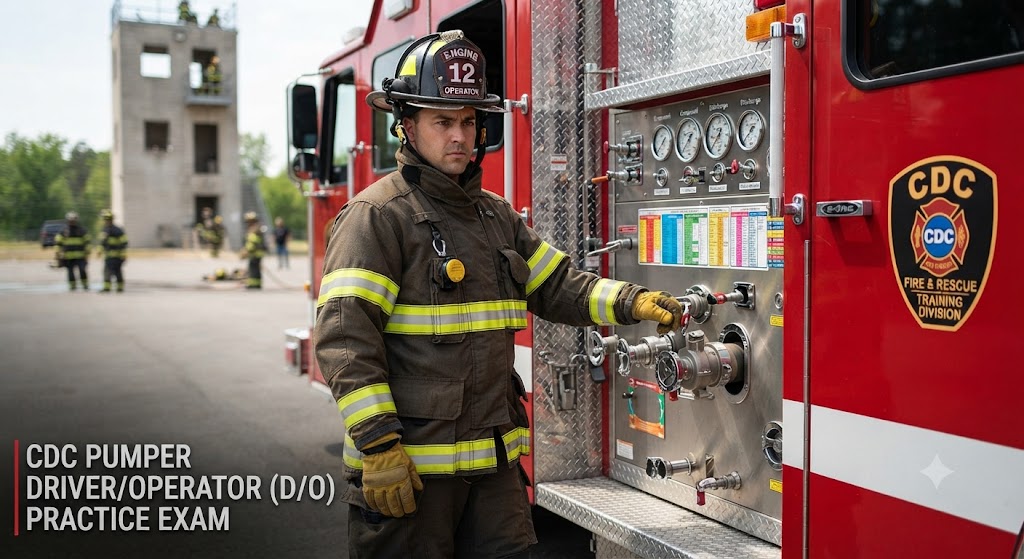
Additional Information
What the Course Entails and Exam Details
The curriculum for the Pumper Driver/Operator course is
extensive, blending theoretical knowledge with practical application. To
succeed, you must master several core competencies.
Core Course Topics Include:
- Preventative
Maintenance: Performing routine inspections, identifying mechanical
issues, and documenting maintenance checks.
- Apparatus
Operations: Understanding the specific controls, gauges, and safety
mechanisms of various pumper models.
- Water
Supply: Establishing reliable water sources, including hydrants and
static sources like drafting operations.
- Fire
Hydraulics: The most critical component. This involves calculating
pressures, friction loss, elevation loss/gain, and nozzle pressures to
ensure adequate flow (GPM).
- Pump
Systems: Detailed knowledge of centrifugal pumps, priming systems, and
pressure relief devices.
- Apparatus
Positioning: Safely placing the pumper at the scene considering fire
conditions, collapse zones, and water supply access.
- Master
Stream Operations: Deploying and operating deck guns and other
high-volume water delivery devices.
The certification typically consists of two parts: a written
cognitive exam and a practical skills evaluation (skills test).
What to Expect in
the Final Exam
The final exam is the culmination of your study and
training. It rigorously tests both your theoretical knowledge and your ability
to perform under pressure.
Written Cognitive Exam:
- Format:
This is typically a multiple-choice exam delivered via computer-based
testing or traditional paper-and-pencil formats, depending on the
authority having jurisdiction (AHJ) or certifying agency (e.g., State Fire
Marshal or Pro Board/IFSAC accredited entity).
- Number
of Questions: The exam usually contains 100 to 150 questions, often
weighted based on the complexity of the topic (e.g., hydraulics typically
carries a higher weight).
- Time
Limit: Candidates are generally allotted 2 to 3 hours to complete the
written portion.
- Passing
Score: A minimum score of 70% or 75% is usually required to pass.
Practical Skills Evaluation:
- Format:
This is a hands-on test where you must demonstrate proficiency in various
stations.
- Tasks:
You may be required to perform a pump service test, draft from a static
source, operate the pumper in relay operations, troubleshoot a sudden
pressure drop, and successfully calculate and set discharge pressures for
multiple attack lines simultaneously.
- Scoring:
The practical exam is usually Pass/Fail based on a detailed checklist of
critical steps and safety precautions. Failing a critical safety step can
result in an automatic failure of the entire station.
How to Study and
Exam Centers
Effective preparation is the key to success. Do not rely
solely on the course lectures; you must engage in active study.
Actionable Study Strategies:
Master the Hydraulics:
This is where most candidates struggle. Practice complex hydraulic calculations
repeatedly until they become second nature. Understand the "Fireground
Hydraulics" formulas, such as PDP = NP + FL + TPL + A/E. Use a dedicated
hydraulics workbook.
Review IFSAC/Pro Board
Manuals: The written exam is almost always based on the standard texts,
such as the IFSTA Pumper Driver/Operator Handbook or the Jones &
Bartlett Fire Service Apparatus Driver/Operator manual. Read the chapters
thoroughly.
Take a Practice Exam:
Utilizing a CDC Pumper Driver/Operator Practice Exam is one of the best
ways to gauge your readiness. Practice tests familiarize you with the question
format, highlight your weak areas, and help manage test anxiety.
Flashcards: Create
flashcards for formulas, definitions (e.g., net pump pressure, cavitation), and
preventative maintenance checks.
Hands-On Practice: Get
into the apparatus bay. Practice priming the pump, switching from tank to
hydrant, and setting pressures for simulated hose lays. Explain your actions
out loud as if you are teaching them to someone else.
Where and How to Take the Exam:
The final exam is administered by your specific certifying
authority.
- Authorized
Schools/Academies: If you are taking the course through a fire academy
or regional training center, the exams will likely be scheduled on-site
upon course completion.
- State
Fire Marshal Office: In many jurisdictions, the State Fire Marshal
coordinates the testing process. You may need to register for the exam
through their online portal.
- Accredited
Testing Centers: For agencies that use third-party testing (like
Pearson VUE for certain national certifications), you will schedule your
written exam at a physical testing center.
Always confirm the registration deadlines and required
prerequisites with your training officer or the certifying agency well in
advance of the exam date.
Job Opportunities
from the Course
Achieving the Pumper Driver/Operator certification is a
vital step in career advancement within the fire service. It signifies a high
level of technical competence and reliability.
This certification unlocks the following specific job titles
and career paths:
- Fire
Apparatus Operator (FAO): The primary driver and operator of a fire
engine or pumper.
- Engine
Operator: Specialized role focusing specifically on the operations of
the engine company's pumping apparatus.
- Driver/Engineer:
A combined role often found in larger departments, responsible for both
driving the apparatus and operating the machinery/pump.
- Relief
Driver/Operator: An essential position for personnel who fill in when
the regular operator is on leave or unavailable.
- Senior
Firefighter: In many departments, obtaining the D/O certification is a
prerequisite for promotion to Senior Firefighter or Engineer ranks.
- Fire
Instructor (Apparatus Operations): With experience and this
certification, you can become qualified to teach pumper operations to new
recruits.
- Company
Officer Preparation: The knowledge gained is crucial for future
officers who must manage fireground resources and understand the
capabilities of their apparatus.
By earning the CDC Pumper Driver/Operator certification, you
are proving your commitment to excellence and enhancing your value to your
department and your community.
Frequently Asked Questions
Reviews
5.0
Based on 0 reviews
Leave a Review
No reviews yet. Be the first to review!