
Castilla La Mancha PAU Practice Test & Exam Prep | Spain
$69.00
- Buy to unlock unlimited access to all Quiz questions.
- After purchase you can print a PDF of the whole quiz at any point. The PDF will contain the questions and the correct answers.
About this Exam
The Prueba de Acceso a la Universidad (PAU), commonly referred to in Castilla-La Mancha as the EvAU (Evaluación de Acceso a la Universidad), is the crucial standardized entrance examination for high school graduates in the region. This exam is designed for students who have completed their Bachillerato (Spanish Baccalaureate) and wish to pursue higher education at Spanish universities. The results of this test, combined with the student's Bachillerato GPA, determine their admission to various degree programs.
Ready to test your knowledge?
Buy Now to Access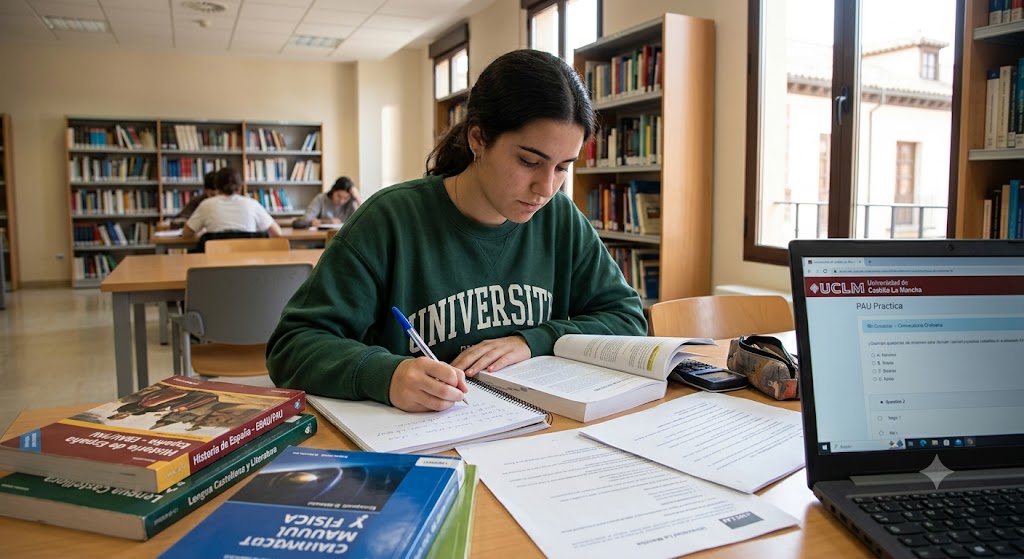
Additional Information
What the Course Entails and Exam Details
This examination does not follow a single "course" structure, but rather assesses the knowledge and skills acquired throughout the two years of Bachillerato. The content is aligned with the official curriculum of the Castilla-La Mancha region. The exam is divided into two distinct phases:
The Obligatory Phase (Fase General): This phase is mandatory for all students and tests core competency in foundational subjects. It generally includes:
Spanish Language and Literature II
History of Spain
Foreign Language II (e.g., English, French, German)
A core subject corresponding to the specific Bachillerato modality the student studied (e.g., Mathematics II for Sciences, Latin II for Humanities).
The Voluntary Phase (Fase Específica): This phase allows students to take exams in additional subjects to raise their final admission score. Students can choose up to four subjects related to their desired university degree, and the two best scores will be considered.
What to Expect in the Final Exam
The EvAU/PAU in Castilla-La Mancha is a series of written examinations, typically spread over three days.
Format: Each subject exam consists of open-ended and semi-structured questions requiring written analysis, problem-solving, or commentary. Multiple-choice questions are rarely used.
Scoring:
Obligatory Phase: Each exam is graded from 0 to 10. The average of these four exams constitutes the Obligatory Phase score. A minimum average of 4.0 is required.
Final Access Score (Calam): This is calculated as 60% of the Bachillerato GPA + 40% of the Obligatory Phase score. A minimum Calam of 5.0 is required to access university.
Admission Score (Nota de Admisión): Students can increase their Calam up to a maximum of 14 points by performing well in the Voluntary Phase exams, which are weighted based on the chosen university degree.
Time Limits: Each subject exam typically lasts 90 minutes, with a 45-minute break between exams.
How to Study and Exam Centers
Actionable Study Strategies:
Review Bachillerato Material: Focus heavily on your class notes, textbooks, and summaries from your two years of Bachillerato. The exam tests this specific curriculum.
Practice with Past Exams: This is the most critical strategy. The Universidad de Castilla-La Mancha (UCLM) publishes previous years' exams and their grading criteria (correctores). Practice completing these under timed conditions.
Understand the Criteria: Pay close attention to how questions are scored. Knowing precisely what examiners are looking for in an analysis or problem can significantly improve your score.
Time Management: Practice planning your answers quickly and allocating time appropriately to each section of the exam.
Exam Centers and Logistics:
The EvAU/PAU is organized by the Universidad de Castilla-La Mancha (UCLM). The exams are held physically at various university campuses and designated high schools across the provinces of Albacete, Ciudad Real, Cuenca, and Toledo. Students will be assigned to a specific center based on their high school's location. Information regarding enrollment, specific dates, and assigned centers is provided through the students' secondary schools and officially communicated on the UCLM website.
Job Opportunities from the Course
Successfully passing the PAU/EvAU does not lead directly to a job, but it is the prerequisite for accessing university education, which is the pathway to countless professional careers. Your score determines your eligibility for different degrees. Here are examples of career paths unlocked by various university degrees accessible after passing the PAU:
Health Sciences: Doctor, Nurse, Pharmacist, Physiotherapist, Veterinarian.
Engineering & Architecture: Civil Engineer, Software Engineer, Mechanical Engineer, Architect, Data Scientist.
Social Sciences & Law: Lawyer, Business Administrator, Economist, Psychologist, Primary School Teacher, Journalist.
Sciences: Biotechnologist, Chemist, Physicist, Mathematician, Environmental Scientist.
Arts & Humanities: Secondary School Teacher (various subjects), Historian, Translator, Graphic Designer, Archaeologist.
Frequently Asked Questions
Reviews
5.0
Based on 0 reviews
Leave a Review
No reviews yet. Be the first to review!