
California Vector Control Technician Practice Exam
$69.00
- Buy to unlock unlimited access to all Quiz questions.
- After purchase you can print a PDF of the whole quiz at any point. The PDF will contain the questions and the correct answers.
About this Exam
The California Vector Control Technician Certification is an essential credential for professionals dedicated to protecting public health by managing and controlling populations of vectors. Vectors are organisms, such as mosquitoes, rodents, and ticks, capable of transmitting diseases to humans.
This certification is designed for individuals seeking employment with government public health agencies, mosquito abatement districts, and vector control districts throughout California. It validates that a technician possesses the critical knowledge and skills to identify vector species, understand their biology, and implement integrated pest management (IPM) strategies safely and effectively. Achieving this certification is often a mandatory requirement within the first year of employment in this field, demonstrating a commitment to professional excellence and public safety.
Ready to test your knowledge?
Buy Now to Access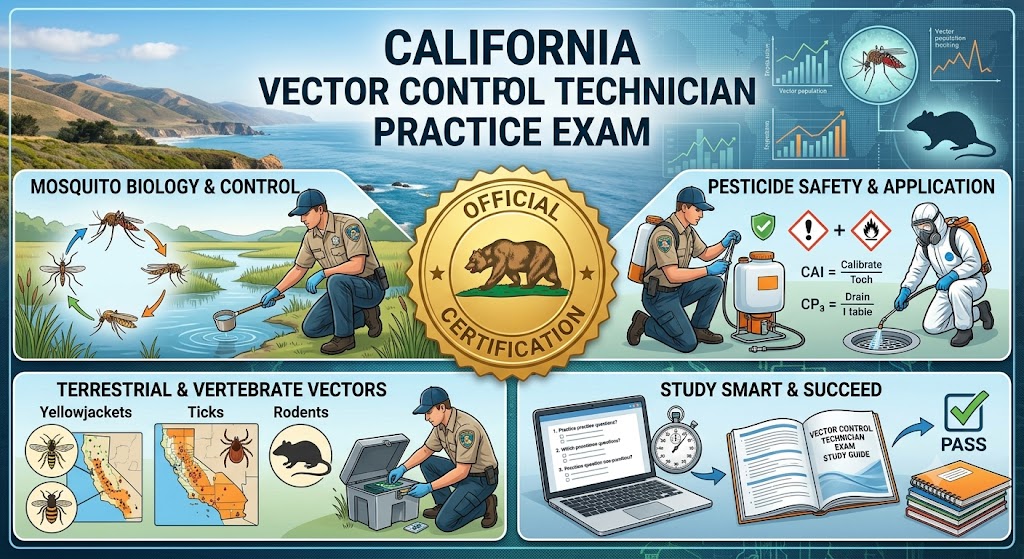
Additional Information
What the Course Entails and Exam Details
To become a certified Public Health Vector Control Technician (VCT) in California, you must demonstrate proficiency across several key domains. This is achieved by passing a series of specialized examinations administered by the California Department of Public Health (CDPH).
The certification process is structured around four distinct exam categories, and all applicants must first pass the foundation exam to proceed.
Pesticide Application and Safety (Category A): This is the mandatory core exam. It covers essential topics like pesticide laws and regulations, label comprehension, safety precautions, first aid, mixing, loading, application techniques, and environmental considerations.
Biology and Control of Mosquitoes in California (Category B): Focuses on mosquito identification, life cycles, ecology, disease transmission (e.g., West Nile Virus), and integrated control methods, including larval and adult management.
Arthropods of Public Health Significance in California (Category C): Covers the biology, ecology, and control of other significant terrestrial arthropods, such as ticks, fleas, mites, yellowjackets, and flies.
Vertebrates of Public Health Importance in California (Category D): Details the management of vertebrate vectors, primarily rodents (rats and mice), including their biology, disease transmission, trapping, and baiting strategies.
Prospective technicians are often required to obtain certification in multiple categories to advance in their careers.
What to Expect in the Final Exam
Preparing for the final examinations is a crucial step. While there is no single "course" with a uniform final exam, you will need to prepare for and pass the specific CDPH exams relevant to your job duties. Here is what to expect from these rigorous assessments:
The exams are typically multiple-choice and require a strong grasp of both technical knowledge and practical application. Each exam category—A, B, C, and D—has a time limit. For example, the core Pesticide Application and Safety (Category A) exam is known to be a significant hurdle with multiple versions and strict passing requirements.
To pass, candidates must achieve a score of at least 70% in each category taken. Retaking an exam is allowed if you do not pass on your first attempt, but candidates must wait a specified period between attempts, often having only a limited number of opportunities within a year. It's imperative to confirm the current scoring, retake policies, and exact format with the official CDPH guidelines.
How to Study and Exam Centers
Effective preparation for the California Vector Control Technician Certification exams is non-negotiable. CDPH provides official study manuals and, in recent years, complementary PowerPoint reviews and webinars, which are the absolute best primary resources.
A highly recommended study strategy involves creating a comprehensive schedule, focusing first on the mandatory "Pesticide Application and Safety (Category A)" manual before diving into the specific biology sections (B, C, or D). Utilizing flashcards for definitions, species names, and safety formulas can be extremely effective. The most powerful preparation tool is to take multiple "California Vector Control Technician Practice Exams." Look for practice materials that accurately simulate the format and question types you will encounter to build confidence and identify knowledge gaps.
Regarding testing locations, these are not taken at open online portals. The California Department of Public Health offers the exams only twice a year, typically on the third Thursday of May and November.
A key detail: You can only take the certification exam if you are currently employed by a government public health agency that performs vector control. Once your employment is confirmed and your exam application is approved by the CDPH, you will receive information regarding the specific physical testing location. This information is clearly marked on your approved application and is not a public testing center. For all logistics, you must contact the CDPH Training and Certification Coordinator directly.
Job Opportunities from the Course
Obtaining your California Vector Control Technician Certification unlocks numerous direct and rewarding career paths within public service throughout the state. Because vectors must be managed on a large scale to be effective, most opportunities are with specialized governmental districts. This certification is a critical key to securing long-term employment and advancement in these roles.
The primary career paths include:
Vector Control Technician I / II: The standard career ladder for field operations, involved in surveillance, pesticide application, and public education.
Mosquito Control Technician: A specialist focused specifically on identifying and managing all aspects of mosquito populations.
Supervisor / Field Inspector: For experienced technicians who take on leadership, quality control, and personnel management roles.
Laboratory Technician / Entomologist (with additional education): Specialized scientific roles that support field operations with research and data analysis.
Environmental Health Specialist: A broader role that includes vector control among other public health responsibilities for county or state health departments.
Seasonal Vector Control Worker: The usual starting point, often leading to full-time employment upon successful completion of the certification requirements.
Frequently Asked Questions
Reviews
5.0
Based on 0 reviews
Leave a Review
No reviews yet. Be the first to review!