
ATSC Weather for Sailing, Flying & Snow Sports (113) – Sailing Module Practice Test
$69.00
- Buy to unlock unlimited access to all Quiz questions.
- After purchase you can print a PDF of the whole quiz at any point. The PDF will contain the questions and the correct answers.
About this Exam
Welcome to the definitive guide for mastering the ATSC Weather for Sailing, Flying & Snow Sports (113) – Sailing Module. This specialized certification is a critical benchmark for professionals and serious enthusiasts who rely on accurate weather interpretation to ensure safety and performance on the water.
Designed specifically for sailors, this module bridges the gap between general meteorology and practical maritime application. Whether you are a competitive racer, a delivery skipper, or an aspiring cruising sailor, this certification validates your ability to analyze complex weather data, anticipate marine hazards, and make high-stakes decisions in dynamic environments. This course is not just about theory; it’s about translating atmospheric science into actionable, life-saving seamanship.
Ready to test your knowledge?
Buy Now to Access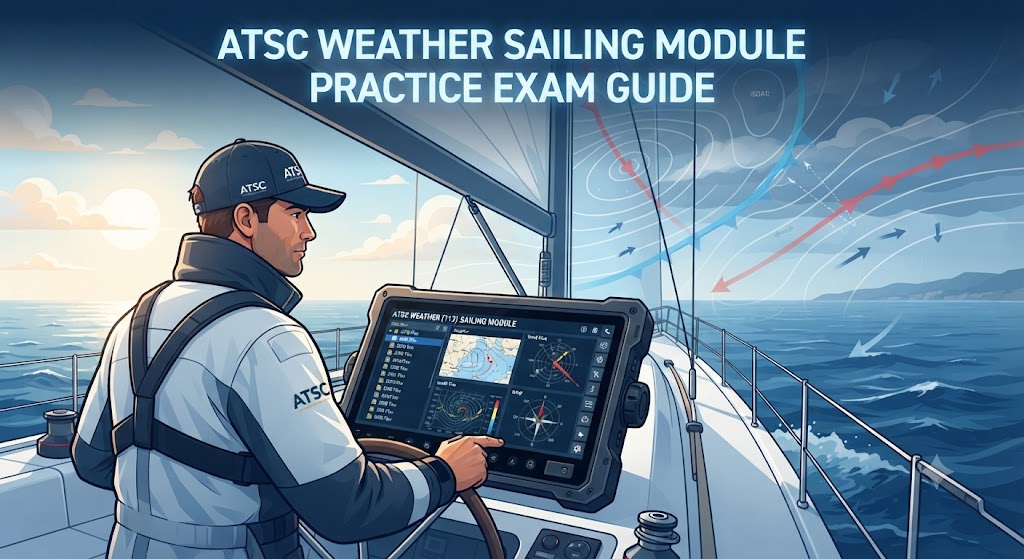
Additional Information
What the Course Entails and Exam Details
The ATSC Sailing Module is a rigorous curriculum focused on
the unique interaction between weather systems and the marine environment. The
syllabus is comprehensive, covering essential topics that every mariner must
understand to navigate safely.
Candidates are expected to master the following core
competencies:
- The
Basics of Maritime Meteorology: Understanding pressure systems, the
Coriolis effect, atmospheric stability, and the formation of fog and
marine layers.
- Wind
and Waves: Decoding the relationship between isobars and wind speed,
understanding sea breezes versus gradient winds, and accurately predicting
wave height based on fetch and duration.
- Synoptic
Chart Analysis: Learning to read and interpret surface analysis
charts, identifying fronts (cold, warm, occluded), and predicting the
sequence of weather changes as they pass.
- Local
and Regional Weather Effects: Recognizing the impact of coastline
topography, thermal effects, and currents on local weather patterns.
- Tropical
Systems and Severe Weather: Understanding the formation, tracking, and
avoidance strategies for hurricanes, cyclones, and major squalls.
- Applied
Weather Routing: Using GRIB files, satellite imagery, and onboard
observations to optimize passage planning and avoid hazardous conditions.
The final exam is a comprehensive assessment of these
skills. It is designed to test both your theoretical knowledge and your ability
to apply that knowledge to practical sailing scenarios.
What to Expect in the Final Exam
The ATSC (113) Sailing Module Exam is a proctored assessment
structured to challenge your understanding of real-world marine weather
scenarios.
- Exam
Format: The exam typically consists of a combination of
multiple-choice questions, short-answer problems, and practical scenario
analysis. The practical portion often involves interpreting actual weather
charts or GRIB data to answer questions about routing and safety.
- Number
of Questions: The exam generally features between 60 and 80 questions,
weighted to emphasize practical application over rote memorization.
- Time
Limit: Candidates are usually given 2.5 to 3 hours to complete the
exam. This time is sufficient if you are well-prepared, but it requires
efficient analysis of the scenario-based questions.
- Passing
Score: The standard passing score for the ATSC Weather (113) module is
75% or higher.
- Rules
and Materials: This is a closed-book exam, meaning no external study
materials or notes are permitted. However, you will be provided with all
necessary reference materials, such as the specific charts, GRIB samples,
and tables needed for the scenario questions.
How to Study and Exam Centers
Preparation is the key to success in this demanding exam.
Relying solely on the course material is rarely sufficient.
Actionable Study Strategies:
- Master
the Syllabus: Do not just read the material; understand the why
behind the weather phenomena. Create flashcards for key terms, symbols,
and definitions.
- Analyze
Real-World Charts: Practice reading daily surface analysis charts from
NOAA or the Met Office. Try to predict the weather for the next 24 hours
based only on the chart, then check your prediction against the
actual forecast.
- Utilize
GRIB Files: Familiarize yourself with interpreting GRIB data
visualization software (like Expedition, Adrena, orqtVlm). Understand how
to layer wind, pressure, and precipitation data.
- Use
the Official Practice Exam: The most valuable resource is the official
ATSC Weather for Sailing, Flying & Snow Sports (113) – Sailing Module
Practice Test. Treat this practice test like the real exam: complete it in
one sitting, under time constraints, and without assistance. Analyze every
incorrect answer to identify knowledge gaps.
- Join
Study Groups: Discussing complex weather scenarios with fellow sailors
can deepen your understanding and expose you to different perspectives on
interpretation.
Exam Centers and Registration:
The ATSC (113) exam is administered securely to maintain the
integrity of the certification.
- Authorized
Testing Centers: The exam can be taken at any approved ATSC testing
center, which are often located at authorized sailing schools, maritime
academies, and dedicated proctoring facilities worldwide.
- Online
Proctoring: ATSC also offers a secure online proctoring option. This
allows you to take the exam from your home or office, provided you have a
reliable computer, high-speed internet, a webcam, and a strictly
controlled, private testing environment.
- Registration:
Registration for the exam must be completed through the official ATSC
portal. You will need to select your preferred location (physical center
or online) and schedule a date and time from the available options. Job
Opportunities from the Course
Earning the ATSC Weather for Sailing (113) certification is
a significant professional credential that opens doors across the maritime
industry. It signals to employers and clients that you possess a high level of
expertise in marine meteorology and risk management.
This certification unlocks the following career paths and
roles:
- Professional
Yacht Skipper/Captain: Essential for commanding vessels on deliveries,
charters, or private operations where safety is paramount.
- Superyacht
Officer: Demonstrates the specialized knowledge required for senior
deck roles on large, commercially operated vessels.
- Ocean
Racing Navigator: A critical role in competitive sailing, where
weather routing directly impacts race results and safety.
- Certified
Sailing Instructor: Enhances your credentials and allows you to teach
advanced meteorology components within recognized sailing programs (e.g.,
RYA, US Sailing).
- Marine
Meteorologist Assistant: For those pursuing a career in meteorology,
this certification provides specialized knowledge sought after by private
weather forecasting firms servicing the marine industry.
- Expedition
Leader: Crucial for planning and executing adventure sailing voyages
in remote or challenging environments (e.g., high latitudes).
- Commercial
Vessel Operator (Up to 200 GRT): Fulfills or exceeds the weather
knowledge requirements for various commercial endorsements.
By achieving this certification, you are not just passing an
exam; you are investing in your capability to navigate the world’s oceans
safely and professionally.
Frequently Asked Questions
Reviews
5.0
Based on 0 reviews
Leave a Review
No reviews yet. Be the first to review!