
ATPL Canadian Meteorology, Radio Aids to Navigation, and Flight Planning (SAMRA) Practice Test
$69.00
- Buy to unlock unlimited access to all Quiz questions.
- After purchase you can print a PDF of the whole quiz at any point. The PDF will contain the questions and the correct answers.
About this Exam
Welcome to the ultimate guide for mastering one of the most challenging steps in your Canadian aviation career: the ATPL Meteorology, Radio Aids to Navigation, and Flight Planning exam, commonly known as SAMRA. This Transport Canada written exam is a mandatory requirement for pilots seeking their Airline Transport Pilot Licence (Aeroplane). It is designed to test a candidate's advanced knowledge and operational competence in critical areas of flight operations. Whether you are an experienced commercial pilot or an aspiring first officer, passing this exam proves you have the theoretical knowledge necessary to make safe, efficient, and professional decisions in complex, real-world airline environments.
Ready to test your knowledge?
Buy Now to Access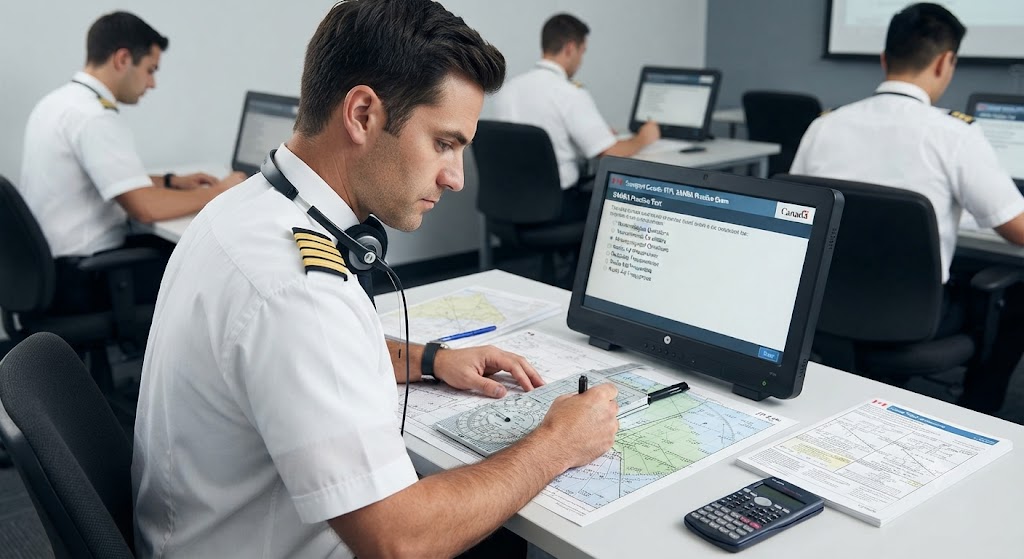
Additional Information
What the Course
Entails and Exam Details
The SAMRA exam is comprehensive and integrative, combining
three complex subjects into one rigorous assessment. To succeed, you must move
beyond rote memorization and demonstrate a deep understanding of how these
elements interact during airline operations.
The syllabus covers three primary domains:
- Meteorology
(SAMET): This section delves deep into advanced weather theory. You
will be tested on upper-level wind and temperature systems, synoptic
charts, severe weather avoidance (including thunderstorms, icing, and wind
shear), and interpretation of complex meteorological reports and forecasts
(TAFs, METARs, GFA, SIGMETs). The focus is on practical application—using
weather data to make tactical flight decisions.
- Radio
Aids to Navigation (SARON): This domain covers the principles,
operation, and limitations of modern navigation systems. You need expert
knowledge of GNSS (GPS), ILS, VOR, NDB, and DME systems. Furthermore, you
must be proficient in RNAV and PBN (Performance Based Navigation) concepts,
including the interpretation of arrival, departure, and approach charts.
- Flight
Planning (SAFLT): This is often considered the most challenging
component. You are required to perform complex, accurate flight planning
calculations for a commercial multi-engine aircraft (typically a generic
turbojet or high-performance turboprop). This includes calculating fuel
requirements, alternate airport selection, payload planning, determining
appropriate cruising altitudes based on winds and aircraft performance,
and completing master flight plans.
What to Expect in the Final Exam
The SAMRA exam is a proctored, multiple-choice examination
administered by Transport Canada or authorized delegates.
- Format:
The exam consists of approximately 65 to 75 multiple-choice questions.
- Time
Limit: Candidates are typically allotted 3.5 to 4 hours to complete
the exam. Time management is critical, especially given the complex
calculations involved in the flight planning section.
- Passing
Score: The pass mark is 70% overall. Transport Canada does not
provide separate scores for each section; therefore, a weakness in one
area (e.g., Flight Planning) can only be offset by strength in the others.
- Authorized
Materials: You are expected to bring specific tools to the exam
center. These include an approved flight computer (e.g., E6B), a a scale
ruler, a navigation protractor, a current Canada Flight Supplement (CFS),
and specific designated charts (e.g., VNC, VTA, Lo Enroute). You are
responsible for ensuring your charts and supplements are current Transport
Canada approved editions.
How to Study and Exam Centers
Success on the SAMRA exam requires a structured, disciplined
approach. Relying solely on ground school notes is often insufficient.
Actionable Study Strategies:
- Invest
in Dedicated Prep: Utilize dedicated SAMRA prep guides and commercial
online ground schools. These resources are specifically designed to mimic
the style, difficulty, and question types found on the actual Transport
Canada exam.
- Master
the Flight Computer: You must be fluent in using your E6B. Practice
complex calculations (true airspeed, density altitude, wind correction
angles, and specific fuel consumption) repeatedly until they become second
nature. Speed and accuracy are paramount.
- Practice
Chart Interpretation: Do not just read the theory. Purchase the
required current charts and physically practice plotting courses,
identifying waypoints, determining Minimum Enroute Altitudes (MEAs), and
interpreting radio aid signals.
- Solve
Full Flight Plans: Allocate significant study time to solving complete
flight planning scenarios. Work backward from destination fuel reserves to
determine required takeoff fuel and payload. Identify common pitfalls such
as using the wrong atmospheric data or forgetting to apply temperature
corrections on approaches.
- Take
Timed Practice Tests: The most effective preparation is simulating
exam conditions. Use a reliable practice test platform to take full-length
exams under strict time constraints. This builds stamina and helps
identify areas requiring further review before you book your official
sitting.
Where and How to Take the Exam:
The SAMRA exam is administered electronically at authorized
Transport Canada examination centers across the country. You must obtain a
Candidate Authorization Document (CAD) from Transport Canada before scheduling
your exam. Once you have your CAD, you can locate a testing center and book
your seat online through the Transport Canada Aviation Examination Reporting
System (AERS).
Job Opportunities
from the Course
Passing the SAMRA exam is not merely an academic hurdle; it
is the gateway to the professional flight deck. Achieving a passing score
demonstrates the high level of competency required for advanced pilot roles.
This certification unlocks career paths that demand significant aeronautical
knowledge and decision-making authority.
The qualification positions you for the following roles:
- Airline
Transport Pilot (First Officer)
- Airline
Transport Pilot (Captain)
- Air
Ambulance Pilot
- Corporate
Flight Department Captain
- Charter
Pilot (Multi-Engine IFR)
- Flight
Operations Manager
- Check
Pilot or Simulator Instructor
Frequently Asked Questions
Reviews
5.0
Based on 0 reviews
Leave a Review
No reviews yet. Be the first to review!