
ATLS Musculoskeletal (MSK) Practice Test
$69.00
- Buy to unlock unlimited access to all Quiz questions.
- After purchase you can print a PDF of the whole quiz at any point. The PDF will contain the questions and the correct answers.
About this Exam
The Advanced Trauma Life Support (ATLS) program is a critical credential for medical professionals who manage trauma patients. Developed by the American College of Surgeons, it focuses on the essential principles for the assessment and treatment of acutely injured patients, particularly during the first "golden hour" after injury. The ATLS Musculoskeletal (MSK) module addresses the critical and systematic evaluation of injuries to the musculoskeletal system, emphasizing the potential for associated life-threatening trauma and severe disabilities. A practice test for this module is designed for physicians, nurse practitioners, physician assistants, and other emergency medicine personnel. It serves as a vital tool to assess readiness and reinforce the structured, priority-based decision-making skills needed to excel on the official certification exam.
Ready to test your knowledge?
Buy Now to Access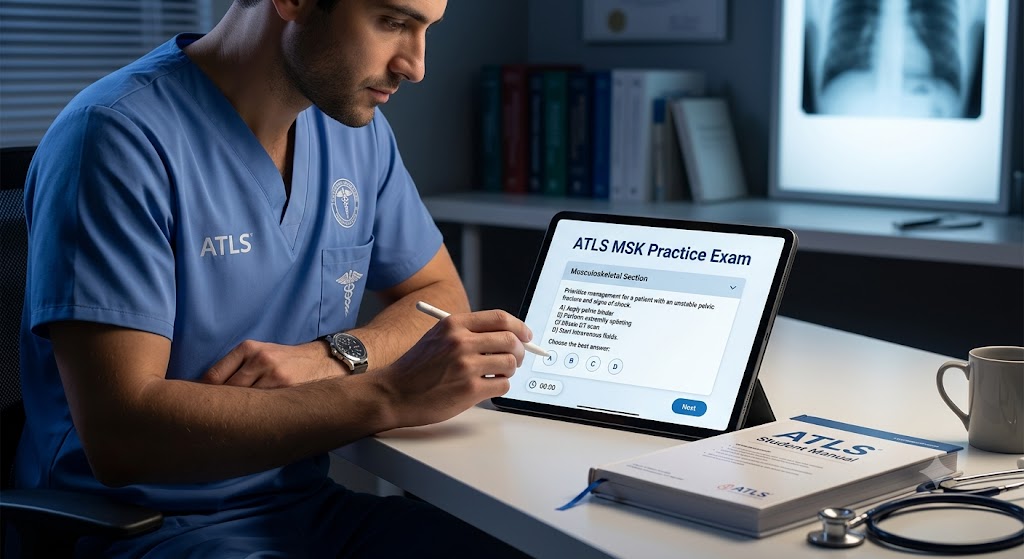
Additional Information
What the Course Entails and Exam Details
This specific segment of the ATLS course is focused squarely
on understanding, recognizing, and initiating proper treatment for
musculoskeletal trauma. It emphasizes the systematic approach required when
dealing with multiple injuries, starting with the primary survey (ABCDE). The
course content typically covers a range of topics including pelvic fractures
and associated complications, major extremity trauma such as long-bone
fractures and dislocations, arterial injuries associated with fractures, crush
syndrome, and the risk of compartment syndrome. The exam assesses a candidate's
ability to prioritize assessment and management, stabilize injured limbs, apply
pelvic binders, recognize signs of vascular compromise, and understand the
definitive care pathways for these time-sensitive injuries.
The actual exam for ATLS certification is a component of the
multi-day course, involving both multiple-choice questions (MCQs) and a
practical assessment of skills in simulating trauma scenarios. A practice test
for the MSK section is usually a focused online or paper-based assessment,
containing a set number of multiple-choice questions. It aims to simulate the
cognitive challenges of the relevant portion of the main exam, testing
conceptual understanding and application of the ATLS protocols. Practice tests
may vary in the exact number of questions but often cover key scenarios and
decision trees.
What to Expect in the Final Exam
For the ATLS Musculoskeletal (MSK) section, candidates can
expect a comprehensive assessment through multiple-choice questions in both
practice tests and the final certification exam. These questions often use
clinical scenarios and require candidates to apply knowledge to determine
priorities, identify appropriate immediate interventions, and recognize serious
complications. Expect questions on mechanisms of injury, initial assessment
priorities (like stabilizing the pelvis to control bleeding), diagnostic
modalities, emergency stabilization techniques, and criteria for urgent
surgical consultation or transfer.
The official certification exam has strict protocols,
including defined passing scores (often in the 70% to 80% range) for the
multiple-choice section. It is typically time-limited, designed to test
efficiency and decisiveness under pressure. The complete ATLS exam is
closed-book, although the format of any specific online practice test
might vary (some may be open-book for self-assessment, while others might
simulate the closed-book condition). Understanding the rules and constraints of
the formal certification process is key for effective preparation.
How to Study and Exam Centers
Preparation for the ATLS MSK exam must center on the
official ATLS Student Course Manual, which is the foundational resource. Focus
particularly on the chapters and content dedicated to musculoskeletal trauma
and the primary survey. Attending a formal, in-person ATLS provider course is
usually required for full certification and is highly recommended as it
includes hands-on skills stations and expert instruction. Taking focused
practice tests, like a dedicated MSK practice test, early and repeatedly helps
to identify knowledge gaps, practice time management, and become familiar with
the style of questioning.
Utilize study groups with fellow medical colleagues and
engage in simulated case scenarios. Review clinical decision tools and
algorithms for stabilizing major fractures and injuries. Practice identifying
signs of life- or limb-threatening orthopedic emergencies on diagnostic
imaging. The physical ATLS course, which includes the final certification exam,
must be taken at an authorized ATLS training center. These centers are located
in hospitals, medical schools, and military facilities globally. Many
organizations also offer online resources and practice tests to support student
preparation before the course date.
Job Opportunities from the Course
Earning the ATLS certification, which includes passing
assessments like the MSK component, is a crucial credential for many medical
career paths involving acute care and emergency situations. It demonstrates a
high level of proficiency in managing trauma and is often a job requirement.
- Emergency
Medicine Physician
- Trauma
Surgeon
- Orthopedic
Surgeon
- General
Surgeon
- Emergency
Department Nurse
- Acute
Care Nurse Practitioner (NP)
- Emergency/Critical
Care Physician Assistant (PA-C)
- Flight
Medic or Flight Nurse
- Pre-hospital
Medicine Professional
- Anesthesiologist
(particularly in trauma centers)
- Surgical
Resident
- Emergency
Medicine Resident
By utilizing this comprehensive study guide, focusing on the
systematic ATLS approach, and practicing diligently, you will be well-prepared
to successfully pass your ATLS Musculoskeletal assessment and advance your
medical career in trauma care. Good luck with your studies and preparation!
Frequently Asked Questions
Reviews
5.0
Based on 0 reviews
Leave a Review
No reviews yet. Be the first to review!